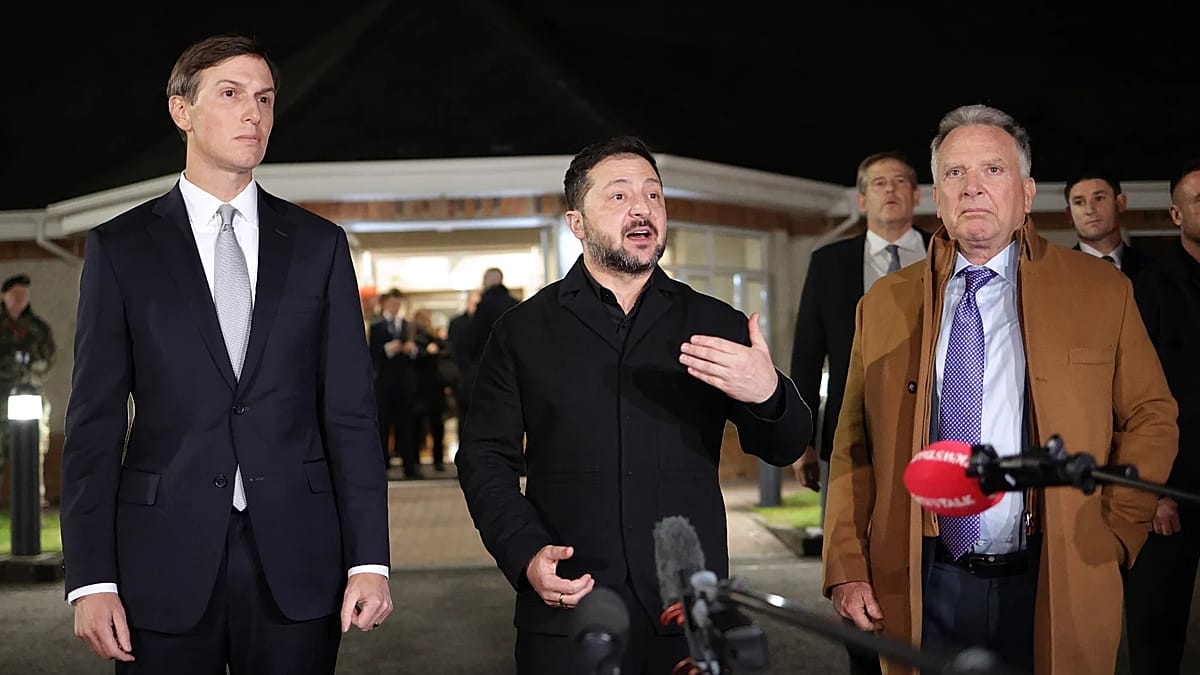
US special envoys Steve Witkoff and Jared Kushner met with Ukrainian President Volodymyr Zelenskyy in Ireland this week, following a visit to the Kremlin, and announced that European negotiators would be included in future talks on ending Russia's war in Ukraine. The announcement, made at a military base near Dublin, marks a potential shift in the format of peace negotiations that have so far been dominated by Washington, Moscow, and Kyiv.
Speaking alongside Zelenskyy, Kushner, who is also US President Donald Trump's son-in-law, said on X: "Both sides have now agreed to expand the next round of negotiations to include our European partners." He added that this would allow discussions to cover "broader postwar European security arrangements alongside the territorial issues between Ukraine and Russia."
Zelenskyy welcomed the development, telling reporters that Europe would have a "voice" in future talks and would not be kept "separately" on the sidelines, as had happened in recent trilateral negotiations in Abu Dhabi. "This is important for us because the war is in Europe. We will be member of EU in the future and that's why it's very important. For prosperity and for security guarantees it's very important to have Europe," he said.
However, Moscow has not confirmed whether it agrees to include European negotiators. In comments shared by the Russian foreign ministry on Friday, presidential aide Yuri Ushakov said: "For our part, the position of the Europeans has been comprehensively outlined. They are striving by every means possible to join the negotiations, but, as our President has said, they must decide whether they want peace or the continuation of the war."
European leaders seek a unified stance
The push for European involvement comes as EU leaders have been trying to coordinate a common position on Ukraine. A recent Dublin summit highlighted the difficulty of achieving a single voice, with disputes over envoy representation overshadowing discussions. The inclusion of European negotiators would address long-standing concerns that the continent, which bears the brunt of the war's consequences, has been sidelined in key decisions.
Witkoff and Kushner met with Russian President Vladimir Putin in Moscow earlier this week. During that meeting, Putin signalled that Russia would not back down on territorial demands to control parts of Ukraine and rejected the idea of foreign peacekeeping troops being deployed in the country, dampening hopes of a nearing deal. The US envoys' visit to Moscow had raised expectations, but the lack of progress on core issues suggests a long road ahead.
European capitals have reacted cautiously. While some officials see the US announcement as a positive step, others note that Moscow's refusal to confirm the expanded format means the promise may be hollow. The Kremlin has consistently sought to minimise Europe's role, viewing the EU as a hostile bloc rather than a neutral mediator.
For Ukraine, European involvement is not just about symbolism. Security guarantees, reconstruction funding, and future EU membership all depend on a coordinated European approach. Zelenskyy's remarks underscore this, linking the presence of European negotiators to the country's long-term prosperity and security.
The next round of talks has not been scheduled, and it remains unclear whether the format will indeed be expanded. The US envoys' optimism contrasts with Moscow's dismissive tone, leaving the situation fluid. As the war enters its third year, the question of who sits at the negotiating table is as contentious as the territorial disputes themselves.
European leaders are likely to press the issue at upcoming summits, seeking to translate the US announcement into a concrete commitment. The Moscow's downplaying of the European role suggests that any inclusion will be hard-won. For now, the promise of European participation remains just that—a promise, awaiting Russian confirmation.