Moscow and Tehran have reacted sharply to the creation of a new US military task force aimed at monitoring and blocking Iranian trade and transport routes in the Caspian region. Russia's foreign ministry described the move as a "clear threat" to the rights and interests of the five littoral states, insisting that security in the Caspian Sea is an internal matter for those countries alone.
"We consider this latest escalatory and provocative step a blatant violation of the norms of international law," the ministry said in a statement, adding that it fully supports Iran's position that continued economic pressure will not succeed in collapsing its economy.
The reaction came after US Central Command (CENTCOM) announced on 7 November the creation of the "Iron Gate" task force, a unit designed to prevent the transfer of advanced weapons and dual-use items to Iran via land borders and the Caspian Sea. CENTCOM also reiterated its commitment to keeping the Strait of Hormuz open to commercial shipping while enforcing an "Iron Maritime Blockade" against Iran, and to working with partner institutions to stop the Islamic Revolutionary Guard Corps (IRGC) from using land routes and the Caspian to move weapons, dual-use technologies, sanctioned items, and illicit revenue.
In Tehran, deputy foreign minister for legal and international affairs Kazem Gharibabadi met with the Russian ambassador to discuss countering "unilateral US measures" and the Iron Gate programme. Gharibabadi stressed that "Tehran and Moscow emphasise the need for coordination and cooperation in the face of common threats," adding that "the interests of the littoral states will also be served by maintaining stability and security in the Caspian."
ISW assessment highlights sanctions evasion
The Washington-based Institute for the Study of War (ISW) and the Critical Threats Project (CTP) released a joint assessment concluding that "Iran and Russia are cooperating to counter US efforts to stop weapons shipments to Iran via the Caspian Sea and land routes." The study notes that Iran has used its Caspian trade routes with Russia to import arms before and during the 2026 US-Israel-Iran War, which prompted Ukraine to strike a shipment in July 2026.
According to the think tanks, the Caspian Sea lies outside the reach of Western monitoring bodies, allowing sanctioned Russian cargo ships to move consignments from the ports of Astrakhan and Olya to the Iranian ports of Anzali, Nowshahr, and Amirabad. Maritime traffic data shows that these ships often switch off their Automatic Identification Systems (AIS) as they approach the shores of the two countries, concealing the nature of their cargoes.
Last summer, Ukraine's Security Service announced that its long-range drones had targeted two cargo ships in the Caspian Sea which, according to Kyiv, were involved in transferring military equipment between Iran and Russia. This incident underscores the growing concern over the use of these routes for military logistics.
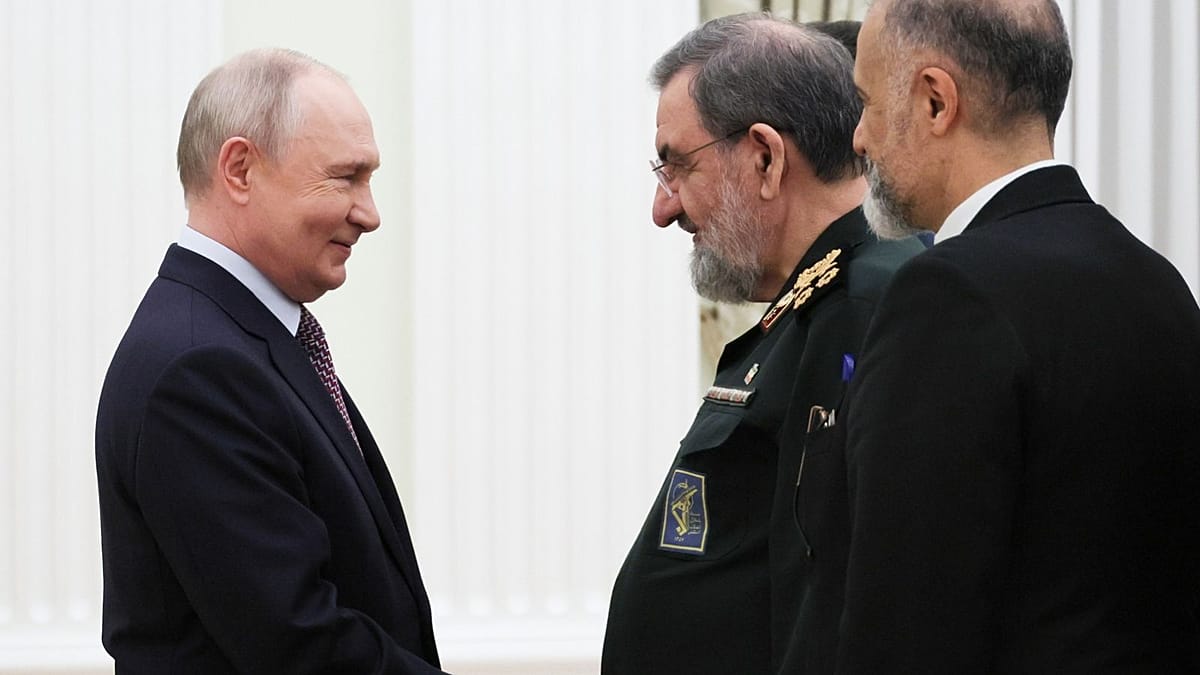
Beyond security cooperation, Tehran and Moscow have been deepening their economic and transit ties within the framework of the North-South corridor. A flagship project is the completion of the Rasht-Astara railway, the missing link in this transit route connecting Russia to ports in the Persian Gulf. Mohsen Rezaei, secretary of Iran's Supreme National Security Council, said after a recent meeting with Russian president Vladimir Putin in Moscow that the council had approved the executive agreement for the railway's construction. The two sides also discussed building gas pipelines from Russia to Iran to address fuel shortages and allow exports to neighbouring countries.
The tensions over Iran's northern trade routes come amid a fragile security situation in the Strait of Hormuz, described by observers as a "no war, no peace" environment. The Revolutionary Guard Navy reported on Thursday that two "supertankers" carrying more than four million barrels of oil had been brought to a halt by a "massive explosion" while passing through the southern route of the strait. According to the Guard, the vessels had "ignored repeated warnings that the southern route was unauthorised and unsafe." Iran insists that ships should use only the route it has designated and holds "violating" vessels responsible for the security consequences.
The ISW and CTP assessment also notes that Iran has abandoned its claimed 2,000-kilometre limit on ballistic missile range, formalising its longstanding efforts to develop longer-range systems. This comes as Tasnim news agency, close to the Revolutionary Guard, reported the display of a new ballistic missile in the Guard's missile city, combining the warhead of the "Fattah" missile with a new propulsion system.
The developments highlight the growing complexity of the security landscape around Iran, with the Caspian Sea emerging as a key arena for sanctions evasion and military logistics. As the US tightens its blockade, Russia and Iran are likely to continue their coordination, posing challenges for Western efforts to curb arms transfers and revenue flows.