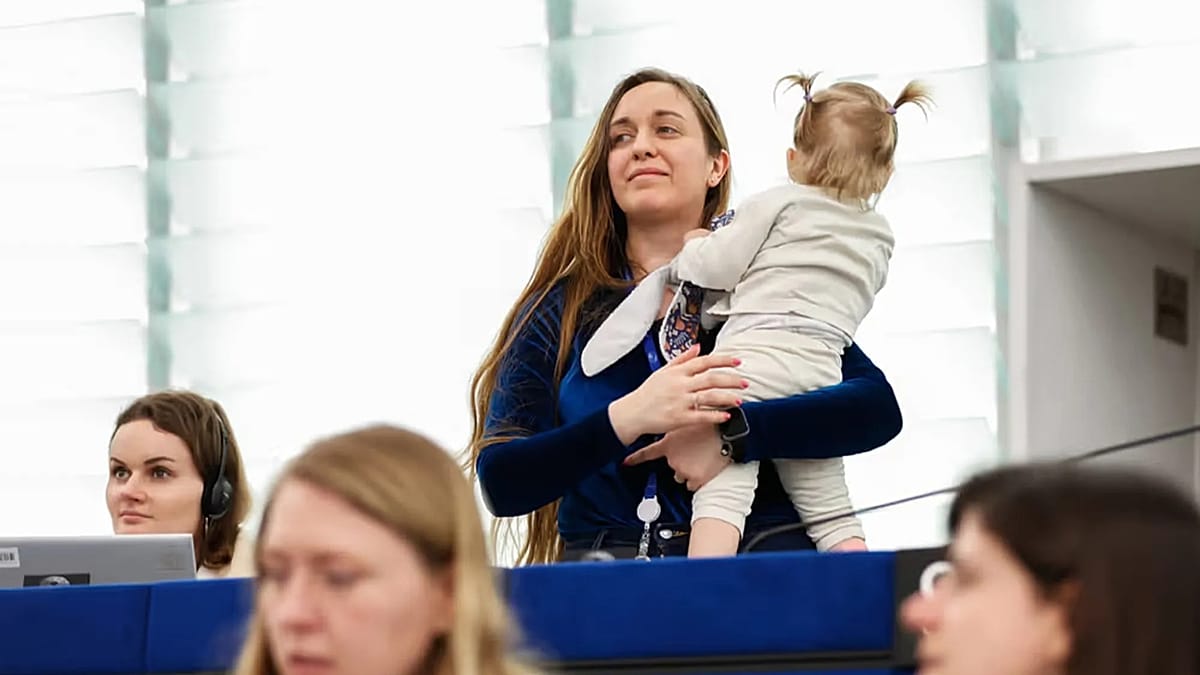
The European Parliament has approved a measure allowing female lawmakers to delegate their votes to colleagues during pregnancy and after childbirth, a move intended to support new mothers. However, the rule does not extend to fathers, prompting questions about gender equality among the chamber's members.
The decision, finalized on Thursday, introduces a temporary exemption to the requirement that MEPs vote in person during plenary sessions. Female members will be able to appoint a trusted colleague to cast their vote for up to three months before their due date and six months after giving birth.
Supporters argue the change ensures that new mothers can continue to participate in parliamentary work while caring for their children. But the exclusion of fathers has drawn criticism from lawmakers who point to the EU's own advocacy for shared parental responsibilities.
“I wish we could be doing the same for young fathers, or those adopting children,” said Dutch Socialist MEP Lara Wolters, who steered the file through the chamber. Her remarks reflect a broader unease among MEPs who voted overwhelmingly in favor of the measure but remain dissatisfied with its scope.
Why fathers were left out
The decision to exclude male lawmakers was pragmatic rather than principled, according to Spanish Socialist MEP Juan Fernando López Aguilar, who drafted a parallel amendment to the European Electoral Act. Changing the in-person voting rule requires not only the approval of all 27 EU member states but also ratification by national parliaments, a lengthy and complex process.
“It is an extremely complex process, which requires not only the backing of all 27 EU member states, but also ratification by national parliaments,” López Aguilar told Euronews. He added that including male MEPs would have been too ambitious and could have jeopardized the entire provision.
An earlier attempt to extend the measure to fathers was rejected in November 2025, though the vote was not a roll call, leaving the identities of opponents unknown. Far-right lawmakers have openly opposed legal parity between men and women in this context.
“This amendment only deals with mothers who are physically incapacitated to cast their vote, either because they are about to give birth, or they have to nurse their newborn. Therefore, it cannot be extended to men or foster parents,” said Marieke Ehlers, a Dutch MEP from the Patriots for Europe group. She argued that the rule addresses the “physical consequences of childbirth,” which affect only women.
Parliament's existing leave rules already cover both parents, allowing any MEP a justified absence from two months before the birth to four months after. The new voting delegation is an additional layer, but its narrow scope has reignited debates about how the institution balances biological realities with social expectations.
The provision will only take effect once all member states have ratified the amended European Electoral Act through their national parliaments. So far, only ten countries have completed the process, meaning the change could take months or even years to become operational.
While the measure is a step forward for maternal representation, it highlights the challenges of adapting parliamentary rules to modern family dynamics. As the EU continues to champion gender equality in other policy areas, the exclusion of fathers from this provision may become an uncomfortable inconsistency.