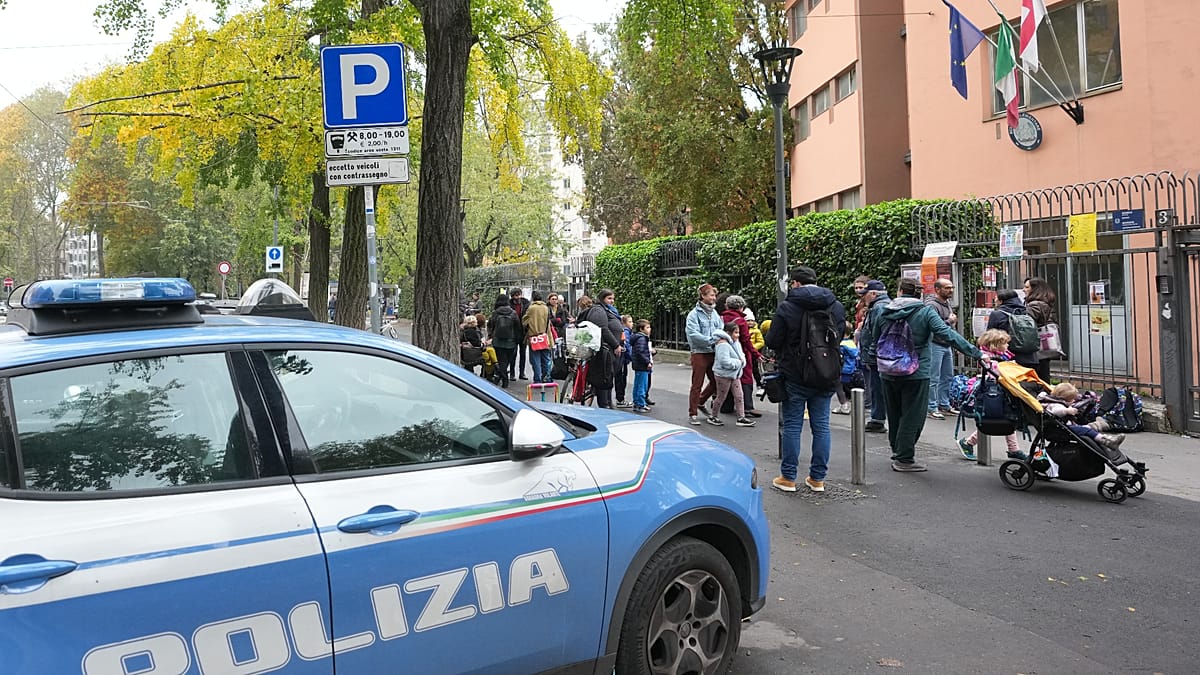
For the second consecutive day, Italian schools were hit by emailed bomb threats, forcing some to evacuate pupils and staff while authorities conducted security checks at others. The messages, signed with the name “Mikhail Andropov”, arrived on Thursday morning at several schools across the country, a day after a similar wave targeted more than 6,300 institutions nationwide.
Prime Minister Giorgia Meloni summoned government representatives and opposition leaders to Palazzo Chigi, her official residence in Rome, on Thursday morning to address the escalating situation. According to participants, Meloni urged all political parties to present a united front and promised that Foreign Minister Antonio Tajani, Defence Minister Guido Crosetto and Interior Minister Matteo Piantedosi would brief parliament urgently.
The government also announced that the Interministerial Committee for the Security of the Republic (CISR) would convene in the afternoon to agree on a common protocol for handling such threats. Under the proposed guidelines, schools would no longer be automatically evacuated solely on the basis of a mass email. Instead, prefects – the central government’s representatives in each province – would retain the authority to order an evacuation only when there are specific and concrete risks.
The centre-left Democratic Party (PD) responded cautiously. Its leader, Elly Schlein, said after the meeting: “The discussion is welcome but it must continue in the appropriate venues, which are parliament and Copasir,” referring to the parliamentary committee that oversees Italy’s intelligence services. She added: “As the opposition, we are fully willing to cooperate in the face of threats aimed at destabilising the country and creating alarm, but we will not give the government a blank cheque on the decisions it takes. Today we did not receive any specific proposals.”
Schools on edge
The threats have disrupted education across the country, with hundreds of schools choosing to evacuate on Wednesday alone. On Thursday, head teachers in several cities received similar emails, prompting some to close their gates while police and bomb disposal units carried out searches. The repeated nature of the attacks has raised concerns about the psychological impact on students and parents, as well as the logistical strain on local authorities.
In Milan, Turin, and Naples, some schools opted for precautionary evacuations, while others remained open after police assessed the emails as non-credible. The situation has also revived memories of previous hoax threats that have periodically disrupted Italian schools, but the scale and coordination of this week’s campaign appear unprecedented.
The name “Mikhail Andropov” echoes the Soviet-era KGB chief Yuri Andropov, suggesting a possible attempt to create a sense of foreign involvement. However, investigators have not yet identified the source of the emails, and no explosive devices have been found so far.
The government’s proposed protocol has sparked debate about the balance between security and normalcy. Some education unions have welcomed the idea of avoiding unnecessary evacuations, while others worry that downplaying threats could put students at risk. The PD’s demand for parliamentary oversight reflects broader concerns about the executive’s handling of security matters, particularly given the lack of concrete proposals presented at Thursday’s meeting.
Meloni’s call for unity comes as her administration faces pressure to respond decisively to what many see as an attempt to destabilise the country. The episode also highlights the challenges of coordinating security responses across Italy’s 20 regions, where prefects play a key role in crisis management.
As the CISR prepares to meet, the government has promised to keep parliament informed. The coming days will test whether the proposed protocol can strike the right balance between vigilance and proportionality, and whether the political consensus holds.