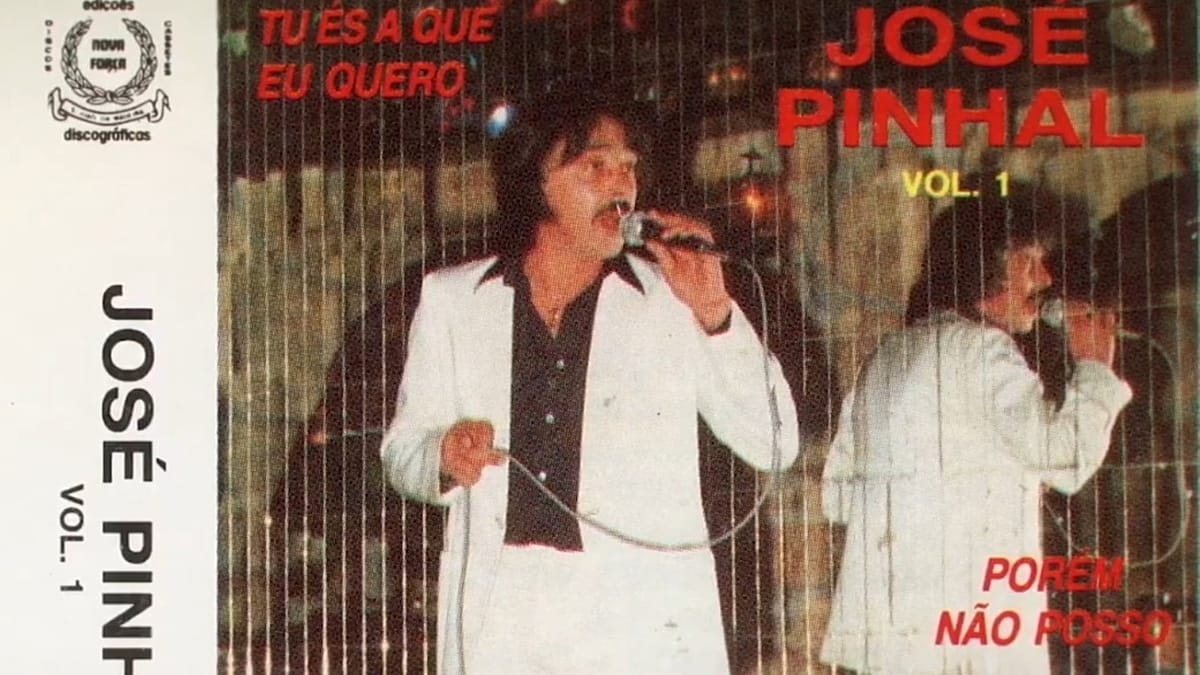
For most of his life, José Pinhal was a name that meant nothing to anyone outside a small circle of dance-hall regulars in northern Portugal. Born in Santa Cruz do Bispo, near Matosinhos, he spent the 1980s performing at weddings, nightclubs and local festivities, never breaking through to a wider audience. In 1993, at the age of 41, he died in a car crash on his way home from a gig, leaving behind a handful of recordings and almost no public recognition.
That might have been the end of the story, but the 21st century has a peculiar hunger for rediscovered gems. Think of Vivian Maier, the nanny whose street photography became famous only after her death, or the fictional silent-film director in Paul Auster's The Book of Illusions, rescued from oblivion by a grieving protagonist. José Pinhal's fate took a similar turn, albeit with a very Portuguese twist.
The turning point came when the brother of Paulo Cunha Martins, a Porto-based photographer and collector of musical rarities, moved into a flat that had once served as an office for a music agent. Among the dusty relics left behind were two cassette tapes. At first, they were played only among friends. Years later, someone uploaded the songs to YouTube, and the phenomenon took off.
Tracks like “Tu És a Que Eu Quero (Tu Não Prendas o Cabelo)” — later used in an advertising campaign for an online betting company — became unlikely hits. The story reached the British newspaper The Guardian, inspired a documentary, and sparked a wave of curiosity. Who was this man with the thick northern accent who sang with such raw passion, sometimes off-key, but always with total commitment?
The answer began to emerge in 2016, when Marina Pinhal, the singer's only daughter, commented on the YouTube video, which has since amassed around 1.4 million views. That same year, a group of musicians from Porto's alternative scene, led by guitarist João Sarnadas, decided to form a tribute band as a joke for a birthday party. They called it José Pinhal Post-Mortem Experience.
“My first reaction when I heard José Pinhal's music was realising that it is something unique,” Sarnadas told European Pulse. “Although it lives within a context — romantic music, dance music — his music is something unique.” The band, which was supposed to play just one night, ended up touring Portugal for a decade, performing at festivals, clubs and cultural centres.
Frontman Bruno Martins, who performs under the stage name Bruno de Seda, embodies Pinhal with a black shirt, white suit and gold chain — “more 80s would be impossible,” he jokes. “What impressed me most about him was the voice and the way he sang. That vast commitment he gave to the songs,” he says. That authenticity, which de Seda reproduces on stage, has attracted a young, urban, educated audience — a stark contrast to the typical fans of Portuguese popular music, or what is sometimes dismissively called música pimba.
Yet Pinhal's originality is debatable. Most of his compositions are credited simply as “DR” (rights reserved), and a quick listen to a Spotify playlist reveals that his “greatest hits” are actually versions of songs by Brazilian and Spanish artists of the era, such as Paco Escudero, Chiquitete or Cláudio Fontana. But that hardly matters to his fans, who are drawn to the sincerity and emotional weight of his performances.
The farewell tour culminated in two sold-out concerts at the Coliseu do Porto and the Coliseu dos Recreios in Lisbon — the very hall where Pinhal once dreamed of performing. The final show, on a recent evening, was a rare explosion of energy, with the audience singing along to every word. “The message of showing who José Pinhal is and his work has been delivered. That job has been done,” says Bruno de Seda. “Above all, this takes up a lot of our time. A band of this calibre requires almost total dedication and, after ten years, we already want to do other things.”
The José Pinhal phenomenon is a testament to the internet's ability to resurrect forgotten voices and give them a second life. It also speaks to a broader European trend of rediscovering obscure cultural artefacts, from lost films to unheard music, and celebrating the imperfect, the authentic, and the human. As the band steps off the stage, Pinhal's legacy — once confined to two dusty cassettes — now belongs to a new generation that found him, and refused to let him fade away.