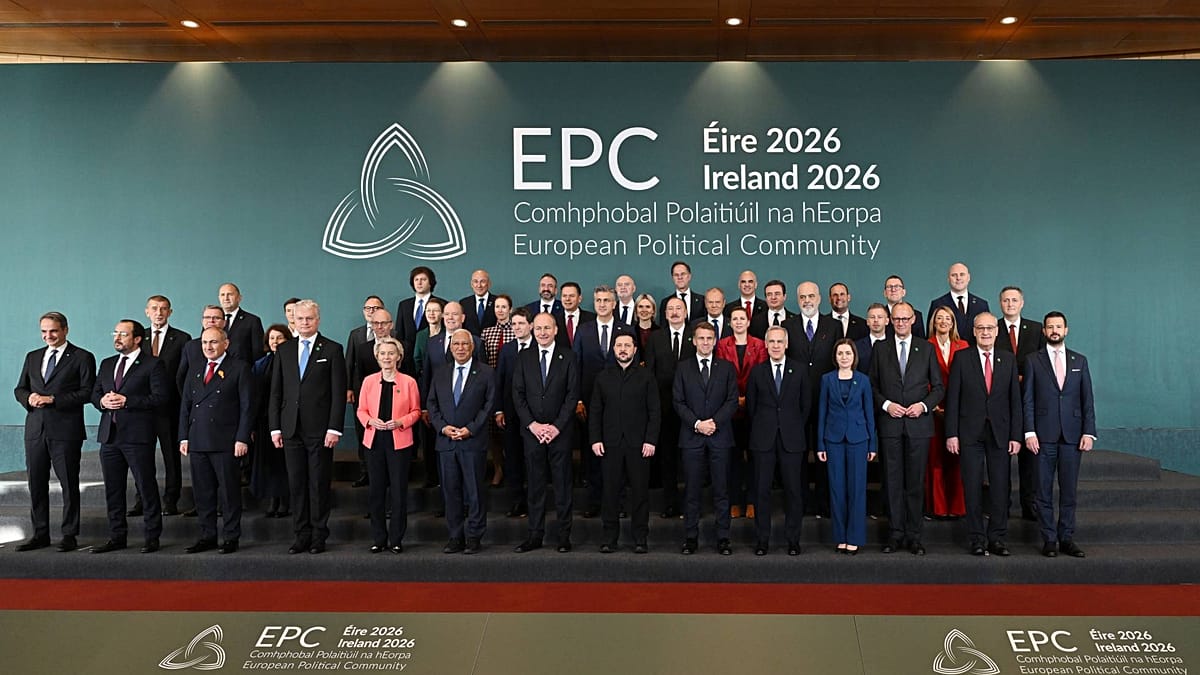
At the ninth European Political Community summit in Dublin, Azerbaijan's president Ilham Aliyev used the gathering to reinforce his country's role as a key energy supplier and security partner for Europe. In a series of bilateral meetings, Aliyev pledged to increase and diversify gas deliveries beyond the current ten EU member states, signed a strategic partnership with the United Kingdom, and held fresh talks with Armenia's prime minister on consolidating the historic peace process.
Energy expansion and EU partnership
Speaking on Thursday, Aliyev confirmed that Azerbaijan is ready to boost gas exports to the European Union, building on the existing strategic partnership established in 2022. He noted that supplies have already risen from 8 billion cubic metres to 13 billion cubic metres, accounting for nearly half of Azerbaijan's total exports. With new gas fields coming on stream, Baku intends to increase volumes further.
In a meeting with European Council President António Costa, the two leaders discussed long-term energy contracts. Costa described the resumption of negotiations on a new EU-Azerbaijan agreement as "good news for our citizens," and stressed the mutual benefits of cooperation. "This has been an important year for EU-Azerbaijan relations," Costa said, adding that "with peace between Azerbaijan and Armenia now a reality, the EU is also investing to ensure that people across the region benefit."
The Southern Gas Corridor, which runs from Baku through seven countries to Italy and supplies ten EU member states via interconnectors in Bulgaria, is currently operating at full capacity. Aliyev said Baku intends to continue expanding that capacity. The two leaders also discussed the Nakhchivan railway project, with an EU assessment expected soon, and the development of the Middle Corridor—a trade route linking Asia to Europe via the South Caucasus and Central Asia, seen as an alternative to the Strait of Hormuz for global supply chains.
Costa invited Aliyev to Brussels for further talks on energy security and broader cooperation.
Strategic partnership with the UK
In a separate development, Aliyev and British Prime Minister Andy Burnham signed a Joint Declaration on Strategic Partnership. The UK is the largest European investor in Azerbaijan's economy, historically through BP's Caspian operations. The new framework covers defence and security, trade and investment, renewable energy, infrastructure, artificial intelligence, and advanced technology.
British officials described the accord as a historic milestone, with both leaders committing to expand mutual trade, defence cooperation, and private-sector investment. The declaration specifically mentions "strengthening cooperation in defence and security in support of regional peace and stability" and addressing "a broad spectrum of security priorities, in response to evolving security challenges and threats." The two sides also agreed to support the Middle Corridor and related transport and logistics projects.
Support for Ukraine's energy grid
President Volodymyr Zelenskyy met Aliyev for a "detailed discussion" on emergency support for Ukraine's battered energy infrastructure ahead of winter, as well as post-conflict reconstruction. Zelenskyy confirmed that contracts under the ongoing "Drone Deal" were signed, saying "we are working to scale up orders," and that "relations between our countries are developing."
Azerbaijan has provided €1.35 million in emergency grid support, including heavy electrical equipment and generators, bringing total humanitarian aid to Ukraine to €48 million, focused on civilian energy infrastructure and medical rehabilitation. Zelenskyy also noted that Kyiv is studying Azerbaijan's reconstruction of Karabakh and East Zangezur as a potential blueprint for Ukraine's own recovery. He praised Azerbaijani companies that "are staying and continuing to work for our people, often despite Russia's vile attacks."
Peace process with Armenia
Aliyev and Armenian Prime Minister Nikol Pashinyan met again to advance the peace process, discussing border delimitation, water cooperation, electricity grid interconnection, and confidence-building measures. They also reviewed progress on the Trump Route for International Peace and Prosperity (TRIPP) connectivity project, including railway planning.
The Dublin summit underscored Azerbaijan's growing integration with European political and economic structures, even as the EU seeks a unified stance on Ukraine and regional security. For more on the summit's broader diplomatic context, see our coverage of EU leaders seeking a single voice and the week of diplomacy that shaped the agenda.