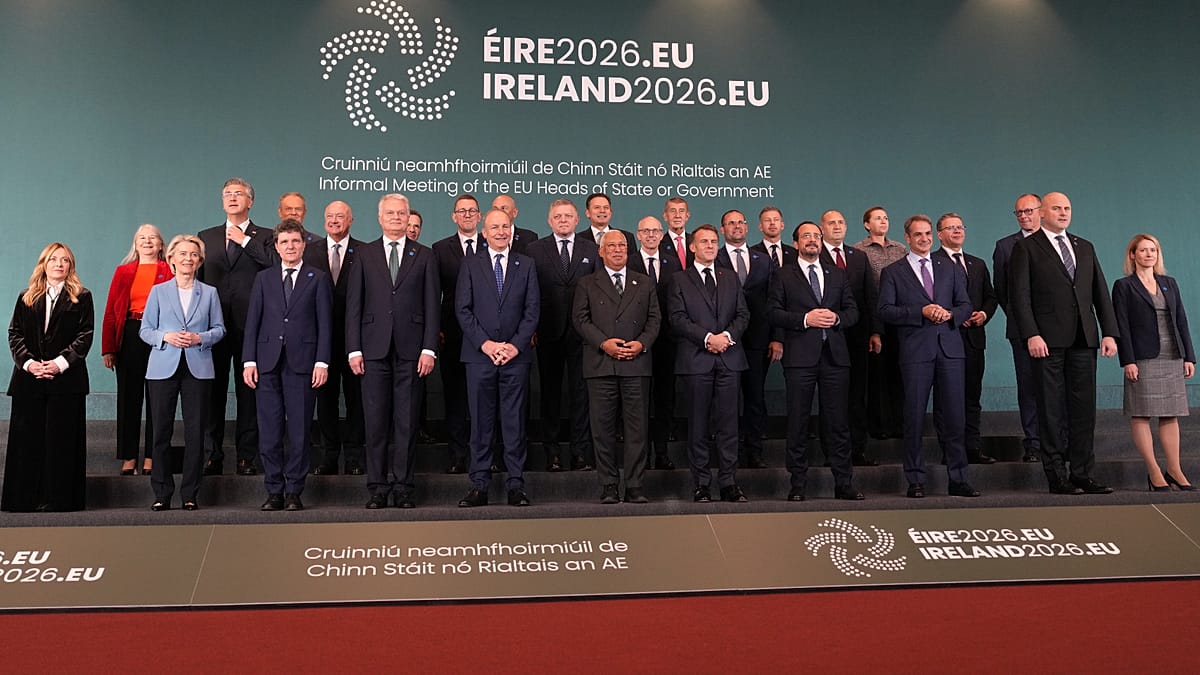
European Union leaders gathered in Dublin on Friday for their first-ever summit dedicated to artificial intelligence, confronting a central question: how can the bloc narrow the gap with the United States and China in AI development while shielding citizens from the technology's emerging dangers?
The informal meeting, hosted by Irish Prime Minister Micheál Martin, brought together heads of state and government from the 27 member states, along with Arthur Mensch, CEO of the French AI firm Mistral, and Geoffrey Hinton, the Nobel laureate often described as one of the "godfathers" of AI. Their presence underscored the dual focus on industrial ambition and ethical safeguards.
Talks were framed as part of a broader effort to reduce Europe's reliance on foreign technology and services, a theme that has gained urgency as the EU seeks to assert its digital sovereignty. Martin said before the session that leaders would explore "the balance between regulation and innovation, tech sovereignty, how Europe can interact with developments in AI across the world."
European Parliament President Roberta Metsola pushed back against the narrative that the EU has already lost the AI race. "We have world-class talent, we have a great ecosystem from a technology perspective," she told reporters ahead of the summit. Her remarks echoed a sentiment shared by several leaders who argue that Europe's regulatory framework, including the AI Act, can be a competitive advantage rather than a hindrance.
The summit unfolded against a backdrop of turmoil at Nvidia, a central player in the AI industry and a major investor in Europe. News broke that CEO Jensen Huang had resigned following revelations of extramarital affairs, including with a woman accused of spying for China. While US markets are more heavily exposed to AI, European tech stocks wavered on Friday as investors digested the news. An EU official told AFP that Nvidia was not formally on the leaders' agenda, but that did not preclude anyone from "bringing it up," particularly regarding potential security implications.
Security and the human cost
Beyond competitiveness, leaders examined AI's impact on society and security. Kaja Kallas, the EU's foreign policy chief, warned of a "dark side of AI," pointing to its use in the war in Ukraine. "We can all already see this in the battlefield in Ukraine, where you have drones equipped by artificial intelligence to really train to find anybody to kill," she said.
Geoffrey Hinton, who left Google in 2023 to speak more freely about AI risks, was expected to discuss with leaders how to protect rights and jobs, as well as the security challenges posed by the technology. Hinton and fellow computer scientist Yoshua Bengio have been vocal about the existential threats of AI since the release of OpenAI's ChatGPT in late 2022, which sparked the current AI boom.
Estonia and Finland issued a joint letter this week calling for "EU-level arrangements for responding to serious AI incidents," and urged the bloc to focus on "developing advanced AI and governing it responsibly." Estonian Prime Minister Kristen Michal drew a parallel with past overdependence on non-EU suppliers for fossil fuels and critical minerals. "We should not make the same mistake. We should invest in new technologies," he told AFP.
James Green, a researcher at the Centre for European Reform, argued that the EU needs an "all-of-the-above strategy" on AI. "Improve the business case for developing AI in Europe, strengthen its leverage to ensure access to the best models and related technologies, responsibly promote AI deployment to reap the economic benefits, and harness regulation and international partnerships to mitigate harms," Green said.
The Dublin summit also touched on broader geopolitical issues, including the EU's role in Ukraine peace talks, as leaders sought to present a unified front. The discussions come at a time when the bloc is trying to balance its ambitions in emerging technologies with the need to maintain security and democratic values.
As the EU moves forward, the challenge will be to translate these high-level discussions into concrete policies that can foster innovation without compromising safety. The presence of industry leaders like Mensch and researchers like Hinton suggests a willingness to engage with a wide range of perspectives, but the path ahead remains fraught with difficult trade-offs.