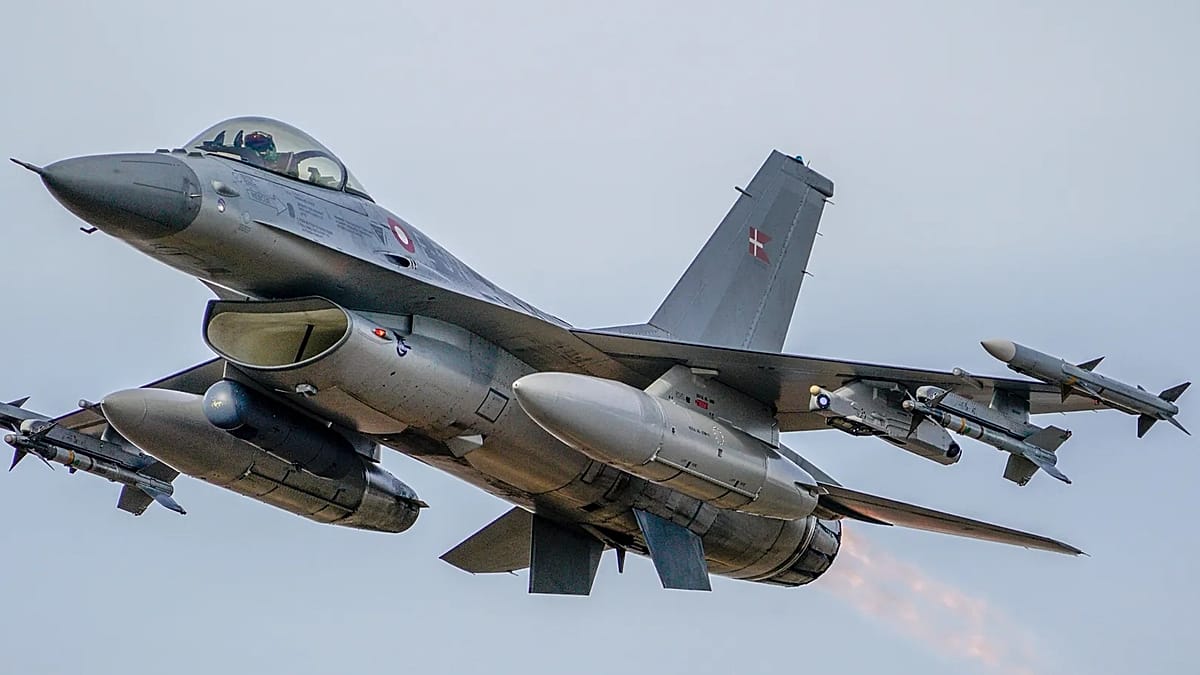
NATO fighter jets operating under the Baltic Air Policing mission shot down an unidentified drone over Latvian airspace on Friday, the country's armed forces confirmed. The interception took place near the eastern town of Balvi, close to the border with Russia, after the aircraft entered Latvian territory.
In a statement, the Latvian military said the drone had crossed into the country "as a result of Russian electromagnetic warfare," a phrase that points to Moscow's use of electronic jamming and spoofing to divert unmanned aircraft across NATO borders. The armed forces have since deployed additional air defence units to Latvia's eastern frontier and said they would maintain heightened surveillance of the airspace.
"As long as Russia's aggression in Ukraine continues, a recurrence of cases where foreign drones enter or approach Latvian airspace is possible," the military warned. It also reported that further airspace threats had been detected in the municipalities of Augšdaugava, Preiļi, Rēzekne, Balvi, and Alūksne, though those alerts have since ended.
Growing pattern of drone incursions
The incident is the latest in a series of drone breaches along NATO's eastern flank, a region that has become increasingly exposed to the fallout from Russia's full-scale invasion of Ukraine, now in its fourth year. The alliance has repeatedly condemned these incursions as dangerous and destabilising.
In July, Romanian fighter jets shot down three drones in as many days, and the country's Prosecutor General's Office later determined that at least one was a Shahed-type drone used by Russian forces in Ukraine. Romanian military divers also destroyed two Gerbera-type drones in the Black Sea on Tuesday, near the Neptun Deep gas project, a key energy infrastructure site. Defence Minister Radu Miruță said the controlled detonation was carried out "to ensure the safety of the shipping lane and the work being carried out around the platform."
Earlier this summer, a Ukrainian sea drone exploded in the port of Constanta after Kyiv said it had veered off course due to Russian electronic warfare interference. And last week, another drone exploded near a compressor station of the Trans-Balkan gas pipeline in Bulgaria.
NATO allies met on Wednesday to discuss the recent spate of incidents, expressing "full solidarity with and support for the affected Allies." In a statement, the alliance said: "Allies reiterated that Russia bears full responsibility for the airspace violations, which are dangerous and unacceptable, and demonstrate Russia’s increasing tolerance for risk." It added that NATO "stands ready to deter and defend against any aggression."
The Baltic Air Policing mission, which has been in place since 2004, sees allied jets deploy in four-month rotations to air bases at Šiauliai in Lithuania and Ämari in Estonia. From there, they can be scrambled by the NATO Combined Air Operations Centre in Uedem, Germany, to intercept any aircraft approaching allied airspace.
Latvia, which shares a 214-kilometre border with Russia, has been on high alert since the invasion began. The country has also been a vocal advocate for stronger NATO presence in the Baltics, and Friday's shootdown is likely to reinforce calls for additional air defence assets in the region.
The incident comes amid a broader pattern of Russian-linked drone activity across Europe, including NATO's condemnation of airspace violations over Poland and Romania earlier this year. It also follows a deadly Russian drone strike on a passenger train in Odesa, underscoring the wide geographic reach of Moscow's unmanned systems.
While the drone downed over Latvia was not identified, its interception marks a rare instance of NATO forces physically engaging an intruding aircraft in the Baltic region. The alliance has previously scrambled jets to shadow Russian military planes, but shootdowns have been less common, reserved for clear threats.
Analysts note that the use of electronic warfare to push drones across borders is a deliberate tactic by Moscow to test NATO's response times and create ambiguity. By exploiting the difficulty of attributing such incursions, Russia can probe the alliance's defences without triggering a direct military confrontation.
For Latvia, the message is clear: the threat is not hypothetical. The military's decision to reinforce the eastern border with additional air defence units signals that Riga expects more such incidents as long as the war in Ukraine continues.