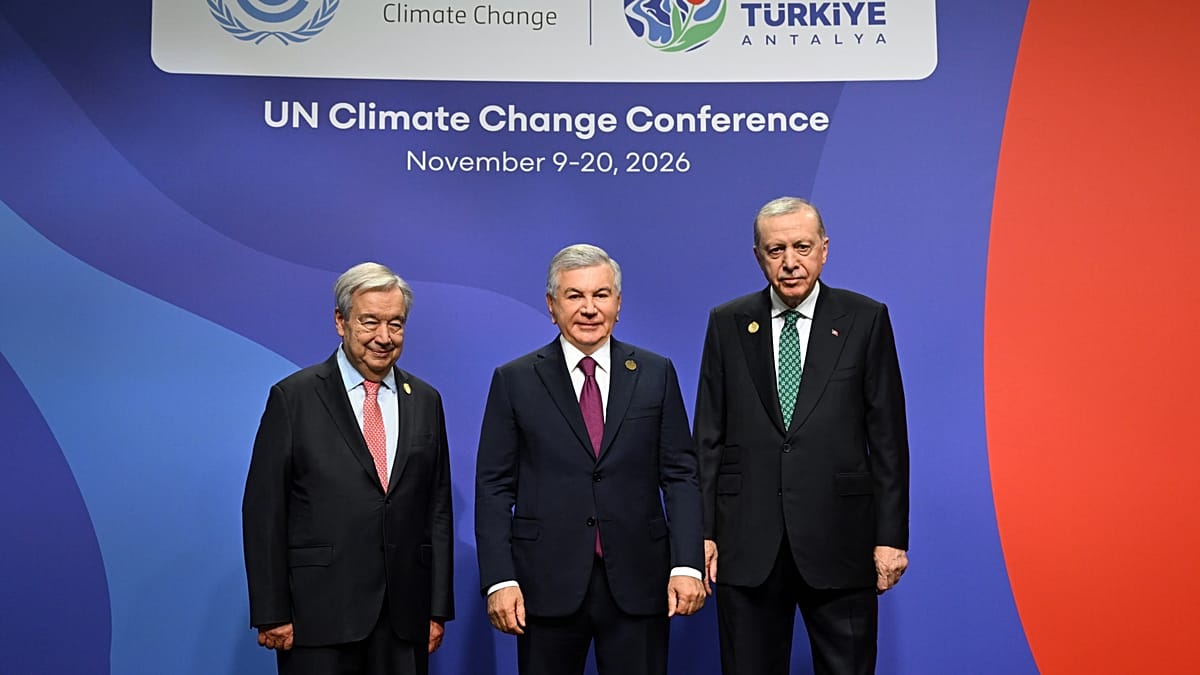
At the COP31 climate summit in Antalya, Türkiye, Uzbekistan's President Shavkat Mirziyoyev laid out a bold vision for regional cooperation, urging Central Asian nations to pool their efforts on early warning systems, green technology, and climate finance. The proposal, dubbed the Climate Integration Model, is a direct response to the accelerating environmental pressures facing the region, from melting glaciers to intensifying droughts.
"No country can address the challenges of climate change on its own," Mirziyoyev told world leaders, underscoring the need for joint action. His remarks come as Central Asia grapples with a 30% decline in glacier surface area over the past six decades, according to the World Bank, a trend that threatens water supplies for agriculture and hydropower across the region.
A three-part plan for regional resilience
The first pillar of Uzbekistan's proposal focuses on shared climate information. Mirziyoyev called for a regional data exchange system, supported by the World Meteorological Organization (WMO), to monitor environmental risks and provide early warnings for natural disasters. This would allow countries like Kazakhstan, Kyrgyzstan, Tajikistan, Turkmenistan, and Uzbekistan to anticipate and respond to shared threats more effectively.
The second pillar promotes green technologies to restore degraded land, capture carbon in arid zones, and combat dust and sandstorms. Uzbekistan also proposed turning its annual ECO-EXPO into a permanent platform linking environmental tech providers, investors, and regional authorities, potentially accelerating the deployment of solutions across the region.
The third pillar addresses the critical issue of financing. Mirziyoyev called for cooperation with international development banks to provide concessional grants and design new funding instruments tailored to regions facing water scarcity and prolonged drought. This is particularly urgent as Central Asia's water stress intensifies, affecting millions of people.
Uzbekistan also confirmed it will take over the chairmanship of the International Fund for Saving the Aral Sea in 2027, a body that coordinates water management and environmental restoration among Central Asian states. The Aral Sea disaster remains a stark symbol of the region's environmental fragility.
On national targets, Mirziyoyev noted that Uzbekistan had already achieved its previous goal of cutting greenhouse gas emissions per unit of GDP by 35% ahead of schedule. The country now aims to source 54% of its electricity from renewables by 2030, a significant shift for a nation historically reliant on fossil fuels.
€264 million boost for climate adaptation
Alongside the summit, a €264.4 million programme called Climate-Resilient Landscapes in Central Asia (CLiCA) was formally launched to support Uzbekistan, Kyrgyzstan, and Tajikistan. Approved by the Green Climate Fund in October 2026, the seven-year initiative will begin implementation in 2027, with funding from the Green Climate Fund and German development partners, and the European Investment Bank as a potential additional partner.
Of the total, €103.7 million is earmarked for Uzbekistan, where projects will restore damaged ecosystems and help rural communities adapt to harsher conditions. The programme aims to restore 18,000 hectares of forest and 123,000 hectares of pasture, introduce drip irrigation and drought-resistant crops, and improve access to agricultural financing. Around 12,000 farmers are expected to receive climate advisory services, benefiting approximately 342,000 people.
On the sidelines of COP31, Mirziyoyev held talks with Green Climate Fund Executive Director Mafalda Duarte on climate financing and Aral Sea restoration, and with WMO Secretary-General Celeste Saulo on weather monitoring and dust storm forecasting. Meetings with UN officials Yasmine Fouad and Alexander De Croo addressed desertification and land restoration, while discussions with the World Bank, the European Bank for Reconstruction and Development, Finnish President Alexander Stubb, and Saudi Arabia's Energy Minister Prince Abdulaziz bin Salman covered water security, renewables, and infrastructure investment.
Uzbekistan and Türkiye also signed an environmental cooperation agreement covering climate adaptation, pollution prevention, waste management, and desertification, strengthening bilateral ties on environmental governance.
As Central Asia's environmental challenges intensify, Uzbekistan's push for a unified regional response may prove pivotal. The success of such initiatives will depend on sustained political will and international support, particularly from European partners who have a stake in global climate stability. For more on the broader European climate debate, see the clash over competitiveness and climate in the EU's 2027 agenda.