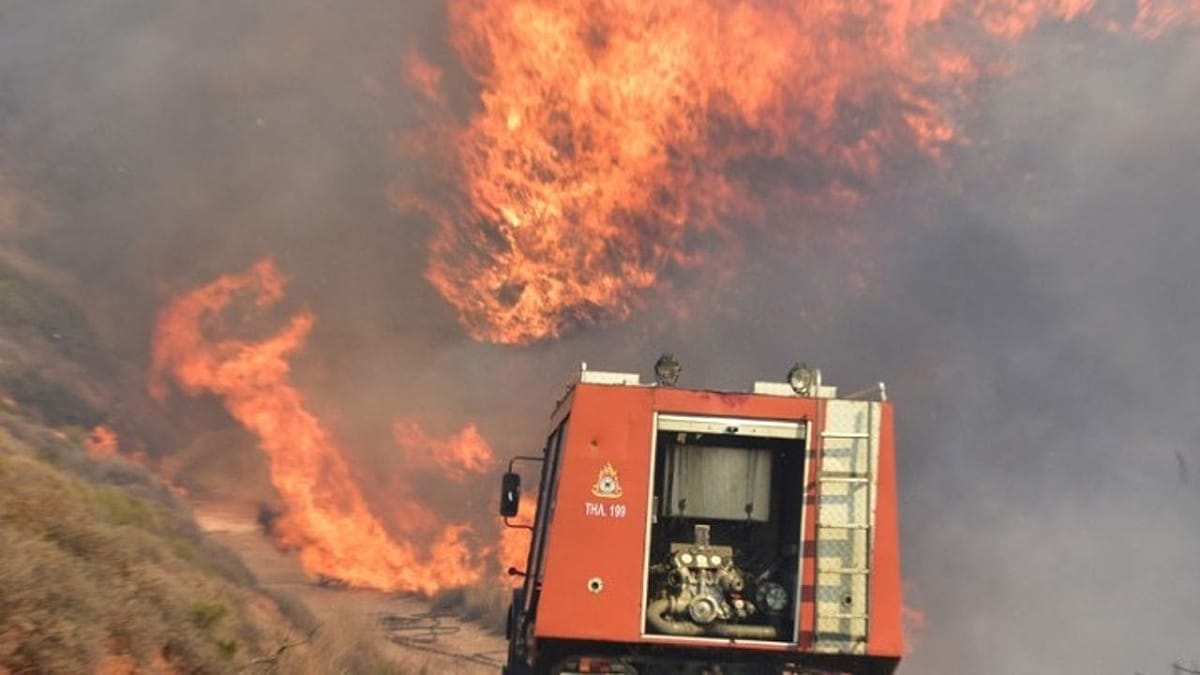
A large wildfire on the Greek island of Paros has entered its second day, forcing authorities to issue successive evacuation orders for residents and tourists across ten locations. The blaze, which first broke out on Tuesday near the Kampi landfill site, initially burned through rubbish and low vegetation before spreading rapidly through dry grass, farmland, and rugged terrain.
Firefighting operations were significantly reinforced at dawn on Wednesday after the fire flared up again overnight. According to the Fire Service, 66 firefighters, four forest commando teams from the 1st Special Forest Operations Unit, and 16 fire engines are now deployed on the ground. Aerial support includes two aircraft and five helicopters, with one helicopter coordinating the overall effort. Additional aircraft remain on standby.
The fire fronts are concentrated on the southern and southeastern parts of the island, an area popular with holidaymakers. Local media report that the flames advanced through the Agkairia region toward Trypiti overnight, while a second front moved toward Faragas beach. The Apianes hill and large tracts of land along the road to the Monastery of Agioi Theodoroi have been burned. Power cuts affected a large part of southern Paros.
Evacuations and local resistance
Authorities sent four 112 emergency alerts between Tuesday afternoon and the early hours of Wednesday. The first ordered people in Agios Charalampos, Kampi, Bougados, and Aneratza to move toward Aliki. Subsequent alerts covered Kamari, Agkairia (directing people to Aliki beach), and finally Trypiti, Glyfa, Pyrgaki, and Aspro Chorio, where residents were told to head toward Dryos.
Paros deputy mayor for civil protection, Christos Giourtzidis, told SKAI that some residents initially refused to leave their properties because they did not want to abandon their animals. He confirmed that at least two livestock facilities had been destroyed, though a full damage assessment is still pending.
The rugged terrain and strong winds remain the primary challenges. Giannis Artopios, deputy spokesman for the Fire Service, described the blaze as “difficult,” explaining that northerly winds of 6 to 7 on the Beaufort scale are causing spot fires and creating new fronts some distance from the main fire. Paros mayor Konstantinos Bizas warned that winds are expected to strengthen further, with gusts locally reaching 8 Beaufort. On Wednesday, Paros is classified as risk category 3, corresponding to a high danger of wildfire.
Ground forces have been reinforced by firefighters and vehicles from Attica, Syros, Naxos, and Piraeus. A further 20 firefighters with eight vehicles are due to arrive by ferry from Rafina. Volunteers, two water tankers, and heavy machinery from the Municipality of Paros are also assisting. Overall coordination has been assumed by the deputy chief of the Fire Service.
The Cyclades Arson Crime Investigation Unit has been activated to investigate the cause of the fire. No information has been released so far.
This wildfire is part of a broader pattern of increasing fire risk across southern Europe. As Europe's 2026 wildfire season could break all records, the challenges faced on Paros highlight the need for better preparedness. The blaze also underscores the growing danger of sixth-generation wildfires, which are more intense and harder to contain due to climate change.
Firefighters remain deployed on the island, carrying out continuous water drops and damping-down operations. They are expected to stay until the fires are fully contained.