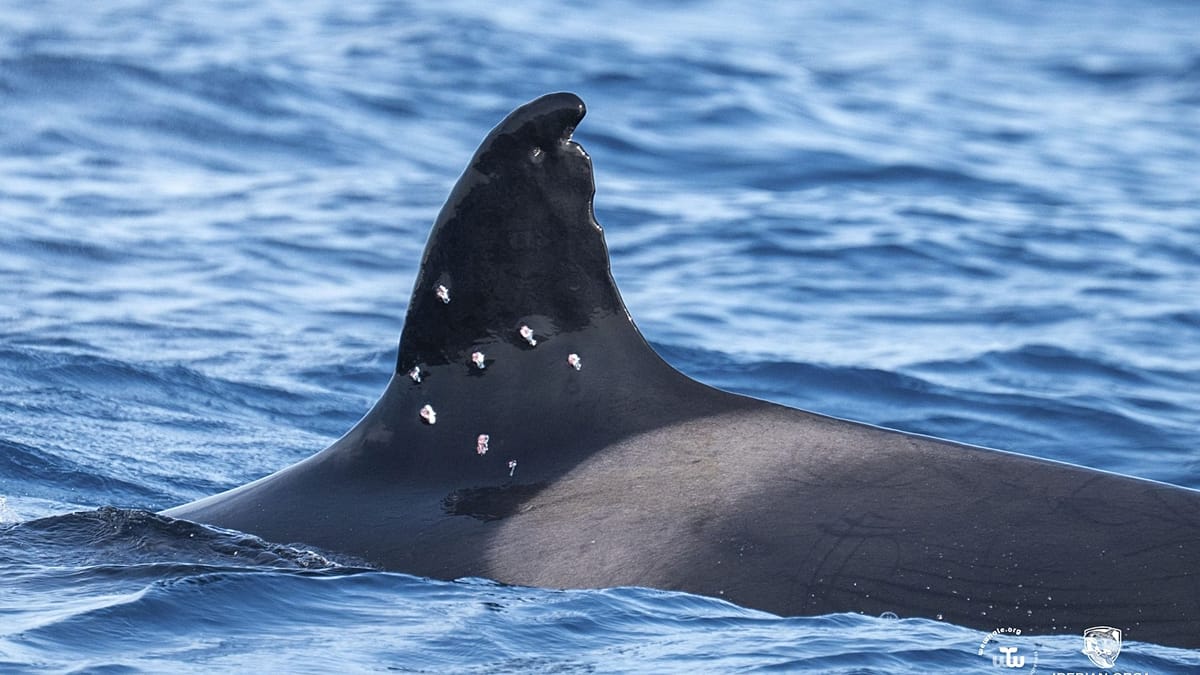
Spanish authorities have opened an investigation after Toñi, the oldest orca in the Strait of Gibraltar, was found with multiple wounds on her dorsal fin and back. The marks, which were not present in photographs taken weeks earlier, have raised suspicions of a shotgun blast.
Toñi, estimated to be around 60 years old, is known among researchers as the "grandmother" of the orca population that moves between the Strait of Gibraltar and the Gulf of Cádiz. The conservation group WeWhale first raised the alarm after comparing recent images with the animal's photographic record. Janek Andre, founder of WeWhale and Iberian Orca Guardians, said the injuries are consistent with the impact of a shotgun blast.
The Atlantic Orca Working Group has gone further, suggesting the wounds could correspond to lead pellets of around 9 millimetres, similar to those used in buckshot cartridges for wild boar. That ammunition typically fires nine projectiles in three rows of three, a pattern they say matches the arrangement of the marks on Toñi's fin.
Government inquiry under way
The Ministry for Ecological Transition and the Demographic Challenge learned of the case on 11 August through information sent by WeWhale. The following day, the Directorate General for Biodiversity, Forests and Desertification opened preliminary proceedings to clarify the facts and, where appropriate, initiate sanctioning proceedings against those responsible.
Vice-president and minister for Ecological Transition, Sara Aagesen, confirmed via the social network Bluesky that the orca showed marks consistent with pellet shots. She stressed that this is a vulnerable species, so any harm caused to it constitutes a serious offence.
CIRCE, an organisation that has been monitoring Iberian orcas since 1999, has also joined the investigation. It holds a photographic archive of Toñi spanning more than two decades. CIRCE said that before determining the origin of the injuries, it is necessary to review available images in detail, compare them with the historical series, and carry out fresh direct monitoring of the individual and its group.
For the moment, none of the authorities involved has officially confirmed that the injuries were caused by a shot, although that remains the main working hypothesis.
Legal protection and how to act
The orca population in the Strait of Gibraltar and the Gulf of Cádiz is listed as vulnerable in the Spanish Catalogue of Threatened Species. Article 57 of Law 42/2007 on Natural Heritage and Biodiversity prohibits any action aimed at killing, capturing, pursuing or harassing specimens included in that catalogue.
Specific regulations on the protection of cetaceans add further restrictions: no vessel may approach closer than 500 metres, make contact with the animals, swim with them, feed them, obstruct their trajectory, split up groups or emit loud sounds to attract or scare them away. In the critical area of the Ensenada de Barbate, Conil and the Banco Majuán, orca watching is also prohibited between 1 March and 31 August. Anyone who fails to comply with these measures faces fines of up to two million euros and criminal liability, according to MITECO.
Since 2020 there has been a rise in interactions between these orcas and vessels sailing through the Strait and the Gulf of Cádiz. That is why the Ministry of Transport and MITECO recommend avoiding navigation in the area between April and August and, if an encounter with the animal does occur, heading towards the coast, avoiding any manoeuvre that could harm it, keeping people away from the gunwale and notifying the Maritime Rescue Coordination Centre.
Toñi's case has once again put the spotlight on this protected population. Organisations working in the area insist that these animals need protection, not reprisals.