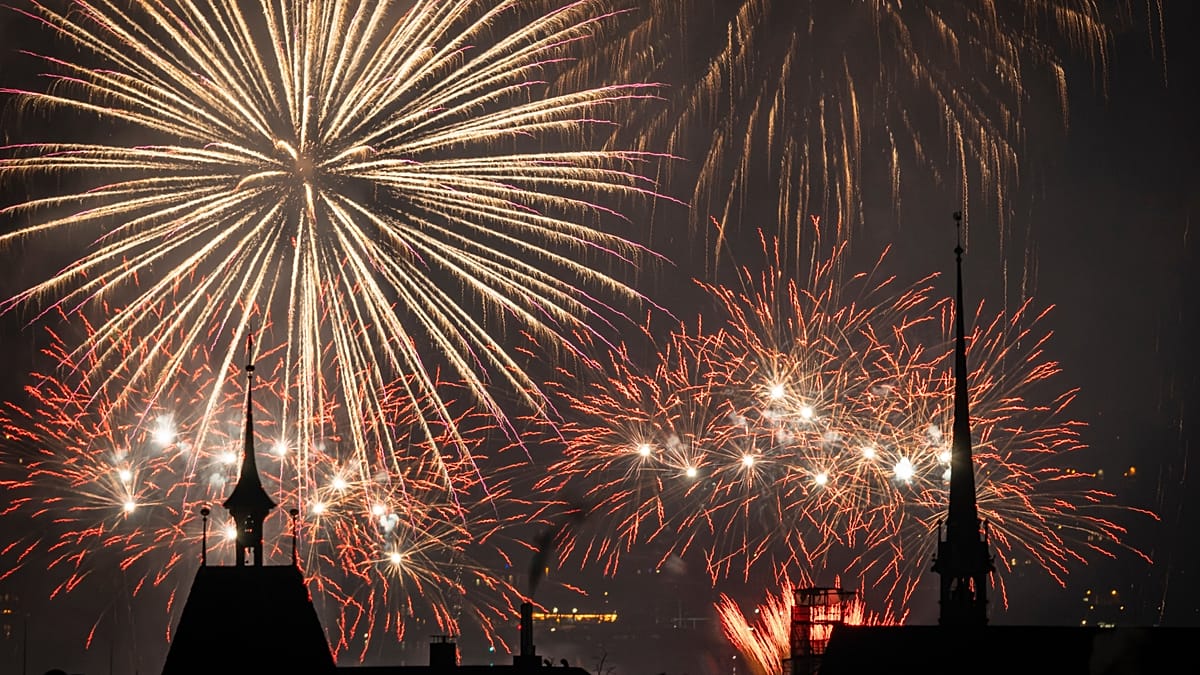
Swiss voters are preparing for a decisive ballot on 29 November that could see the sale of loud fireworks restricted nationwide. The citizen-initiated proposal, backed by animal welfare and environmental organisations, aims to reduce the stress and harm caused to animals, as well as the noise and air pollution associated with private firework displays.
“For pets, wild animals, and farm animals, fireworks are not a celebration, but pure stress,” says Schweizer Tierschutz STS (Swiss Animal Protection), the non-profit supporting the initiative. The proposal also calls for better protection for people and the environment from noise, air pollution, litter, accidents, and fires caused by fireworks.
An initial poll by the Swiss Broadcasting Corporation (SBC), released on 23 October, showed strong public backing, with 69% of voters in favour. Support was highest among left-leaning voters, but the measure also received majority approval across the political spectrum, particularly among women.
Switzerland’s direct democracy allows any citizen or group to propose a constitutional amendment by collecting 100,000 valid signatures. Recent initiatives include the neutrality initiative, rejected in September, and a pending nuclear disarmament proposal. This firework ban initiative, titled ‘For a restriction on fireworks’, was submitted in 2023 with over 137,000 signatures.
What would the ban involve?
The proposal would “significantly restrict particularly loud and disruptive fireworks” in private settings by banning the sale of noisy pyrotechnics. Quieter alternatives, such as sparklers and fountain-style fireworks, would remain available. Cantons could grant exemptions for events of “supra-regional significance”, such as Swiss National Day on 1 August and New Year’s Eve, but with an emphasis on quieter options.
Currently, Swiss cantons and communes have the authority to restrict or ban fireworks locally, with age limits and licensing requirements in place. The initiative would create a uniform national rule, replacing the patchwork of local regulations.
However, the Swiss Fireworks Coordination Office (SFK), an industry association, argues that the proposal is a “threat to Swiss tradition”. Some politicians contend it would infringe on personal freedoms and should remain a cantonal matter. The Swiss People’s Party, the Centre Party, and the Swiss Trade Association have launched a campaign against the measure, warning of economic impacts and a potential “prohibition culture”.
If approved, Switzerland would join the Netherlands, where a broader firework ban came into force this summer, primarily for safety reasons but also on animal and environmental grounds. Other European countries have their own restrictions; for instance, Belgium limits the use of large, powerful fireworks to professionals.
Environmental and health impacts
Fireworks release fine dust particles laden with toxic metals from gunpowder and colouring compounds. According to the Swiss Federal Office of Police, between 1,000 and 2,000 tonnes of fireworks—three-quarters of which is packaging—are used annually in Switzerland, producing 200 to 400 tonnes of particulate matter. That accounts for two to three percent of the country’s annual particulate emissions, according to the Federal Office for the Environment (FOEN).
These fine particles contribute to air, water, and soil pollution and can be inhaled, posing health risks, especially for vulnerable individuals with pre-existing conditions. Unfavourable weather, such as fog, can trap particles in the air longer, while hot, dry conditions increase wildfire risk. FOEN advises responsible disposal of used fireworks in household waste once cooled, with packaging recycled as normal.
Animal welfare concerns
Animal welfare groups have been vocal in their support. “The sudden noise triggers fear, panic, and disorientation [in animals],” says STS. “The consequences range from flight behaviour and acute stress to injuries or even death. Protecting animals from unnecessary noise is therefore a central concern of animal welfare.”
Swiss veterinarian Maruschka Blaser, speaking in a campaign video, explains that animals hear high-pitched sounds and loud bangs more acutely than humans. Using horses as an example, she notes that “things can become dangerous very quickly when they run uncontrollably because of fireworks”, endangering both people and other animals. For domestic pets like cats and dogs, she says, “they sometimes need to be given medication to calm them down days in advance” of displays. She adds, “I also know families who spend the night in an air-raid shelter with their pets, but somehow that isn’t a solution either.”
Casimir von Arx, President of the Bern branch of STS, emphasises the scale of the issue: “Millions of pets live in Switzerland. For many of them, fireworks trigger stress or panic. We can only protect them if, as a society, we show consideration for one another.”
The vote on 29 November will determine whether Switzerland adopts a nationwide restriction on noisy fireworks, a move that could have broader implications for how European countries balance tradition, personal freedom, and environmental and animal welfare. As Switzerland's relationship with the EU evolves, this domestic decision reflects a wider continental debate on regulation and quality of life.