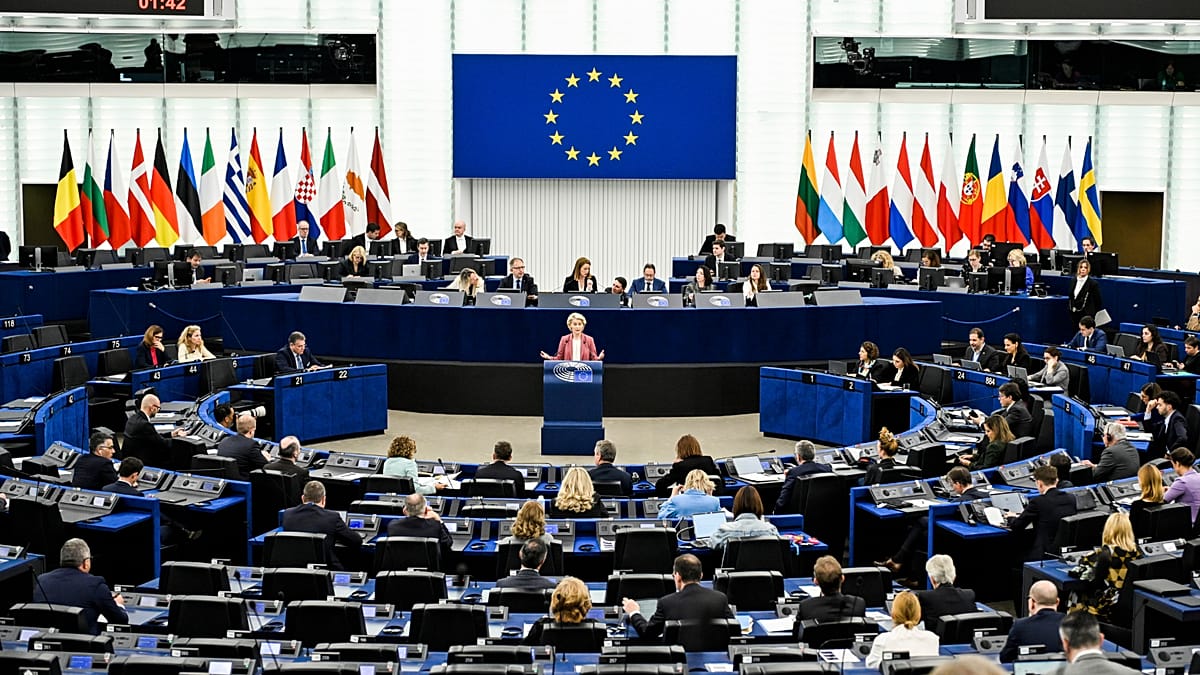
On May 18, the European Parliament will formalise a high-stakes ultimatum: an additional €200 billion for the 2028–2034 Multiannual Financial Framework (MFF). If most MEPs reject the current trajectory, they could freeze the entire €2 trillion plan, delaying the start of the next funding cycle. The demand pits the Parliament against Ursula von der Leyen’s Commission, which insists on a strict 1.26% of Gross National Income (GNI) spending cap. Net contributors such as Germany, the Netherlands, Sweden, and Austria argue that even that level is too high.
The Commission’s proposal, totalling €1,816.89 billion at current prices, aims to fund new priorities in defence and artificial intelligence by streamlining existing programmes. But the Parliament, following a 370-to-201 vote, insists that these needs must not come at the expense of farmers or regional aid. MEPs are demanding a 10% budget increase, targeting 1.27% of GNI, and crucially excluding the massive costs of repaying pandemic debt. They argue that those repayments should be accounted for separately to avoid “suffocating” future investment.
What is at stake in the MFF negotiations?
The Multiannual Financial Framework defines how EU money is allocated across policy areas such as research, climate, agriculture, culture, defence, and environment. The Commission proposes the budget, while the Council and Parliament amend and adopt it together. Unlike national governments, the EU does not levy direct taxes; it relies on “own resources” including GNI contributions, VAT, import duties, and a levy on non-recycled plastic waste. To meet its more ambitious proposal, the Commission has suggested new own resources worth an estimated €58.2 billion annually (2025 prices), starting from 1 January 2028.
The proposed budget reduces the number of programmes from 52 to 16, aiming for greater efficiency and focus on core priorities. The Parliament supports simplification but rejects what it sees as a power grab from regional and local authorities. “I am in favour of simplification of course. But simplification cannot mean recentralisation and bypassing territories,” said Marie-Antoinette Maupertuis, President of the European Alliance Group at the European Committee of the Regions and President of the Corsican Assembly.
Winners and losers in the new budget
The 2028–2034 proposal pivots sharply toward “hard power,” with major increases for industrial and military security. The first pillar (44% of the total) allocates €409 billion to National and Regional Partnership Plans, merging Cohesion Policy and the Common Agricultural Policy into a single framework. Funding is conditional on meeting targets and respecting the rule of law. The second pillar (21%) allocates €409 billion to the European Competitiveness Fund (€234 billion) and Horizon Europe (€175 billion), aiming to reduce reliance on foreign fossil fuels and secure green energy supply chains. Defence receives a tenfold increase, from around €1.7 billion to more than €17 billion, to improve the rapid movement of troops and equipment across Europe in response to Russian aggression. Artificial intelligence and high-tech innovation would benefit from a planned €200 billion research allocation, supporting the “AI Factories” initiative that gives European start-ups access to supercomputers. The third pillar allocates €200 billion to Global Europe, covering enlargement, neighbourhood partnerships, migration management, and aid for Ukraine.
However, funding for civil society and independent journalism is being squeezed into broader, rigid National Partnership Plans. Only €200 billion (10% of the total) is split between Erasmus+ and AgoraEU, while the remaining €293 billion flows into projects like the Connecting Europe Facility and the Single Market Programme. “If governance becomes too concentrated at national level, there is a real risk that local realities, smaller territories and civil society actors progressively lose visibility and influence within the decision-making process,” warned Maupertuis.
Geographic splits and political tensions
Spending priorities have divided member states into two camps. Eastern European countries, led by Poland and the Baltic states, lobby for a security-first budget that maintains high cohesion funding to bridge the economic gap with the West. The “frugal” countries—Germany, Sweden, Austria, and the Netherlands—demand austerity and oppose any increase above the 1.26% GNI cap. France is also pushing back against what it calls a “rushed” agreement, seeking more time for negotiations. The Parliament’s threat to veto the entire plan adds another layer of complexity, as the EU faces a budget battle that could delay the 2028 funding cycle.
The outcome will shape Europe’s ability to respond to security threats, technological competition, and internal cohesion. As MEP Carla Tavares, the Parliament’s rapporteur for the MFF, noted, the Parliament supports flexibility but rejects cuts to regional and municipal authorities. The coming months will test whether the EU can reconcile its ambitions with fiscal constraints, or whether the budget talks will indeed become “ugly and delayed.”