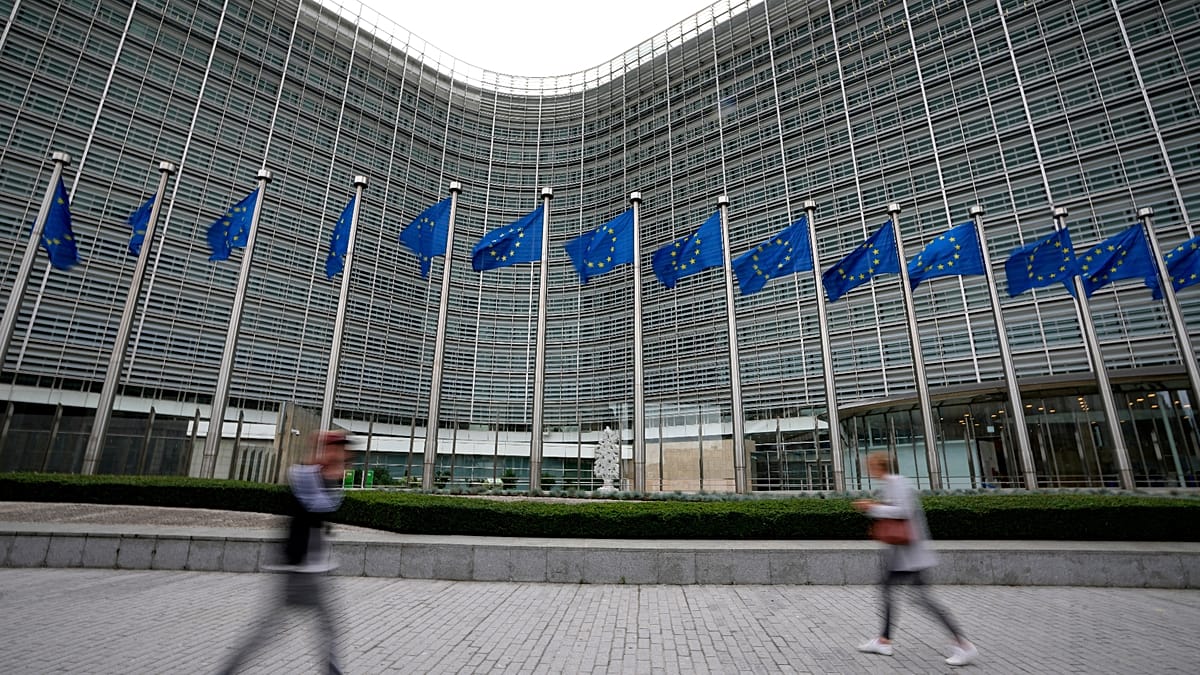
The European Union is preparing its most extensive sanctions package since the start of Russia's full-scale invasion of Ukraine. But according to Joachim Steinhöfel, a prominent German free-speech lawyer, the legal basis for these measures crosses a fundamental line. In an opinion piece for Euronews, he argues that the EU's approach treats individuals as mere means to an end, violating human dignity as enshrined in both German constitutional law and the EU's Charter of Fundamental Rights.
Steinhöfel invokes Immanuel Kant's categorical imperative: "Act in such a way that you treat humanity, whether in your own person or in the person of any other, always at the same time as an end, never merely as a means." This principle, he argues, sets the boundary of state authority. A person may be held accountable for their own actions, but the state may not turn them into a tool for its foreign policy objectives. This idea underpins Article 1(1) of Germany's Basic Law, which declares human dignity inviolable, and is echoed in Article 1 of the EU Charter of Fundamental Rights.
The Commission and the Council, Steinhöfel contends, are on a collision course with these principles. On 17 August 2026, the EU's High Representative Kaja Kallas announced in an interview with the German daily Welt that around 1,600 individuals and entities would be newly designated, increasing the number of listed Russian entities by roughly one third. To speed up adoption, sectoral measures are being set aside, focusing instead on individual listings.
Each listing carries severe consequences: frozen assets, exclusion from European economic life, travel bans, severed banking relationships, and an official stigma as a war supporter. As the number of listings grows and the pace quickens, the need for a listing criterion that respects fundamental rights and is based on solid individual evidence becomes more critical. Steinhöfel argues that the EU's primary listing criterion fails this test.
Guilt by association
The criterion in question, known as criterion (g), covers "leading businesspersons operating in Russia," their immediate family members, and other individuals benefiting from them, as well as businesspersons and entities in economic sectors that provide substantial revenue to the Russian government. It requires no proof of support for the war, no financing role, no proximity to the Kremlin, and no personally attributable misconduct. For family members, merely benefiting from the businessperson's wealth is enough. Liability attaches to marriage or kinship, not to any action of one's own. This, Steinhöfel argues, is guilt by association.
The Court of Justice of the European Union endorsed this construction on 26 March 2026 in a Grand Chamber judgment on five joined cases. The Court held that a listing criterion may cover categories of persons with even a merely indirect objective link to the third country concerned, and that the way the link is expressed cannot invalidate the criterion. The influence of leading businesspersons is understood purely in economic terms; neither a personal connection to the Russian government nor any actual ability to exert influence needs to be shown.
Steinhöfel notes that the Court was aware of the objection. The appellants had argued that criterion (g) targets people for what they are, not for what they do, and leaves them unable to know what conduct they could change to escape sanctions. The Court recorded this argument but rejected it, ruling that the criterion is lawful as long as it is not manifestly inappropriate to its objective.
But this reasoning, Steinhöfel argues, misses the point. The Court examined whether the criterion is a proportionate means of exerting foreign policy pressure, but it did not address the prior question: whether a legal order may turn a human being into an instrument of pressure at all, especially when no misconduct is required and no lawful conduct can end the sanction. The former is a matter of expediency within a wide margin of political appreciation; the latter is a limit set by human dignity.
The General Court of the European Union has been unusually candid about the purpose of these listings. In a September 2025 judgment, it stated that the influence of listed individuals is to be exploited "by compelling them to put pressure on that government to have it change its policy with regard to Ukraine." This, Steinhöfel argues, is the explicit instrumentalisation of individuals: they are to be used as levers against a sovereign state, regardless of their own conduct.
Steinhöfel's critique comes as the EU continues to expand its sanctions regime, including recent measures targeting those involved in the forced deportation of Ukrainian children and ongoing debates over the use of frozen Russian assets. The legal challenge he raises is not merely academic; it goes to the heart of the rule of law in the EU. If the Union's sanctions are to remain credible, he argues, they must respect the dignity of every person, even those whose actions are deemed harmful. Otherwise, the EU risks undermining the very values it claims to defend.