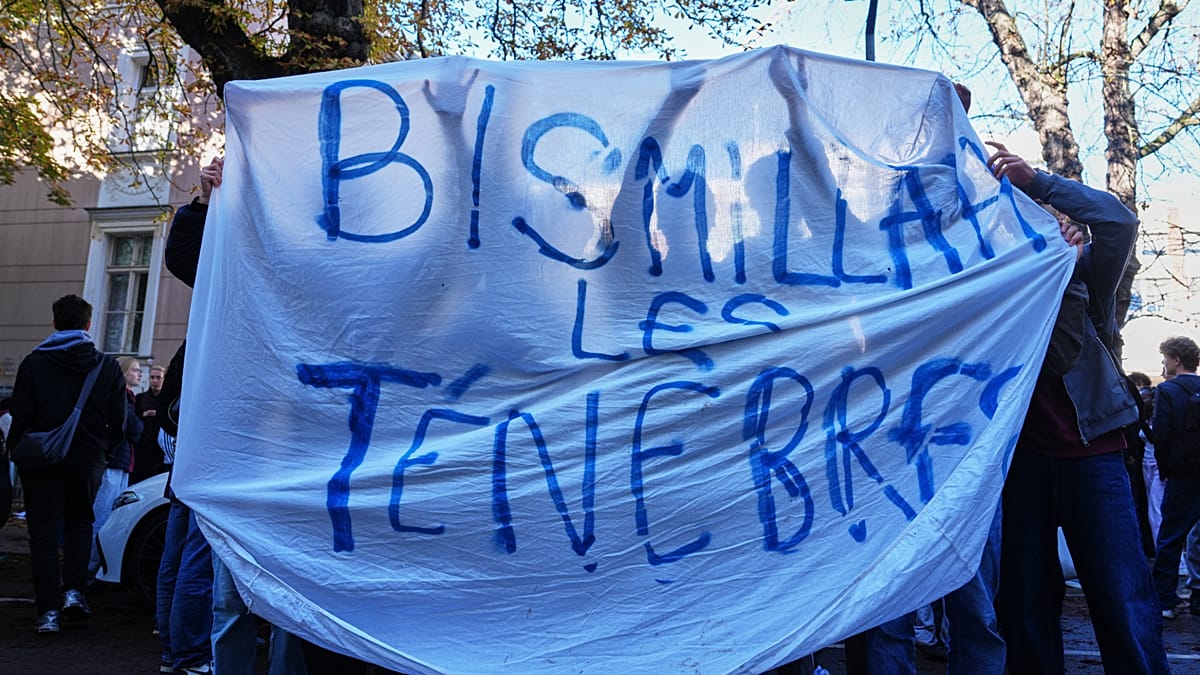
It has appeared on cardboard signs outside blockaded schools, been shared in parody videos tens of thousands of times, and even used by Greta Thunberg. In just a few weeks, "Bismillah, c'est les ténèbres" has become the unofficial slogan of France's high school protest movement.
Literally, the phrase makes little sense—and that is precisely the point.
What does the slogan mean?
"Bismillah" is Arabic for "in the name of God," a phrase Muslims traditionally utter before beginning a task. In everyday French slang, it can also mean something like "let's go." "C'est les ténèbres" translates as "it's the darkness," but among young people it is slang for a situation that is catastrophic or grim.
Put together, the phrase is absurd: "In the name of God, it's the darkness." Students say that is exactly why it caught on—they are mocking someone trying, and failing, to sound like them.
Origins of the slogan
The phrase comes from a screenshot of a Snapchat conversation that began circulating in early October, while students were using the app to organise school blockades. In the message, a user named "Mamadou" asks to join a group: "Hi, in the name of God, it's the darkness. When's the blockade, wallah, bro?" The message was accompanied by Algerian flag emojis.
Other screenshots showed similar accounts asking students where blockades would take place and who was selling fireworks and smoke grenades. To many students, the clumsy mix of Arabic, street slang, and national flags gave the game away. They concluded that the messages were written by police officers posing as teenagers to infiltrate private protest groups.
However, this has not been proven. Neither the police nor the interior ministry in France has commented on the screenshots, and nobody has independently verified who was behind the accounts. Some internet users claimed to have traced the accounts to locations near police stations, but those claims remain unverified. Some of the circulating screenshots may themselves be hoaxes or parodies.
Why are French students protesting?
The movement began in Créteil, south-east of Paris, on 18 September and quickly spread nationwide. A range of student grievances lie at the heart of the movement, including long school days, overcrowded classrooms, run-down schools, and teacher absences. Many argue that these problems hit working-class suburbs and minority communities hardest. Around 400 schools were closed by blockades on 2 October alone.
The student protests fed into the nationwide demonstrations over the cost of living on Saturday 17 October, which ended in some of the worst rioting and looting France has seen in years. The unrest has also had economic repercussions, with European markets dipping as French unrest hits businesses and bonds.
Spread beyond France
Swedish activist Greta Thunberg used the slogan during a visit to striking students in Seine-Saint-Denis, north of Paris, on 13 October, according to the Italian news agency ANSA. On 9 October, it appeared on placards at a union-led demonstration in Brussels against the Belgian government's budget cuts, where it was used as a gesture of solidarity with French students rather than a reference to the infiltration claims.
In Italy, ANSA reported that the phrase appeared at student demonstrations in Bologna on 15 October. It was heard again in Milan over the weekend of 17 and 18 October, when protests in Piazza del Duomo also turned to looting, and students from a French school in Berlin were photographed holding a banner with the slogan. The unrest in Milan led to over 200 arrests as cost-of-living protests turned violent.
The slogan's journey from a suspected police sting to a pan-European symbol of youth frustration underscores the deep-seated anger among students and workers alike. As protests continue, the phrase "Bismillah, c'est les ténèbres" has become a darkly humorous badge of defiance, encapsulating both the absurdity of the situation and the seriousness of the underlying grievances.