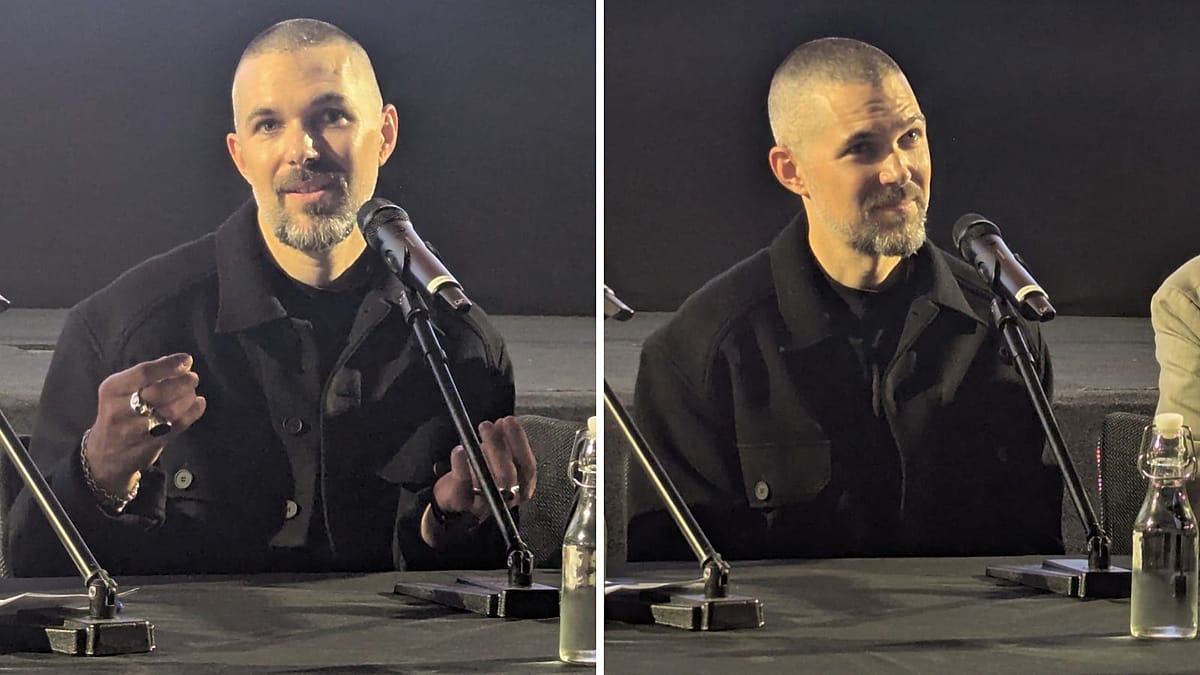
At this year's Lumière Film Festival in Lyon, American director Robert Eggers—the mind behind gothic folklore horrors like The VVitch, The Lighthouse, and Nosferatu—sat down with the audience to dissect the dark, meticulously crafted worlds he has become known for. The occasion was a masterclass, and the highlight was a world exclusive: the first screening of the opening scenes of his upcoming werewolf film, Werwulf.
Set in 14th-century England, Werwulf stars Aaron Taylor-Johnson, Lily-Rose Depp, and Willem Dafoe, all of whom appeared in Nosferatu. Eggers warned the audience that the film's grading process is still being refined, but the footage shown was enough to send shivers through the Salle Lumière.
A visceral opening
The film opens with a howl in the dark, followed by a transformation that is anything but glamorous. There is vomit, screaming, writhing, and the crunch of bones. Eggers, as is his custom, takes mythical authenticity seriously, delivering something far more visceral than the sudden sprouting of fur seen in typical werewolf movies. The audience barely glimpsed the creature's final form, but they did witness the aftermath: a field of dead livestock and a bloodied Taylor-Johnson, back in human form, knocking on a door. He is greeted by a disfigured Depp in a manner that suggests Eggers will be exploring the uneasy intersection of violence, animality, and sexuality—a theme he has navigated before.
If the opening is any indication, Werwulf promises to be a treat for fans of Nosferatu. The film is slated for release on 1 January in the UK and the following week across mainland Europe.
Key takeaways from the masterclass
Beyond the exclusive footage, Eggers offered a series of insights into his creative process, touching on everything from his viewing habits to his love of silent cinema.
On what he's watching
“All my favourite directors are dead,” Eggers admitted. “I rewatch films often—I watch Jack Clayton’s The Innocents once a year. I have a hard time keeping up with what’s in cinemas because I’m always chipping away at a list of old films, which generally have to do with research for what I’m currently working on.”
On the importance of silent cinema
Eggers is a vocal advocate for visual storytelling. “I love silent cinema. Everybody knows the story that when sound cinema began, there was a dip in using images to tell stories—it became all about dialogue. Of course, there are exceptions. Fritz Lang immediately knew how to do it. I think I’ve succeeded in Werwulf in making a film where you can turn off the sound and still understand the story. The images are telling the story.”
He noted that Werwulf is in Middle English, but even for English-speaking audiences without subtitles, the narrative remains clear. “I was watching 12 Angry Men last night—it’s great, it’s dialogue-driven and it’s cinema. But I’m more interested in telling stories with images.”
On the recurring image of women's eyes
Eggers’ films often feature intense close-ups on eyes, a motif he explains with a simple adage: “Eyes are the window to the soul.” He credits his actresses—Anya Taylor-Joy in The VVitch and Lily-Rose Depp in Nosferatu—for having “big eyes, so that helps.” He also revealed a practical trick: “I always put a little piece of tape near the lens, so actors often have to look at the camera. I always like tight eyelines. Watch Elem Klimov’s Come and See, and you realise why it’s a good idea to do that.”
On why the past inspires him
Eggers is known for his period settings, and he explained why the past holds such appeal. “I get enough of the kitchen sink in my own kitchen! It’s always a mirror to society, but if the mirror is too close, I feel like the film can be working too hard to say something. By trying to make a film that is timeless and of the time... It’s impossible. Of course, I don’t live in a vacuum. But in endeavouring to go into not only the verisimilitude of the physical world of the period but also the interior world of the period, I think we may be able to more easily see who we are today and where we’re going.”
On the use of specific languages
Language plays a crucial role in Eggers’ films. “Language is always very specific in all of my films, and I like the way language informs how you think. Language isn’t perfect and it can’t really express everything. When you learn other languages, you learn different ways to think. ‘Oh, in Germany, they have a word for that concept I struggle to describe...’”
On the common setting of night
Despite the nocturnal settings of his vampire and werewolf films, Eggers confessed, “I hate night shoots! The older I get, the more it’s difficult! But if you’re making a vampire movie or a werewolf movie, you don’t have a choice.”
The masterclass, while short on audience questions—a recurring criticism of the Lumière Festival—offered a rare glimpse into the mind of one of contemporary horror's most distinctive voices. With Werwulf on the horizon and a rumoured adaptation of Romeo and Juliet in the works, Eggers shows no signs of slowing down. For those who appreciate his blend of historical rigor and visceral terror, the wait for the new year will be well worth it.