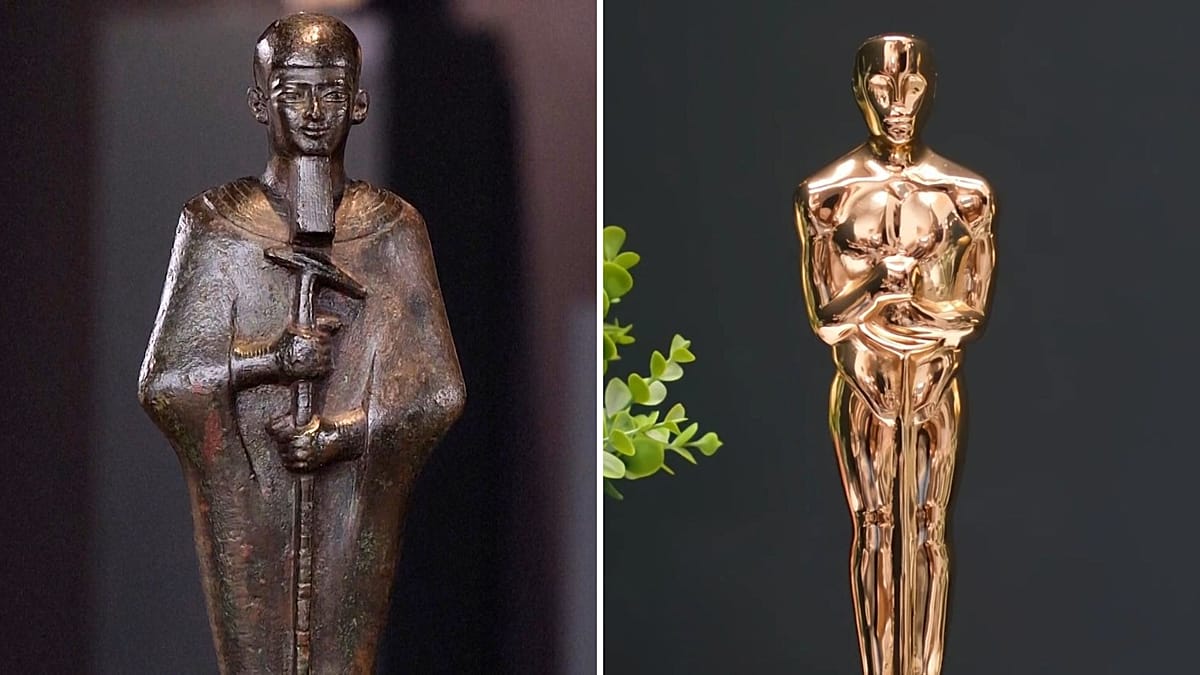
Could the most coveted trophy in cinema owe its silhouette to an ancient Egyptian deity? A 2,700-year-old bronze figure of Ptah, the creator god and patron of craftsmen, has surfaced at Frieze Masters in London, and its provenance is reigniting speculation about the design of the Academy Award statuette.
The statuette, which depicts Ptah standing with a staff, was once part of the collection of newspaper magnate William Randolph Hearst. Hearst was a close associate of Cedric Gibbons, the art director who sketched the Oscar in 1928. Gibbons, who later became a leading figure at MGM, was a frequent visitor to Hearst's estates in California and New York, where Hearst displayed his Egyptian antiquities in a dedicated room.
Rupert Wace, the London-based antiquities dealer who offered the piece at Frieze Masters, says the connection emerged during his research into the object's history. "We found out that this particular piece was with [Randolph] Hearst and the chap who designed the Oscar called Cedric Gibbons was a frequent visitor and friend of Hearst's, and would have visited him both in San Simeon in California and his place in New York where he had a specific Egyptian collection room," Wace told European Pulse.
Gibbons, who died in 1960, never publicly confirmed what inspired his design. Yet the visual parallels are hard to ignore: the statuette's stance, the sword held at the side, and the overall proportions echo the classic Oscar form. Wace is careful not to overstate the case. "The whole thing is supposition in a sense. We put two and two together and either made four or five. We can't prove it. It's uncannily similar and was in the right place with the right people at the right time for it to be more than just a coincidence," he explains.
A masterpiece beyond the Hollywood link
Even if the Hollywood connection remains speculative, the bronze itself is a remarkable artifact. Dating to Egypt's Late Period, shortly before the Achaemenid Persian conquest, it exemplifies the finest metalwork of its era. The figure's inlaid eyes, crafted from gold, lend it a striking presence that has captivated collectors for over a century.
Wace emphasizes that the piece stands on its own merits. "Without the history, this piece would still be fantastic. It's a very fine bronze. It's got a very good history, collecting history. So the extra Hollywood angle is the cherry on the cake," he says.
The statuette sold on the opening day of Frieze Masters for an undisclosed sum, adding another chapter to its long and storied journey. Its previous owners include not only Hearst but also other notable collectors, reflecting the enduring fascination with ancient Egyptian art among Europe's elite.
For those intrigued by the intersection of ancient craftsmanship and modern iconography, the Ptah bronze offers a tangible link. It also invites reflection on how cultural symbols travel across millennia, from the banks of the Nile to the red carpets of Los Angeles. As Wace notes, the truth may never be fully known, but the coincidence is tantalizing enough to keep the debate alive.
Meanwhile, the broader world of ancient art continues to yield surprises. Recent discoveries, such as the oldest known cargo from a Bronze Age shipwreck off Turkey, remind us that the Mediterranean basin remains a treasure trove of history. And closer to home, a newly found wall beneath a Paris hospital may help pinpoint the true site of Gallic Lutetia, underscoring how much of Europe's ancient past is still being uncovered.
Whether or not Ptah truly inspired the Oscar, the statuette's journey from a temple to a tycoon's collection to a London fair is a story in itself—one that bridges continents and epochs, and reminds us that the past is never as distant as it seems.