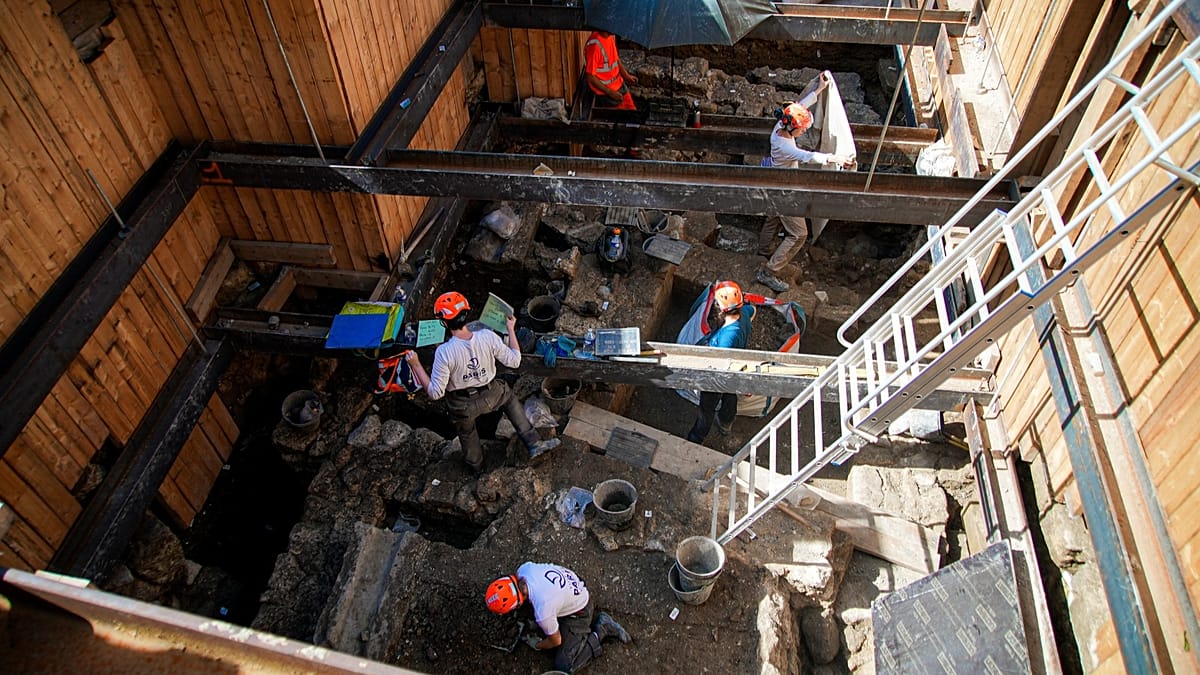
Archaeologists in Paris have uncovered a 2,000-year-old defensive wall beneath the Hôtel-Dieu hospital, a discovery that could rewrite the early history of the French capital. The 20-metre-long rampart, found just steps from Notre-Dame Cathedral, has been described by the French Culture Ministry as a “major breakthrough” in understanding the city’s Gallic origins.
The stone-and-wood structure is believed to be the remains of a stronghold dating to the Gallo-Roman period, when the settlement was known as Lutetia. Its location on the Île de la Cité—the historic heart of Paris—challenges the long-held theory that the main Gallic settlement was in Nanterre, a suburb to the west.
For decades, historians have debated where Lutetia actually stood. Excavations in Nanterre in the early 2000s uncovered significant Iron Age remains, leading many scholars to conclude that the Gallic oppidum was there. But the new find suggests that the island in the Seine may have been the true political and defensive centre, even before Julius Caesar’s legions conquered the area in 52 BC.
The wall was unearthed in July during routine excavations at the hospital, which is currently undergoing renovation. The Culture Ministry only made the discovery public last week, after initial analyses confirmed the structure’s age and significance.
What the wall tells us about Lutetia
According to the archaeologists involved, the rampart’s construction technique—a mix of stone and timber—is typical of Gallic fortifications from the late Iron Age. The presence of such a substantial defensive structure on the Île de la Cité implies that the island was not merely a small trading post, but a fortified settlement of considerable importance.
“This is a game-changer for our understanding of pre-Roman Paris,” said one researcher familiar with the excavation. “We always knew the island was occupied, but we didn’t expect to find a wall of this scale. It suggests that the Gauls chose this naturally defensible spot as their stronghold, not the open plains of Nanterre.”
The discovery also raises questions about the relationship between the two sites. It is possible that Nanterre was a larger civilian settlement, while the Île de la Cité served as the military and political centre. Alternatively, the island may have been the primary settlement all along, with Nanterre acting as a satellite or seasonal gathering place.
Further excavations are planned, and researchers hope to uncover more of the wall and associated artefacts, such as pottery, coins, and tools, which could provide clues about daily life in Lutetia and its trade links across Gaul and beyond.
The find comes at a time of renewed interest in France’s ancient heritage. Earlier this year, a massive papal mass in Paris drew hundreds of thousands of visitors, highlighting the city’s enduring role as a spiritual and cultural centre. The wall, however, offers a glimpse of a much older Paris—one that predates the Roman conquest and the later Christianisation of the city.
For locals and tourists alike, the discovery adds a new layer to the already rich history of the Île de la Cité. Visitors to Notre-Dame, which is still under reconstruction after the 2019 fire, may soon be able to see the ancient rampart if plans for a public display go ahead. The Culture Ministry has not yet confirmed whether the site will be open to visitors, but the archaeological significance is undeniable.
The find also resonates beyond Paris. It underscores the complexity of urban development in Europe, where modern cities often sit directly on top of ancient settlements. Similar discoveries have been made in other European capitals, from Rome to London, reminding us that the continent’s urban landscapes are layered with millennia of history.
As the excavation continues, the team hopes to date the wall more precisely and determine whether it was built before or after Caesar’s campaign. If it predates the Roman conquest, it would prove that the Gauls had already established a formidable stronghold on the island—one that the Romans later incorporated into their own city plan.
For now, the wall remains a silent witness to a pivotal moment in European history. Its discovery not only challenges old assumptions but also opens a new chapter in the story of Paris, a city that has always been at the crossroads of power, culture, and faith.