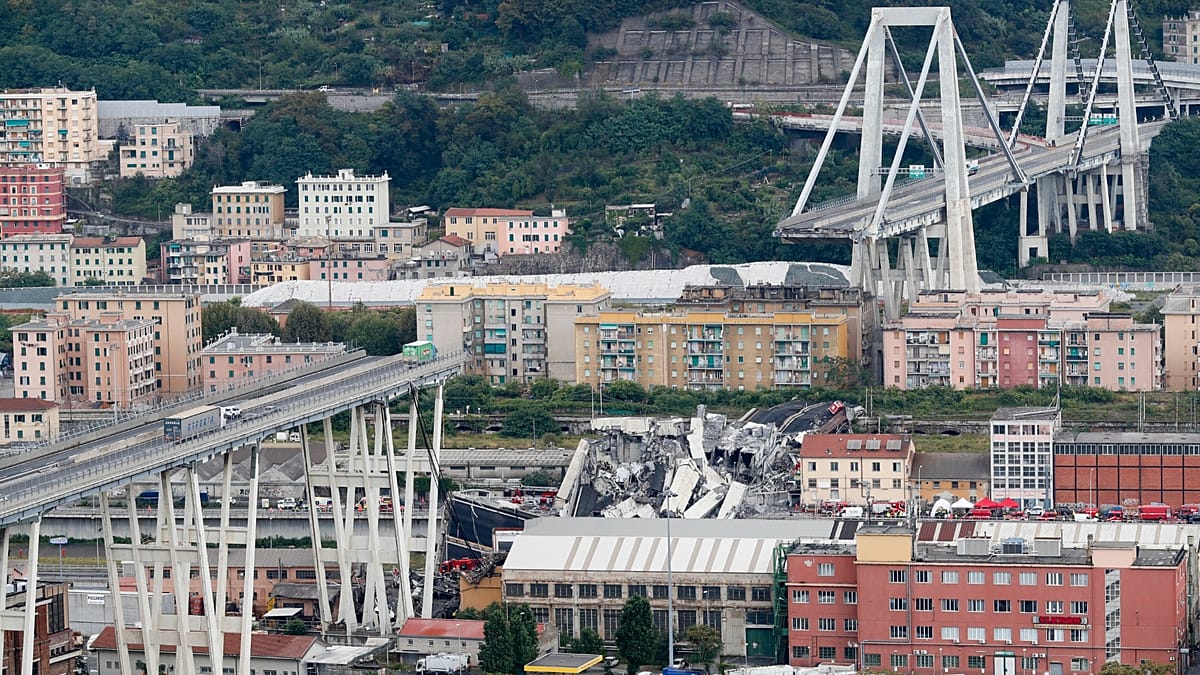
A Genoa court has handed down convictions against 32 individuals, including the former chief executive of Italy's largest motorway operator, for the catastrophic collapse of the Morandi Bridge in 2018. The disaster, which killed 43 people and displaced hundreds, remains one of the deadliest infrastructure failures in modern Italian history.
Giovanni Castellucci, who led Autostrade per l'Italia (Aspi) at the time, was sentenced to 12 years in prison. Prosecutors had sought 18 years and six months. Castellucci is already serving a separate six-year sentence for a fatal coach crash near Avellino. The court also sentenced Michele Donferri Mitelli, Aspi's former head of maintenance, to 11 years, and Antonino Galatà, former CEO of the engineering firm SPEA, to five years and six months.
A Verdict Met With Tears and Relief
Dozens of relatives packed the courtroom as Chief Judge Paolo Lepri read the verdicts. Many broke down in tears. Outside the courthouse, Egle Possetti, who leads a committee representing victims' families, said: "I lost my sister, her two children, my brother-in-law and even their little dog. That's where my determination comes from — to make sure they receive justice and that their deaths were not in vain."
Possetti stressed that accountability should extend beyond top executives. "Autostrade, SPEA and the Transport Ministry all had roles to play. I hope the state's responsibility also emerges clearly," she added.
Not all reactions were positive. Guido Carlo Alleva, Castellucci's lawyer, called the ruling "profoundly wrong." He argued that the court had sought a culprit rather than establishing responsibility. "Castellucci has been convicted despite having done nothing wrong. His only 'fault' is that he is innocent," Alleva said, confirming plans to appeal.
Eight Years of Legal Proceedings
The trial, which began on 7 July 2022, involved 282 witnesses, more than 24,000 pages of transcripts, and a 5,000-page closing brief from prosecutors. The Morandi Bridge, designed by engineer Riccardo Morandi and opened in 1967, collapsed on 14 August 2018 during a violent storm. Cars and lorries plunged to the ground, killing 43 and displacing 566 residents.
Prosecutors argued that Aspi's top management pursued a strategy of cutting maintenance costs to boost profits, while the Ministry of Infrastructure failed to provide adequate oversight. The defence countered that the collapse was caused by a hidden structural defect in the stay cables—a flaw that could not have been detected in advance and led to corrosion and the failure of pier 9.
Among those acquitted or whose charges expired under the statute of limitations were several lower-level officials. The current Aspi CEO, Arrigo Giana, who joined the company last year, issued a public apology in major Italian newspapers. "The actions and decisions of some people left indelible scars," Giana wrote. "Offering today the apology that was not made then is, for us, a moral imperative that goes beyond establishing legal responsibility."
The case has drawn attention to infrastructure safety across Europe. In Italy, similar concerns have emerged in other sectors, such as the attack on investigative journalist Sigfrido Ranucci, which highlighted broader issues of accountability. Meanwhile, European efforts to improve oversight, like NATO's drone challenge, show how technology can help bridge gaps in safety and monitoring.
For the families of the victims, Thursday's verdict marks a significant step, but many believe the full truth has yet to emerge. As Possetti put it: "I hope the state's responsibility also emerges clearly."