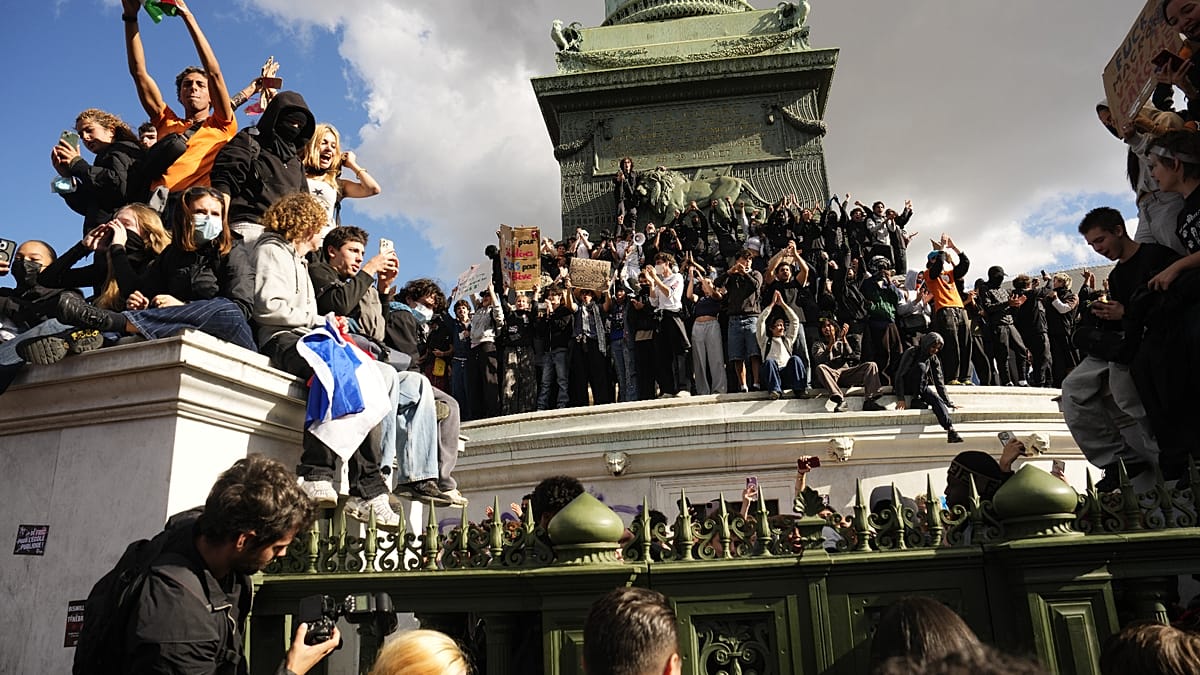
Three weeks into France's student protests, the question on many minds is whether the demonstrations will fade or evolve into a broader social movement. What began in mid-September in Paris's suburbs has rapidly spread nationwide, with school blockades and street marches becoming a familiar sight.
The symbolic weight of the protests was underscored on Thursday when students climbed the column at Place de la Bastille in Paris, an act that evoked the storming of the Bastille prison in 1789, a defining moment of the French Revolution. The square has long stood as a monument to popular defiance against oppression, and hard-left leader Jean-Luc Mélenchon of La France Insoumise declared on X that the Bastille had been "retaken."
Grievances and European echoes
The students' grievances are concrete: long school days, overcrowded classrooms, dilapidated buildings, and a chronic shortage of teachers. Their anger has resonated beyond France, with students in Belgium and Italy staging their own protests in recent days, suggesting a generational discontent with underfunded education systems across the continent.
Trade unions and student organisations have called for another day of action on 13 October. Meanwhile, a separate demonstration against the cost-of-living crisis and rising fuel prices, planned before the student movement erupted, is scheduled for 17 October. Some observers speculate that this could mark the return of the yellow vest movement, which shook France in 2018 over fuel taxes and evolved into a broader anti-government protest.
If the student protests converge with wider social unrest, France could face scenes reminiscent of May 1968, when student demonstrations escalated into a nationwide general strike involving millions of workers. That movement brought the country to a standstill, forced major wage negotiations, and prompted President Charles de Gaulle to dissolve the National Assembly and call snap elections. While his supporters won a majority, May 1968 left an enduring legacy by dismantling rigid post-war hierarchies and embedding a tradition of mass protest in French political culture.
Political and economic backdrop
France's minority government is currently struggling to secure parliamentary support for its 2027 budget, with opposition parties resisting proposed austerity measures. The public deficit is projected to reach 5.4% of GDP for 2026, one of the highest in the eurozone. The cost-of-living crisis, driven largely by high fuel and energy prices, has intensified public frustration, and with presidential elections less than six months away, the political landscape is highly fragmented.
According to an Ifop poll conducted in late September, Marine Le Pen of the far-right National Rally leads the first round with 35%, followed by Édouard Philippe (15%) and Jean-Luc Mélenchon (14%). A second round would likely see Le Pen face either Philippe or Mélenchon, depending on the projection.
Government response and union skepticism
Education Minister Édouard Geffray announced on Thursday that 3,000 substitute teachers would be deployed nationwide to address teacher shortages, a measure he said would cost "tens of millions of euros" for 2026. But unions have dismissed the plan as a short-term fix, warning that the substitutes may not match schools' needs in terms of specialisms or location. In cases where no replacement is available, classes may still go uncovered, while substitutes could be assigned support duties until a matching vacancy arises.
Jean-Rémi Girard, a teacher and president of the national union of schools and higher education (SNALC), told Euronews: "We need to look at the details, because we have to be careful with this figure that has been thrown around." He described a system in "crisis," noting that replacing teacher absences is increasingly difficult, French classrooms are among the most crowded in Europe, and classrooms are not properly equipped during heat waves.
The movement shows no sign of abating, and the upcoming demonstrations could test whether it remains a student-led protest or expands into a broader challenge to the government's policies. As the presidential race heats up, the streets of Paris and other cities may once again become a political battleground.



