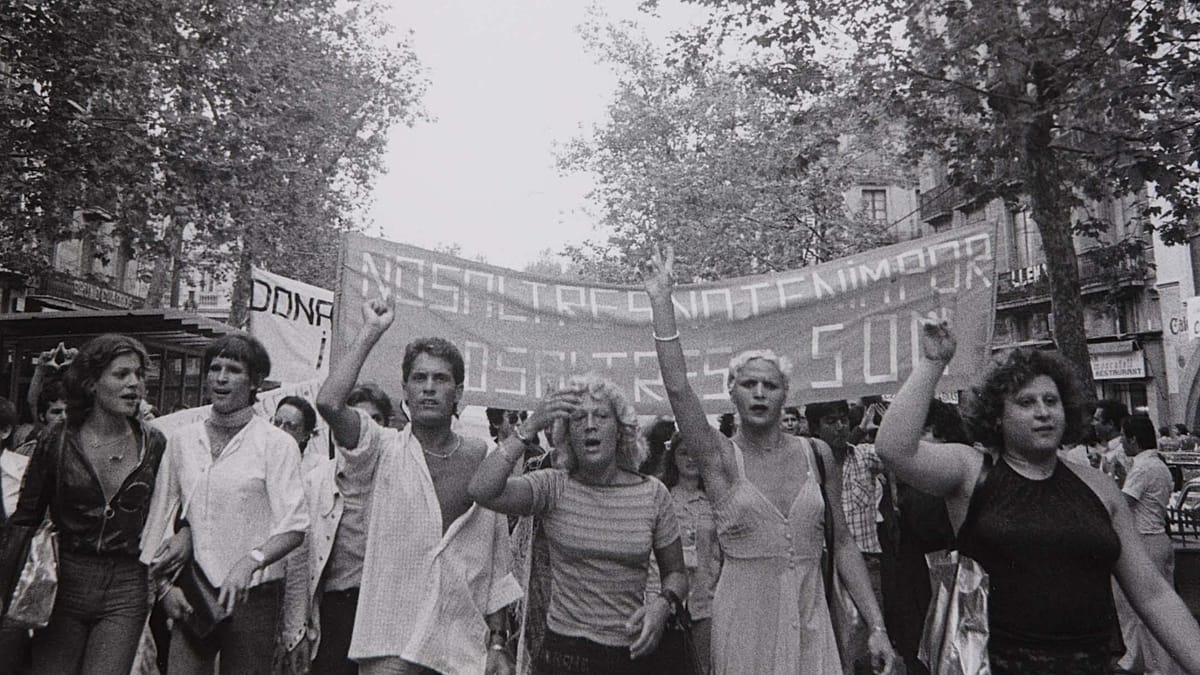
On a Sunday in late June 1977, more than 4,000 people gathered on Barcelona's Las Ramblas and began to walk. They moved slowly, aware that each step carried the weight of decades of silence. Under Franco's dictatorship, homosexuality had been criminalised; trans people were routinely interned in prisons or psychiatric institutions. That day, they stepped into the light for the first time, chanting in Catalan: "Nosaltres no tenim por, nosaltres som" — "We are not afraid. We are."
It was Spain's first LGBTIQ+ Pride march, and it took place just two weeks before the country's first democratic elections since the Civil War. The march was a fragile but defiant assertion of existence in a society still emerging from four decades of authoritarian rule.
From Repression to the Ramblas
Franco's regime had systematically persecuted sexual and gender minorities through the Ley de Vagos y Maleantes (1954) and later the Ley de Peligrosidad y Rehabilitación Social (1970). These laws allowed the state to detain anyone deemed a threat to "moral order" — a category that included homosexuals and trans people. Homosexuality was not merely taboo; it was a crime punishable by internment.
Franco died in November 1975. The Transition to democracy was cautious, but by 1977 the political climate had shifted enough for the LGBTIQ+ community to risk a public demonstration. Photographer Colita Isabel Steva captured the moment: trans women leading the march, arms raised, faces unapologetic. That image remains an icon of Spain's social history.
The march was a beginning, not an endpoint. In 1979, homosexuality was removed from the Ley de Peligrosidad y Rehabilitación Social, though social prejudice persisted. The HIV/AIDS epidemic of the 1980s hit Spain hard, compounding stigma but also strengthening community organisation and the demand for public health policies.
Milestones on the Road to Equality
In 1995, the Criminal Code ceased to treat homosexuality as an aggravating circumstance. Madrid hosted its first mass Pride in 1994, which would grow into one of the world's largest annual events. In 1998, the Madrid regional government recognised civil partnerships regardless of sex, a model gradually adopted by other autonomous communities.
The landmark came on 30 June 2005, when Spain became the third country globally — after the Netherlands and Belgium — to legalise same-sex marriage, including adoption rights. Law 13/2005, championed by Prime Minister José Luis Rodríguez Zapatero, placed Spain at the vanguard of LGBTIQ+ rights. The law faced legal challenges from the political right and the Catholic Church, but Spain's Constitutional Court upheld it in 2012. By then, thousands of same-sex couples had already married and built families under its protection.
In 2023, Spain enacted the so-called Trans Law, allowing anyone over 16 to change their legal sex through a simple administrative procedure, without medical diagnosis or surgery. It is one of Europe's most progressive pieces of legislation on gender identity.
Today's Landscape and Unfinished Business
European surveys consistently rank Spain among the continent's most tolerant countries. According to the Eurobarometer, over 80% of Spaniards believe homosexuality should be freely accepted in society — one of the highest rates in the EU. Madrid Pride now draws more than 1.5 million attendees each June.
Yet legal equality does not guarantee lived equality. Anti-LGBTIQ+ violence still occurs. Trans people face discrimination in employment and healthcare. Young LGBTIQ+ individuals remain vulnerable to bullying and family rejection. The work continues.
Every June, when people march in Barcelona, Madrid, Seville, Bilbao, and hundreds of towns across Spain, they celebrate how far the country has come — and remember where it all began: with 4,000 people on Las Ramblas, arms raised, declaring simply that they existed. "Nosaltres som."