In a rare direct appeal to some of the most powerful figures in global politics, United Nations Secretary-General António Guterres used the Shanghai Cooperation Organisation (SCO) summit in Bishkek to urge world leaders to end the wars that continue to destabilise Europe and the Middle East.
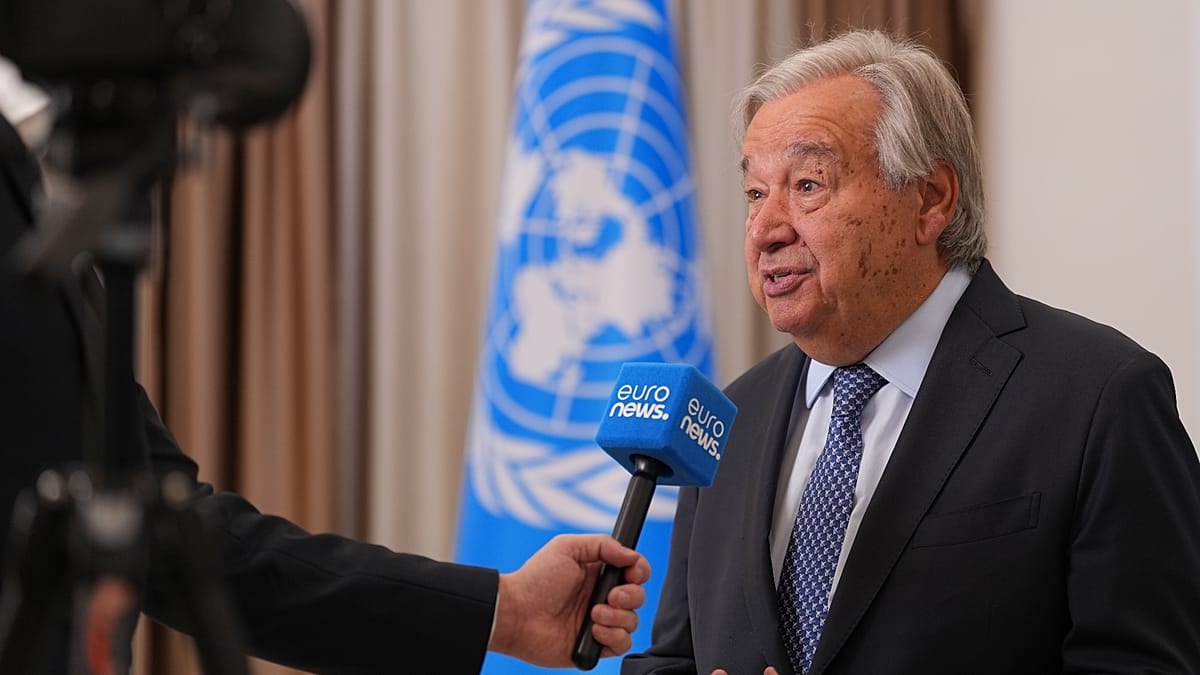
Speaking to Euronews on the margins of the one-day summit on Tuesday, Guterres said the gathering offered a unique opportunity to press his case face-to-face with those who hold the keys to peace.
“A very important message is to say, it is time to stop this madness. It is time for peace. And some of the key actors of these processes are here,” Guterres said.
The UN chief pointed to the two conflicts that dominate global attention: Russia’s war against Ukraine and the multifaceted crisis in the Middle East, from Gaza to the recent direct exchanges between Iran and the United States.
“What worries us more is the fact that we have conflicts that seem never-ending. It is true in relation to Russia and Ukraine. It is true in relation to the Middle East, both from Gaza to the Iran and United States confrontation,” he added.
A call to return to the negotiating table
On Iran, Guterres expressed concern that strikes have resumed after a period of relative calm. He called for maximum restraint and a return to talks that, he said, had been close to yielding results.
“Unfortunately, the strikes have started again. So I think maximum containment is necessary,” Guterres said. “We need to go back to where we were. There were negotiations that seemed to be successful. Let's restart them, and let's make sure that we create a situation of peace and stability in the area, and especially that the freedom of navigation is fully re-established, both in the Strait of Hormuz and in Bab el-Mandeb.”
The Strait of Hormuz and Bab el-Mandeb are critical maritime chokepoints for global oil and trade, and any disruption has direct consequences for European economies and energy security.
Guterres, who attends the SCO as a guest, said engaging with regional organisations has become central to how the UN operates in an increasingly multipolar world.
“We live more and more in a multipolar world. And obviously, for an organisation like the UN, it is extremely important to engage with regional organisations, be it the European Union, the African Union, or the Shanghai Cooperation Organisation,” he told Euronews.
The SCO’s growing weight
The SCO, which is marking its 25th anniversary in Bishkek, brings together ten member states: China, Russia, India, Pakistan, Iran, Belarus, Kazakhstan, Kyrgyzstan, Tajikistan and Uzbekistan. Together, they represent more than 40% of the world’s population.
Fifteen additional states participate as dialogue partners, including Turkey. In Bishkek, the summit drew a roster of heavyweight leaders: Chinese President Xi Jinping, Russian President Vladimir Putin, Indian Prime Minister Narendra Modi, Iranian President Masoud Pezeshkian, and Turkish President Recep Tayyip Erdoğan.
“Here you have a platform, in which practically half of humanity is represented. And the most dynamic economies in the world are today in Asia,” Guterres said. “So for me as secretary-general, it's very important to maintain a dialogue with the Shanghai Cooperation Organisation and to cooperate with them in the areas that are areas of common interest.”
The UN’s engagement with the SCO reflects a broader shift in global diplomacy, where regional blocs are increasingly influential. For European observers, the summit’s outcomes could have ripple effects on security and trade, particularly given the bloc’s ties to Moscow and Beijing.
While Guterres’ appeal was directed at all leaders, his words carry particular weight for European capitals, which have been grappling with the consequences of the war in Ukraine and the instability in the Middle East. The UN chief’s call for a return to diplomacy echoes the positions of many EU member states, though the path to peace remains fraught.
As the summit concluded, the question remains whether the leaders gathered in Bishkek will heed Guterres’ plea or continue on a course that has already exacted a heavy toll in human lives and global stability.