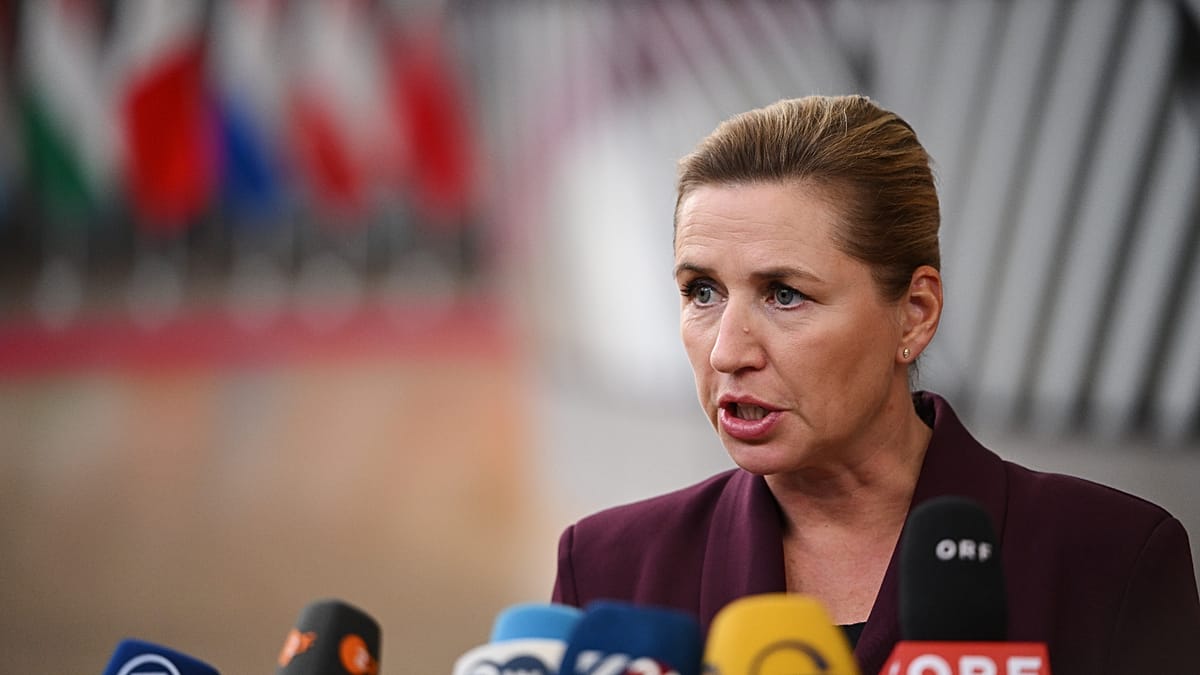
Danish Prime Minister Mette Frederiksen has asked the European Commission to examine Spain's plan to legalise the status of roughly 600,000 irregular migrants, a direct challenge to Madrid's migration policy that threatens to reopen a familiar fault line among EU leaders.
Speaking on the second day of the EU leaders' summit in Brussels, Frederiksen said she had requested a review of what happens when a member state pursues a course that runs against the prevailing direction of the bloc. "I have asked the European Commission to examine what happens when a country does almost the exact opposite of what the rest of us are doing," she told reporters.
The Danish leader's remarks put her at odds with Spanish Prime Minister Pedro Sánchez, despite both belonging to the same broad Socialist political family, which has traditionally favoured a more liberal approach to migration. Spain approved a decree in January last year to regularise around 500,000 undocumented migrants, a figure that has since grown to an estimated 600,000. Sánchez has defended the policy as a model "based on human rights, integration, coexistence and compatible with economic growth and social cohesion."
Frederiksen, however, sees it differently. "I believe this runs counter to the migration policy supported by a large majority in Europe today," she said, warning that the Spanish approach could act as a "pull factor" attracting more irregular arrivals to the continent.
Summit tensions and diplomatic manoeuvres
The issue is expected to dominate discussions over lunch on Friday, with EU leaders bracing for a heated debate. The latest draft of the summit conclusions makes no mention of Spain's plan, but Denmark reportedly tried to insert amendments that would have criticised it. A diplomat from another EU country told Euronews that Copenhagen had attempted to introduce "outlandish amendments" to the text.
This is not the first time Frederiksen and Sánchez have clashed over migration. At the previous EU summit in June, the two leaders reportedly exchanged heated words, with Italian Prime Minister Giorgia Meloni backing Frederiksen, according to a diplomat. Frederiksen and Meloni are now part of a group of countries pushing for tougher measures to curb irregular arrivals.
The Danish prime minister has long advocated a hardline stance on migration, a position that has won her support at home and among some EU partners. Her call for EU scrutiny of Spain's plan reflects a broader shift in European politics, where migration has become a defining issue for many governments.
Spain, for its part, argues that regularisation is a pragmatic response to a labour market that needs workers and a humanitarian obligation to protect vulnerable people. The Spanish government has pointed to the economic benefits of integrating undocumented migrants, who often work in sectors such as agriculture, construction, and care.
The dispute underscores the difficulty of forging a common EU migration policy. While the bloc has made progress on border management and asylum procedures, the question of how to handle the millions of people already living in Europe without legal status remains deeply divisive.
Frederiksen's request to the European Commission is unlikely to lead to immediate action, but it signals a determination to keep the issue on the agenda. The Commission, which is responsible for upholding EU law, could in theory assess whether Spain's decree complies with the bloc's rules, though such a review would be politically charged.
For now, the focus is on the summit, where leaders will try to find common ground on a range of issues, including migration, competitiveness, and support for Ukraine. The clash between Denmark and Spain is a reminder that even within the EU, national interests and ideological differences can run deep.