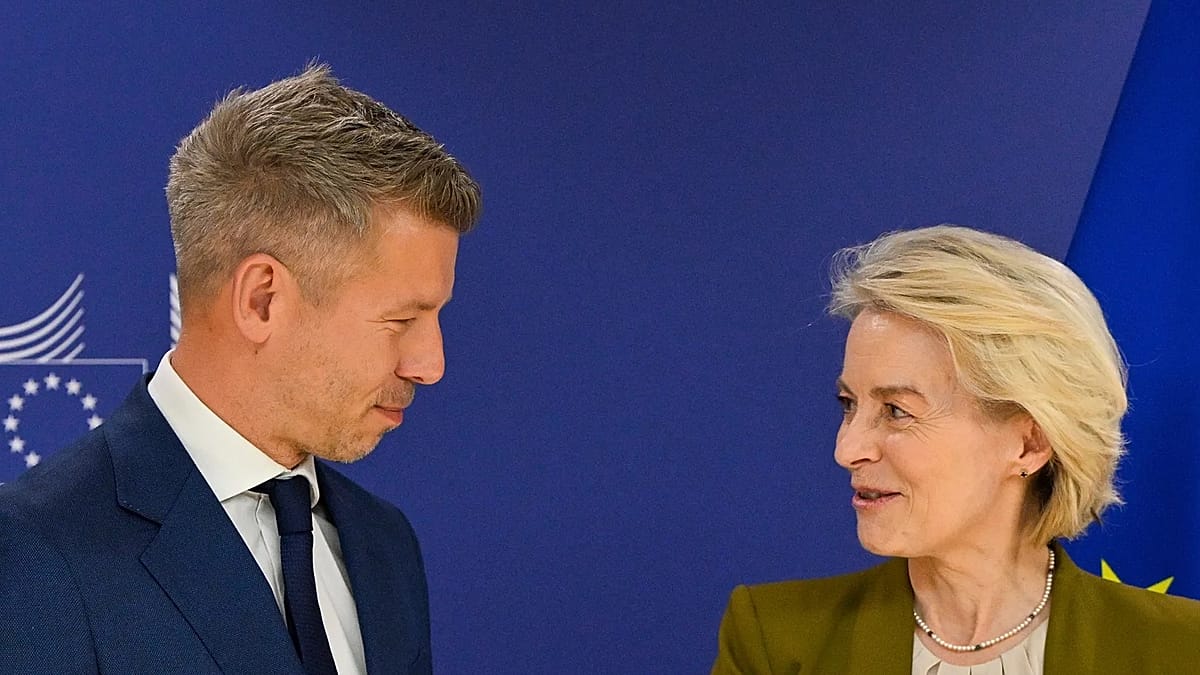
Budapest and Brussels remain at odds over pension and tax reforms, the key sticking points in technical negotiations to unlock €17 billion in EU funds for Hungary, according to European Commission officials. Prime Minister Péter Magyar, who took office after defeating Viktor Orbán, is pushing back against both reforms, arguing they would strain Hungary’s already fragile budget.
The funds, frozen under Orbán over rule-of-law and corruption concerns, include €10.4 billion from the post-COVID Recovery and Resilience Facility (RRF). Hungary faces losing that sum if it fails to meet the August 31 deadline. Commission officials have ruled out extending the deadline, though they have indicated some milestones could be simplified.
Magyar’s government acknowledges that implementing sweeping sectoral reforms before the end of August may be impossible. The issue is politically sensitive: pension reform was a central campaign pledge for Magyar’s Tisza party, which promised to raise minimum and below-average pensions. Hungary’s approved recovery plan includes measures to make the pension system more sustainable and equitable, alongside tax code simplification.
Magyar’s team has told Brussels that Hungary remains committed to pension reform in principle but that the country’s weak fiscal position and limited time make implementation before the deadline impractical. Last weekend, Magyar wrote to Commission President Ursula von der Leyen outlining his red lines; the letter’s contents have not been disclosed.
Taxation and the Budget Bind
On taxation, Magyar has publicly ruled out removing windfall taxes imposed on the energy and financial sectors. “The European Commission’s expectation, for example, is that the government should gradually phase out some of the special taxes. This is obviously also in the interest of the Hungarian economy, but in the current budgetary situation, the Hungarian government certainly cannot undertake this,” he said last week.
It remains unclear how the Commission will respond. Hungary could, in principle, substitute the contested reforms with alternative commitments. A large EU delegation of more than 20 experts arrived in Budapest on Monday for talks scheduled through Friday. A Commission official, speaking anonymously, said the delegation’s size reflects von der Leyen’s personal commitment and described the Hungarian team as “more than constructive.”
Discussions have focused on the RRF, with experts assessing what is realistically achievable before the end of August. Brussels has advised Hungarian negotiators to concentrate on securing the non-repayable grant portion of the funds — worth €6.5 billion — and to forgo the loan component, valued at €3.9 billion, arguing that additional borrowing would worsen Hungary’s fiscal position.
Political Agreement Expected Next Week
Magyar is expected to travel to Brussels next week to sign a political agreement with von der Leyen on the path toward releasing the frozen funds. No date has been confirmed. Commission sources indicate the agreement is primarily symbolic, as Hungary must still meet all criteria to access the funds. The process is complex: unlocking the RRF requires Hungary to meet 27 so-called “super milestones” and more than 368 individual milestones.
According to one official, the political agreement would see von der Leyen and Magyar declare publicly that a new chapter in EU-Hungary relations is beginning. They are expected to agree on a timeline for necessary steps and to reaffirm Hungary’s commitment to joining the European Public Prosecutor’s Office and the eurozone.
Erasmus+ Dispute Nears Resolution
One concrete outcome could be a joint statement on resolving Hungary’s long-running Erasmus+ dispute. In 2022, 21 Hungarian universities — restructured as public interest asset management foundations, known by their Hungarian acronym KEKVA — were suspended from EU funding over corruption concerns linked to their governance boards. The move significantly reduced opportunities for Hungarian students to participate in exchange programmes.
The issue has increasingly frustrated Brussels, as it disproportionately impacts young, pro-European Hungarians, many of whom supported efforts to unseat Orbán. A resolution would require Hungary to address governance concerns around the KEKVA foundations, though the Commission has indicated it is not demanding their abolition outright. Budapest has yet to decide how to proceed.
Another major sticking point is Hungary’s continued non-compliance with a prior European Court of Justice ruling on the treatment of asylum seekers, which has resulted in a €1 million-per-day fine.
As the August deadline approaches, the outcome of these negotiations will test whether Magyar can balance domestic political promises with the fiscal and institutional demands of Brussels. The broader implications for EU-Hungary relations — and for the credibility of the bloc’s conditionality mechanism — are significant.