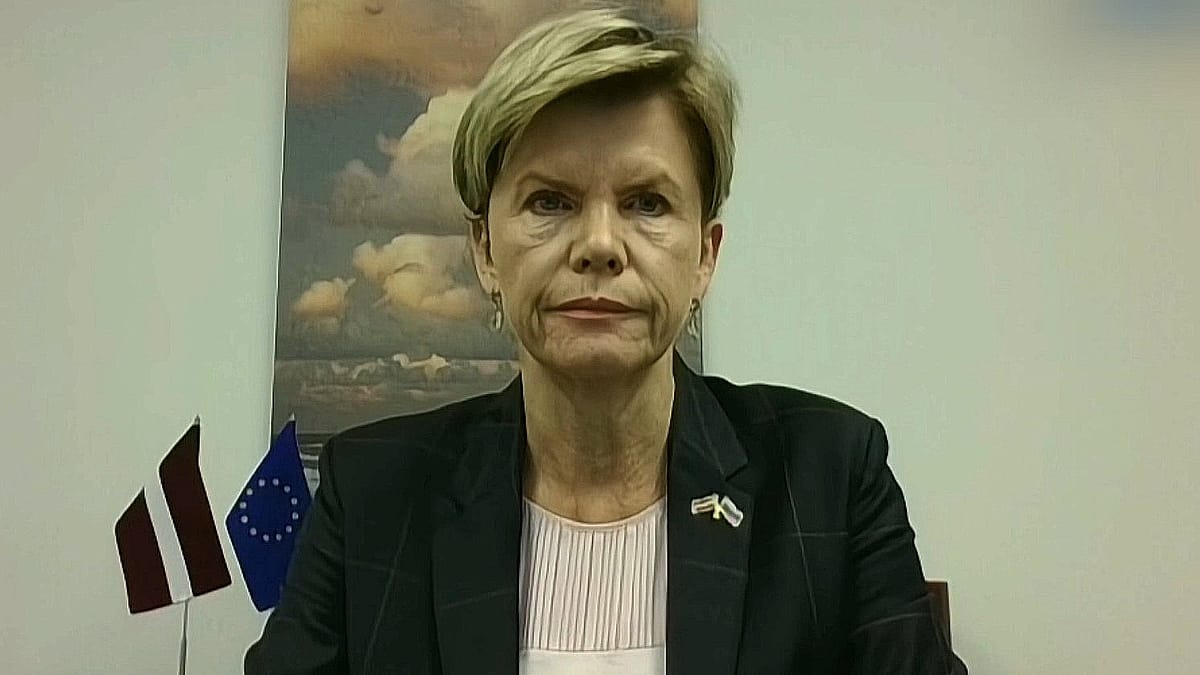
RIGA — NATO's eastern flank is well protected, but the alliance must remain vigilant as Russia tests its resolve through drones and airspace violations, Latvia's foreign minister Baiba Braže has said.
In an interview, Braže framed the alliance's purpose in corporate terms: "NATO's KPI is peace." The remark underscores a broader concern among Baltic officials that Moscow is probing the alliance's readiness without crossing the threshold of a direct military confrontation.
Latvia and its Baltic neighbours have been on heightened alert in recent weeks following a series of incidents involving Russian drones and suspected airspace intrusions. The episodes have revived memories of the Cold War era, when the Baltic region was a frontline of East-West tension.
Braže acknowledged that Russia is "enabling the military to challenge NATO," but she insisted that President Vladimir Putin "cannot militarily attack" Latvia or the other Baltic states because Russia lacks the necessary capabilities. Her assessment reflects a growing confidence in the region that NATO's forward presence, combined with national defence investments, has raised the cost of any potential aggression.
A test of resolve
The Latvian minister's comments come as NATO allies grapple with how to respond to a range of hybrid threats, from cyberattacks to disinformation and the weaponisation of migration. Earlier this year, Latvia sought broader border guard powers after armed migrant incursions, a move that highlighted the security challenges facing the region.
Braže's message is also aimed at domestic audiences in the Baltic states, where public anxiety about Russia's intentions remains high. Opinion polls consistently show that a majority of Latvians, Estonians and Lithuanians view Russia as a direct threat, and support for NATO membership is overwhelming.
At the same time, the minister's confidence in NATO's deterrent posture is not shared by all observers. Some analysts argue that Russia's willingness to violate airspace and deploy drones near NATO borders is a deliberate strategy to test the alliance's response times and political cohesion.
"They are probing our weaknesses," said one European diplomat, speaking on condition of anonymity. "Every incident is a test of our procedures and our unity."
The Baltic states have also been vocal advocates for a stronger NATO presence in the region, pushing for more troops and equipment to be permanently stationed on their territory. While the alliance has increased its forward presence since 2014, the current force levels are still seen by many in the region as insufficient to deter a determined adversary.
Braže's comments also reflect a broader debate within NATO about how to measure success. For many allies, the absence of conflict is the ultimate goal, but others argue that the alliance must be prepared to respond to a wider range of threats, including economic coercion and political interference.
The situation in the Baltic region is closely watched in Brussels, where EU leaders have repeatedly condemned Russian actions and pledged support for the eastern flank. The EU's recent push to strengthen border security and migration rules, including tougher return rules with longer detention and hubs, is partly a response to the challenges posed by Russia's hybrid tactics.
For Latvia, the immediate priority is to maintain public confidence in NATO's ability to protect the country. Braže's message is clear: the alliance is ready, and Russia knows it. But the minister also warns that complacency would be a mistake.
"We must continue to invest in our defence and in our resilience," she said. "Peace is not a given; it must be defended every day."



