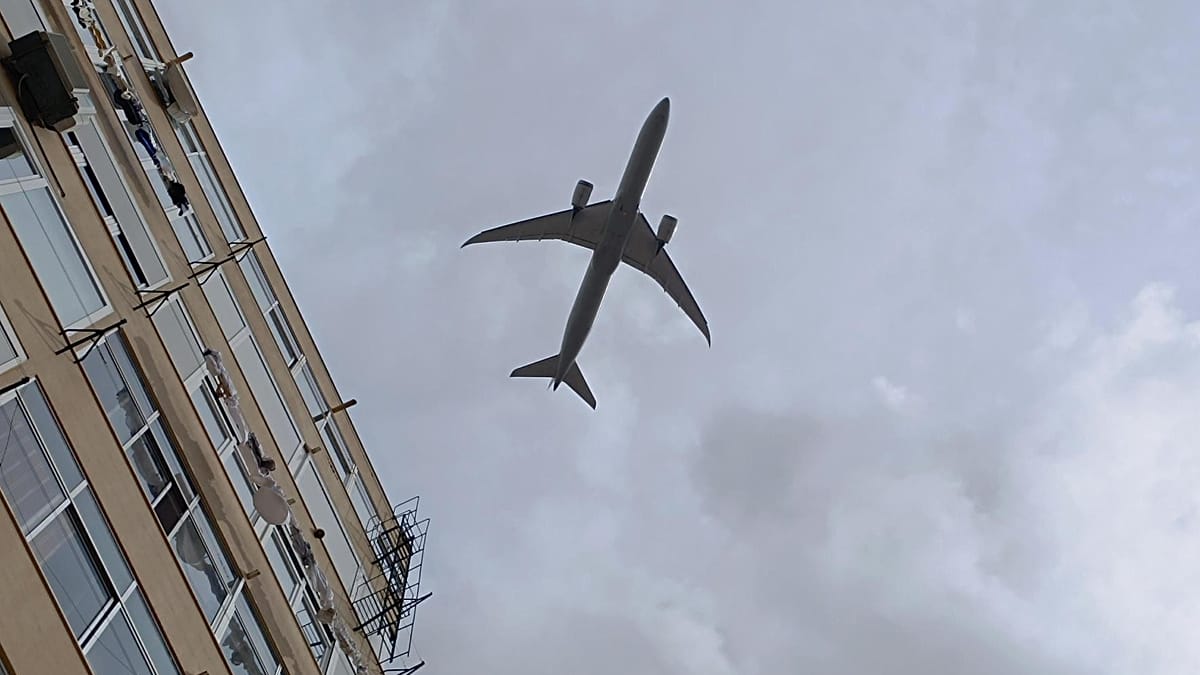
For decades, residents of Lisbon have lived with the constant roar of aircraft overhead. The city's Humberto Delgado Airport sits just a few kilometres from the historic centre, its runways hemmed in by apartment blocks. For many, the noise has become part of the urban fabric — a background hum that barely registers.
António Boaventura, a Lisbon resident with a terrace offering a privileged view of the approach path, is one of those who has grown accustomed to the spectacle. "I've got used to it and, honestly, my grandparents had a house in Alvalade, so since I was a kid I've been watching the planes go by," he says. But his curiosity eventually turned into a project: Lisbon Finals, an online platform that tracks every flight crossing the skies over the Portuguese capital in real time.
From terrace to data hub
Boaventura, who has a background in business management and spent years living abroad, began building the system out of a mix of frustration and fascination. "I realised we could go much further, measuring the aircraft and recording not only the decibels but also the vibrations on the walls," he explains. The result is a fully automated station on his terrace that collects data on speed, altitude, noise, and vibration — and then shares it openly on the web.
The initial investment was modest: around €1,000 for the hardware, and about a month and a half to assemble the station. The programming took longer, and the project remains a work in progress. "I'm always working a bit to improve it and make adjustments based on the data, because we can always make new correlations," Boaventura says.
Since its first measurement on 3 May, the platform has logged more than 39,000 flights. The data is freely available to anyone — residents' associations, aviation enthusiasts, or simply curious citizens. "That is the goal: information that is available to everyone," he says. "The measurements are completely neutral and I think the figures speak for themselves."
Night-time noise under the spotlight
One of the most striking findings from the platform concerns night-time operations. At Humberto Delgado Airport, flights are restricted between midnight and 6am, with a weekly cap of 91 movements and a maximum of 26 per night. Yet the data shows that in July alone, there were 1,477 flights between 11pm and 6:59am. Of those, the platform classifies 397 as violations of the ANAC-regulated period, and at least 207 as "critical violations" — meaning noise levels exceeded 98.9 decibels.
Boaventura, who grew up in France, was surprised to see planes flying over Lisbon at night. "I was surprised to see planes flying at night over the skies of Lisbon," he says, noting that French airports have much stricter curfews.
Environmental groups have long warned about the impact of this noise. In April, the association ZERO assessed the 2024-2029 Noise Action Plan for Humberto Delgado Airport, a document prepared by ANA – Aeroportos de Portugal to comply with EU directives. ZERO concluded that the plan "reveals a situation of profound ineffectiveness and inadequacy of the measures proposed."
According to the plan, nearly 64,000 people in the airport's vicinity are exposed to night-time noise levels above 55 dB(A) — a figure ZERO says is 35 times higher than at Madrid Airport. The association is calling for a revised plan and for the acceleration of the airport concession renegotiation to allow the eventual closure of Humberto Delgado, a move that would only happen once the new airport at Alcochete is operational.
For now, Boaventura's platform offers a transparent, real-time picture of the situation. It also includes flight numbers, airline details, and even photos shared via an associated Instagram page. The system is designed to be expandable, with the possibility of integrating additional measuring stations across the city.
"The system is open so that several measuring stations can be integrated," he says. "I like aviation. The aim of the platform is precisely to remain neutral and give the data to people who need it and who want it."
As Lisbon debates its airport future, projects like this provide the hard numbers that can inform the discussion — and give residents a tool to hold authorities accountable.