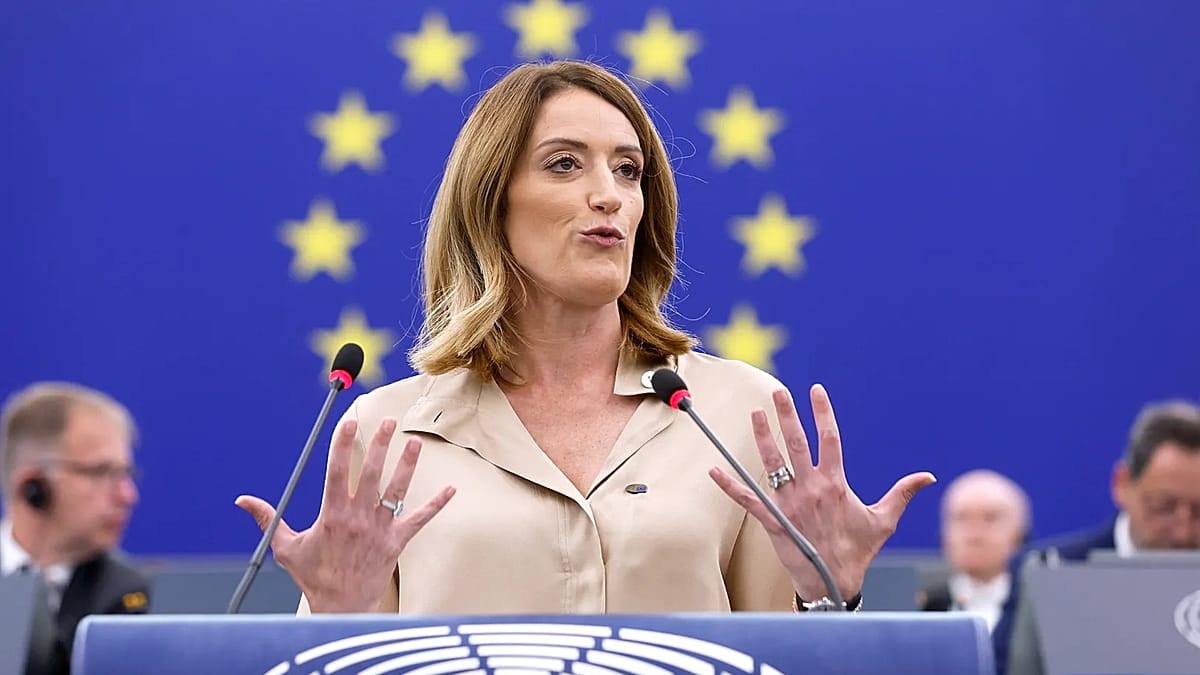
Support is building within the European People's Party (EPP) for Roberta Metsola to remain president of the European Parliament for a third term, a prospect that threatens to upend the informal power-sharing arrangement among the chamber's centrist forces and leave the Socialists and Democrats (S&D) scrambling.
The Maltese conservative, who has led the Parliament since January 2022, has not yet confirmed whether she will stand again when the presidency comes up for renewal in January 2026. But among MEPs she is widely seen as the clear frontrunner, with no obvious rival from the centre-left able to match her cross-party appeal.
That scenario is deeply worrying for the S&D group, which under the traditional rotation should claim the presidency for the second half of the legislative term. Yet the centre-left lacks the numbers and the political leverage to force its own candidate through, leaving it with a painful choice: accept Metsola's re-election or mount a symbolic challenge that would expose its weakness.
“We should not accept Metsola, and we will not do it. But it seems to me quite obvious it will be her again,” a Socialist MEP told Euronews, speaking on condition of anonymity and summarising the mood among fellow lawmakers.
An ambiguous deal
The Parliament's president is elected by secret ballot every two and a half years. In practice, the outcome is usually settled in advance through backroom negotiations among the political families. The EPP, S&D and the liberal Renew Europe have long sought to avoid a public showdown, tying the presidency to a broader package of top EU jobs that includes the heads of the Commission, the Council and the diplomatic service.
That package was last agreed in June 2024, when Ursula von der Leyen secured a second term as Commission president, António Costa took over the European Council, and Kaja Kallas became the EU's foreign policy chief. In Parliament, the same deal has traditionally split the five-year term into two halves, with the EPP and S&D alternating in the president's chair.
Several MEPs have confirmed the existence of that agreement to Euronews, but its precise wording leaves room for interpretation. “It says that the groups aim for a balanced distribution of the Parliament's top positions,” one MEP from another group explained, referring to vice-presidencies and committee chairs as well as the presidency itself.
That ambiguity gives the EPP, which is by far the largest political force in the chamber, room to argue that a third Metsola mandate is compatible with the spirit of the deal. The party could also seek allies to its left or right to secure the necessary majority, though it would prefer to avoid relying on far-right votes.
The Socialists' dilemma
The election rules favour the EPP. In the first three rounds, a candidate needs an absolute majority of votes cast. If no one reaches that threshold, a final run-off takes place between the top two candidates. With the EPP's numerical strength, and Metsola's popularity beyond her own group, stopping her would require a united opposition that the S&D cannot currently muster.
Socialist delegation heads discussed their strategy in one of their last meetings before the summer break. According to people in the room, some argued for striking a deal with the EPP: back Metsola in exchange for concessions such as additional committee chairs or a firmer commitment to legislate only with the centrist majority. Others preferred to put forward a candidate—German MEP Katarina Barley was mentioned—and force a vote, even if it meant certain defeat, to make the EPP explicitly break the informal agreement.
“Socialists should have moved earlier to call the EPP's bluff by tabling a candidate before the summer,” another MEP from a different political group told Euronews. “Now, if the EPP has the first move and it picks Metsola, they are cornered.”
The S&D's predicament is compounded by its own internal divisions. Some of its larger national delegations, particularly those from southern Europe, have traditionally been pragmatic about power-sharing, while others, especially from northern countries, are more inclined to challenge the status quo. Finding a unified position will be difficult.
A president for all seasons
Metsola herself remains silent, though her team insists that any candidate must first be nominated by their political group. She was re-elected in July 2024 with a broad cross-party majority, and if she wins again she would become the first person in history to serve three full terms as Parliament president.
Her appeal lies in her ability to cultivate relationships beyond the conservative camp. “She knows how to keep colleagues on her side,” a senior lawmaker not belonging to the EPP told Euronews. Another MEP added: “I do not see any better choice. She has also built a public image that is very appreciated.”
That image has been shaped by her international profile, particularly on Ukraine and Iran. She was the first European leader to travel to Kyiv in April 2022, less than two months after Russia's full-scale invasion—a visit that caught even Brussels officials by surprise. It was largely symbolic, but it set a precedent for subsequent high-level trips and cemented her reputation as a president willing to take risks.
For the Socialists, the coming months will be a test of whether they can turn their numerical disadvantage into a strategic advantage. The EPP may be in the driver's seat, but a forced vote could expose the fragility of the centrist consensus and open the door to more unpredictable alliances in the future. As one MEP put it, the Socialists' best hope may be to negotiate the best possible terms for a deal they cannot win—or to prepare for a fight that could reshape the Parliament's internal politics for years to come.