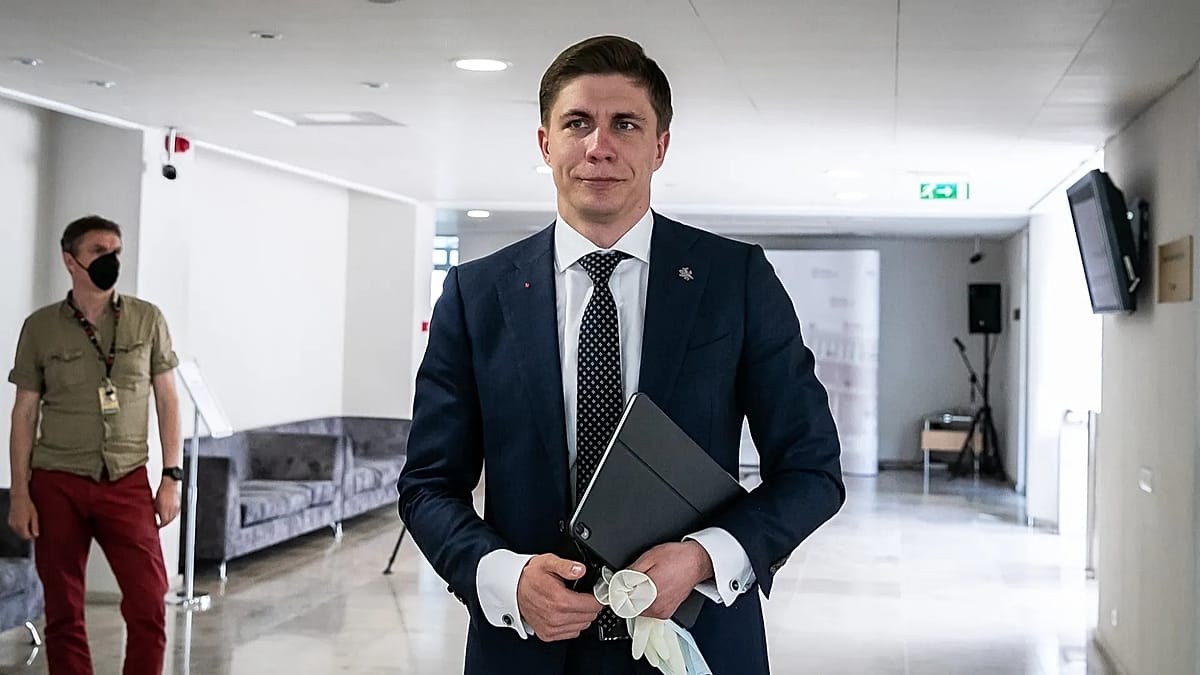
Lithuania's political landscape has shifted after a coalition reshuffle that expelled a populist junior partner, paving the way for Mindaugas Sinkevičius to become the country's next prime minister. President Gitanas Nausėda confirmed the appointment of Sinkevičius, the leader of the Social Democratic party and a former economy minister, on Tuesday.
Sinkevičius will succeed the current prime minister, Inga Ruginienė, who is also a Social Democrat. In a Facebook post, Sinkevičius stated: "I confirm my commitment to take responsibility for forming the new Government and to serve as Prime Minister, acting with full awareness of the expectations of the people."
Coalition Turmoil and the Ouster of Nemunas Dawn
The Social Democrats, who lead the governing coalition, announced in early June that they would remove the populist party Nemunas Dawn from the alliance. The decision came after criticism of its leader, Remigijus Žemaitaitis, for what the Social Democrats described as "inflammatory statements." Last year, a Vilnius court found Žemaitaitis guilty of inciting hatred against Jews and downplaying the Holocaust. Žemaitaitis has claimed he was not given clear reasons for his party's expulsion.
The new centre-left coalition will be led by the Social Democrats, with the Lithuanian Farmers, Greens and Christian Families Union group and the Democrats "For Lithuania" serving as minority partners. Together, they hold 75 seats in the 141-seat parliament. The three parties have pledged to maintain a socially oriented programme, with continued emphasis on defence spending—a critical issue for the ex-Soviet republic, which is now a NATO and EU member closely allied with Ukraine.
The coalition agreement is expected to be signed on 18 June, after which it must be approved by President Nausėda. This political reshuffle comes at a time when European security concerns remain high, particularly in the Baltic region, where defence budgets have been a priority. For context, Lithuania's defence spending aligns with broader European trends, as seen in other NATO members' commitments to increase military expenditure.
The new government's focus on social policies and defence reflects the priorities of a country that has been a staunch supporter of Ukraine since the Russian invasion. Lithuania has also been active in regional energy security discussions, including nuclear energy projects like the planned small modular reactors in Sweden, which could influence energy diversification in the Baltic states.