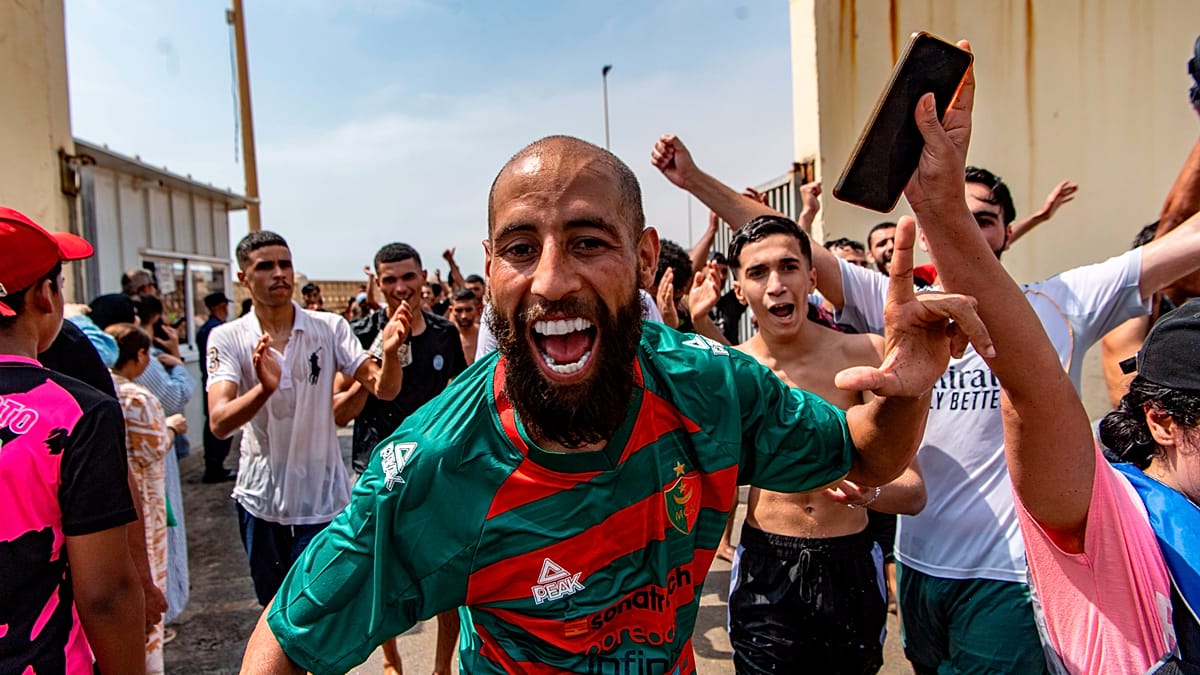
In a matter of hours on Thursday, thousands of migrants crossed from Morocco into Ceuta, a Spanish enclave of just 19 square kilometres. By Friday afternoon, Spain's interior ministry reported 34 deaths, and local officials said some 60,000 people had entered the city — the largest mass crossing since the 2021 crisis. Videos from Tarajal beach showed crowds running between the breakwater and roads, many of them young men, but also women with children and entire families, all risking drowning and exhaustion.
The events have reopened one of the most sensitive files in Moroccan-Spanish relations: sovereignty over Ceuta and Melilla, which Rabat has claimed since its independence in 1956. The crisis coincided with Morocco's Throne Day, a celebration of the monarchy's bond with the people. Morocco's popular news outlet Hespress wrote that the incursions "brought back to the fore the debate on the social and economic situation in the areas bordering the two enclaves," adding that the events "shine a light on the cities' connection with their Moroccan environment and the complexities of their historical and sovereignty dossier."
Morocco's sovereignty narrative
Hespress quoted Yahya Yahya, head of the national committee for reintegration of Ceuta and Melilla, who argued that the way Ceuta's authorities handled the crisis revealed "the fragility of the Spanish presence in the area." He called the request by Ceuta's local government to deploy the army a "political failure." The outlet also noted that Madrid quickly contacted Moroccan authorities to arrange the return of those who had entered, a process that Spain and Morocco agreed to expedite.
Algeria, Morocco's historic rival, used the moment to score political points. The news site Tout sur l'Algérie described the events as a "mass escape of Moroccans" and called Rabat "Europe's spoilt child," accusing it of using the "migration bomb" against Madrid. The site claimed that European leaders, including Italy's Giorgia Meloni, preferred to criticise Spain rather than confront Morocco — Meloni had called for suspending Spain's Schengen membership. It also alleged that Italian Foreign Minister Antonio Tajani was currying favour with the Moroccan royal palace, and that Moroccan security forces either could not control their borders or were deliberately allowing the crossings as a weapon.
Algeria's state television echoed the "mass escape" framing, attributing it to Morocco's difficult economic and social conditions. Yet Algeria itself faces a youth unemployment rate of around 31 percent, and its government has been criticised for suppressing the Hirak protest movement and prosecuting journalists and activists. The irony was not lost on social media users, who traded sarcastic barbs. One Algerian user dubbed Morocco "Switzerland" and insisted Ceuta is Spanish. A Moroccan user responded that among the migrants were Algerians fleeing their own grim reality. Another posted a video of people of other nationalities seeking better lives, noting that migration drivers extend beyond national belonging.
Tunisian social media took a darker, more humorous turn. Memes and jokes circulated about the absurdity of the situation, with some users pointing out that Tunisia's own economic crisis was being overshadowed. The region's broader instability — from Libya's fragmentation to the Sahel's security threats — remained a backdrop to the diplomatic sparring.
The Ceuta surge has also fuelled right-wing criticism in Europe. French far-right figures heaped accusations on Spain without mentioning Morocco, as Tout sur l'Algérie noted. In Spain, the crisis has become a political football, with the opposition accusing Prime Minister Pedro Sánchez of weakness. Sánchez has called the surge a violation of Spain's territorial integrity, but the right-wing backlash across Europe is growing.
The human cost is undeniable. At least 34 people died, many drowning in the rough waters off Tarajal beach. The Spanish government has deployed reinforcements to the border, and the EU has offered assistance. But the underlying issues — poverty, unemployment, and political repression in North Africa — remain unresolved. As one Moroccan user put it, the migrants are not just Moroccans or Algerians; they are people seeking a life their own countries cannot offer.
The crisis has also highlighted the EU's dependence on Morocco as a migration gatekeeper. Brussels has long paid Rabat to police its borders, but the events in Ceuta show how fragile that arrangement can be. The surge may be the EU's largest single irregular border crossing, and it raises questions about the bloc's ability to manage its external frontiers when a partner decides to look the other way.
For now, the immediate crisis has been contained, with thousands of migrants returned to Morocco. But the diplomatic fallout is far from over. Morocco's sovereignty claims, Algeria's accusations, and Tunisia's dark humour all point to a region where migration is not just a humanitarian issue but a weapon in a larger geopolitical struggle. As Europe debates its own response, the voices from North Africa remind us that the crisis is not just about borders — it is about the failure of governance on both sides of the Mediterranean.