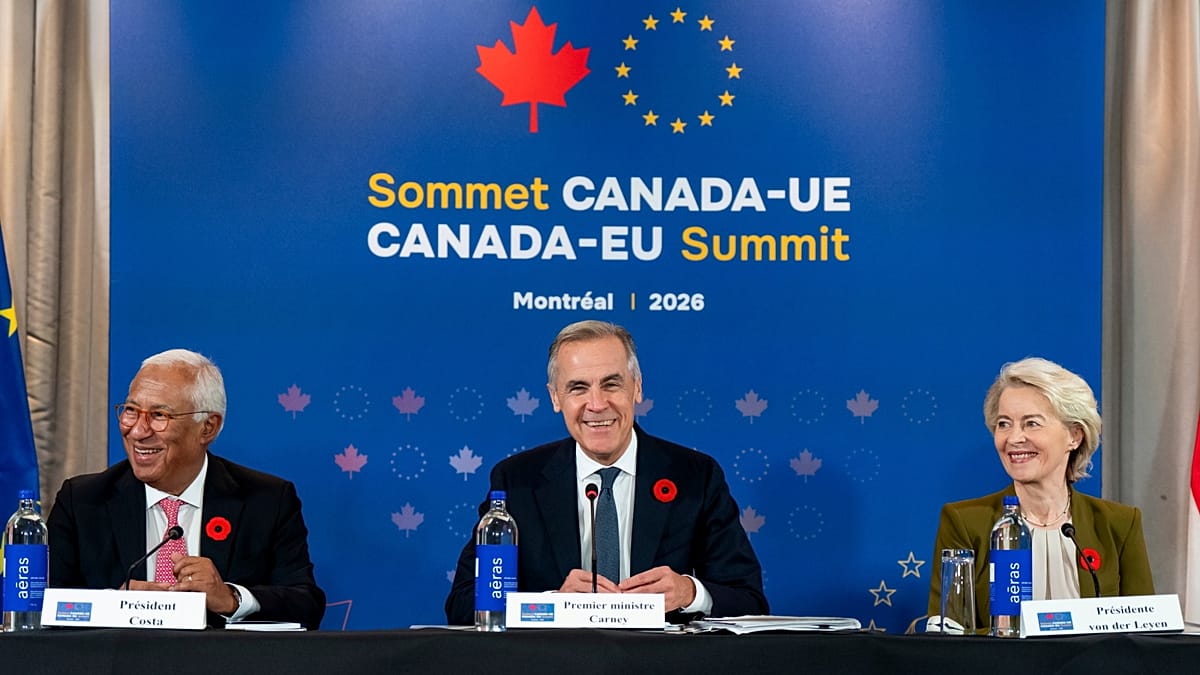
When Donald Trump returned to the White House, the European Union and Canada discovered just how much they had in common. On Friday, their leaders will meet in Montréal to elevate a relationship that has suddenly become central to both sides' strategic thinking.
Ursula von der Leyen, president of the European Commission, set the tone in a speech at the C.D. Howe Institute, where she invoked Canadian cultural icons from Emily Carr to Leonard Cohen. "Canada and the European Union are two complementary systems," she said, arguing that the two partners can achieve far more together than apart.
The choice of Montréal is deliberate. With its Baroque facades and European-style streets, the city embodies the cultural affinity that Brussels hopes to translate into political and economic substance. The EU's ambition is to make Canada its closest non-European ally, a position long held by the United States.
Trump's re-election has upended that calculus. His tariffs, threats to annex Canada, affinity for Moscow, and attacks on multilateral institutions have left Europeans wary of relying on Washington. For Canada, the shock is existential: its economy is deeply integrated with the US, and Trump's "51st state" rhetoric has shattered a bond that seemed unbreakable.
An alliance for the future
The summit is expected to produce a joint declaration committing to an "ever closer association," a phrase that stops short of the "associate membership" von der Leyen proposed in September. Germany objected to that label, which Berlin had earlier used in the context of Ukraine. Still, the Commission chief remains undaunted. "Our idea is simple: it is an association without accession," she said. "We can build a partnership that comes closer to membership than anything we have done before."
Canadian Prime Minister Mark Carney, who addressed the European Parliament in Strasbourg, has pitched an "alliance for the future" built on shared prosperity and security. He insists the partnership must be "strong enough so that no one can dictate our choices" and "open enough that others can join"—a pointed contrast to Trump's America First doctrine.
The agenda spans trade, investment, supply chains, artificial intelligence, climate, security, and the Arctic. Canada's vast reserves of critical raw materials and liquefied natural gas are of particular interest to the EU, which seeks to reduce its dependence on China for minerals and to diversify its energy sources. A potential LNG deal could help ease Europe's gas crunch.
Ukraine is another pressing issue. The war-torn country faces a €70 billion budget gap for 2027 as Russia escalates its aggression. The EU is prepared to cover roughly two-thirds of that shortfall—about €46 billion—and wants Canada and other allies to contribute the rest. The assistance must be new money, meaning Canada's participation in the EU's €90 billion loan package will not count.
The summit's high-level attendance underscores its significance. Von der Leyen is joined by European Council President António Costa, High Representative Kaja Kallas, and nine commissioners. Brussels is even considering a joint meeting of the entire College of Commissioners with the Canadian cabinet next year, a format last used with India—another partner that Trump's disruption has pushed closer to Europe.
"We're embarking on the start of a journey," a senior EU official said. "Let's be honest, this is a tiny bit of uncharted territory."
The deepening ties have not escaped scrutiny. Canada's environmental record, particularly its oil sands, has drawn criticism from climate advocates, and some question whether the EU is compromising its standards for strategic gain. Yet for now, the geopolitical imperative appears to outweigh such concerns.
As the summit gets underway, the shadow of Trump looms large. But for Brussels and Ottawa, the moment also represents an opportunity to redefine their place in a world where old certainties are fading.