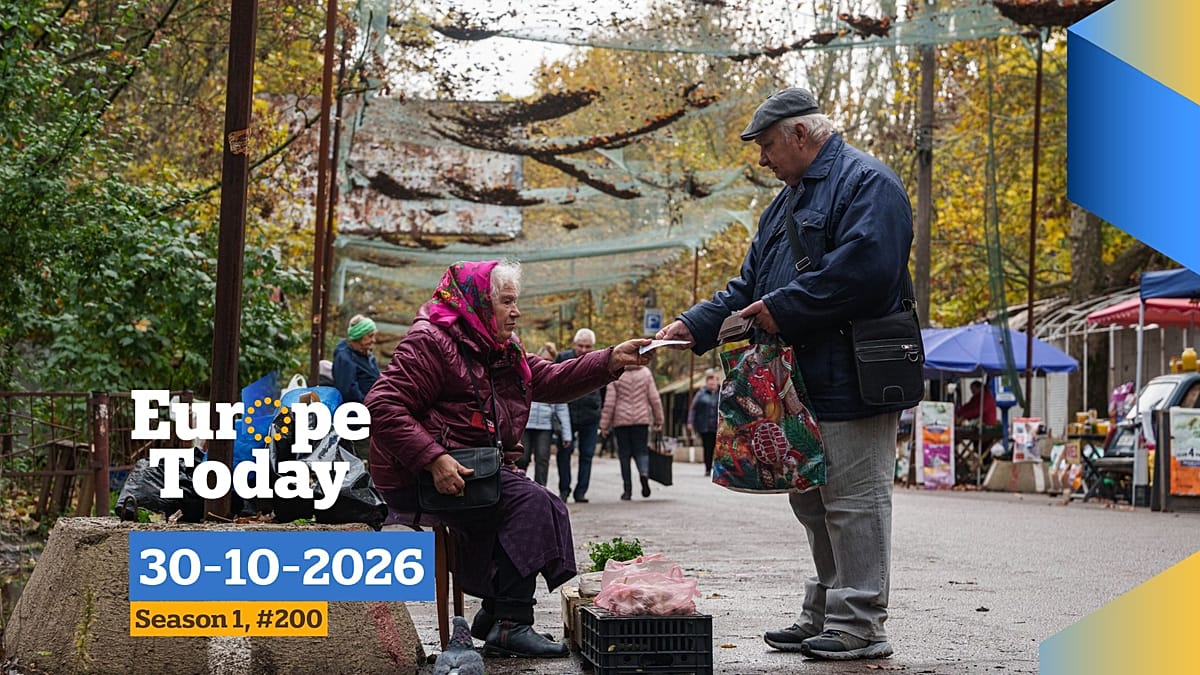
For the first time in months, the southern Ukrainian town of Oleshky—under Russian occupation since early in the war—is experiencing a fragile calm. A local truce, brokered through intermediaries, has held for four days, allowing humanitarian convoys to prepare to enter the town. The pause comes after a Russian drone strike on a railway station in Dnipro killed at least 14 civilians, underscoring the urgent need for safe corridors.
Sasha Vakulina, reporting for European Pulse, explains that the operation is expected to deliver food, medicine, and water to the remaining residents, many of whom are elderly and have survived months without basic supplies. She also spoke with former Ukrainian prime minister Arseniy Yatsenyuk, who stressed that the truce is a tactical exception, not a sign of broader de-escalation. "Russia uses such pauses to regroup," he warned, "but the international community must seize every chance to save lives."
Albania's heavy-handed response to protests
In Tirana, the government has approved fines of up to €5,500 for participants in unauthorized demonstrations, a move that has sparked outrage among opposition supporters and civil liberties groups. The legislation, rushed through parliament, also allows police to seize vehicles and equipment used in protests. Ardit Hoxha, our correspondent in the Albanian capital, reports that the public reaction is sharply divided: some welcome the measure as a deterrent against the chaos that has disrupted the city, while others see it as an attack on democratic freedoms.
The tension reached the parliament itself, where opposition MPs set off smoke flares during a session, forcing a temporary suspension. The incident, captured on live television, has intensified the political crisis. Prime Minister Edi Rama defends the fines as necessary to protect public order, but critics argue they are designed to silence dissent ahead of local elections. The European Union has called for restraint, urging all sides to resolve differences through dialogue.
Israel's political deadlock and the Palestinian question
Beyond Europe, the ongoing political paralysis in Israel—now in its fifth election cycle in four years—has profound implications for Palestinians. Dr. Mustafa Barghouti, Secretary-General of the Palestinian National Initiative, told European Pulse that the deadlock means no progress on a two-state solution. "Israel's internal crisis is not an opportunity; it is a danger," he said. "The occupation continues, settlements expand, and the international community watches without action."
Barghouti's assessment reflects a growing consensus among European diplomats that the two-state framework is on life support. With no credible peace process, the risk of further violence and unilateral annexation looms. European Union foreign policy chief Josep Borrell has repeatedly called for a renewed international initiative, but divisions among member states and the lack of a unified US approach have stalled any meaningful intervention.
Ebola resurges in Congo
In the Democratic Republic of Congo, a new Ebola outbreak has been declared in the northwestern city of Mbandaka, the same region hit by a major epidemic in 2020. At least five cases and three deaths have been confirmed, and health workers are racing to trace contacts and deploy vaccines. The World Health Organization has dispatched teams to support the national response, but the country is also battling measles and cholera, stretching its fragile health system.
European countries, which have funded Ebola research and response efforts in the past, are watching closely. The EU's Health Emergency Preparedness and Response Authority (HERA) has offered technical assistance and is coordinating with African health bodies to prevent a wider outbreak. The lessons from previous epidemics—rapid containment, community engagement, and cross-border cooperation—are being applied, but the challenge remains immense.
As Europe looks outward, it also faces its own security and economic concerns. The European Central Bank's recent decision to hold interest rates at 2.5% reflects cautious optimism about inflation, but the war in Ukraine continues to cast a long shadow. Meanwhile, Brussels has reopened €21.3bn in defence loans, hoping that Ukraine will benefit from the renewed funding. The bloc is also exploring innovative military technologies, such as armed ground robots tested by Germany and Ukraine, to support frontline operations.
The situation in Ukraine remains fluid, with NATO allies fearing that US political dynamics could delay Patriot missile deliveries until after the midterm elections. Such delays would leave Ukrainian cities more vulnerable to Russian aerial attacks, a concern that European leaders are pressing in their transatlantic discussions.
In Albania, the fines on protesters are part of a broader trend across the Western Balkans, where governments are increasingly using legal tools to manage public dissent. The European Union's enlargement agenda, which includes Albania as a candidate country, is being tested by these developments. Brussels has made clear that respect for fundamental rights is a core condition for membership, and the coming months will show whether Tirana heeds that message.
As the day unfolds, European Pulse will continue to monitor these stories, bringing you analysis and on-the-ground reporting from across the continent and beyond. Stay with us for updates on the Oleshky truce, the Albanian protests, and the global health alerts.