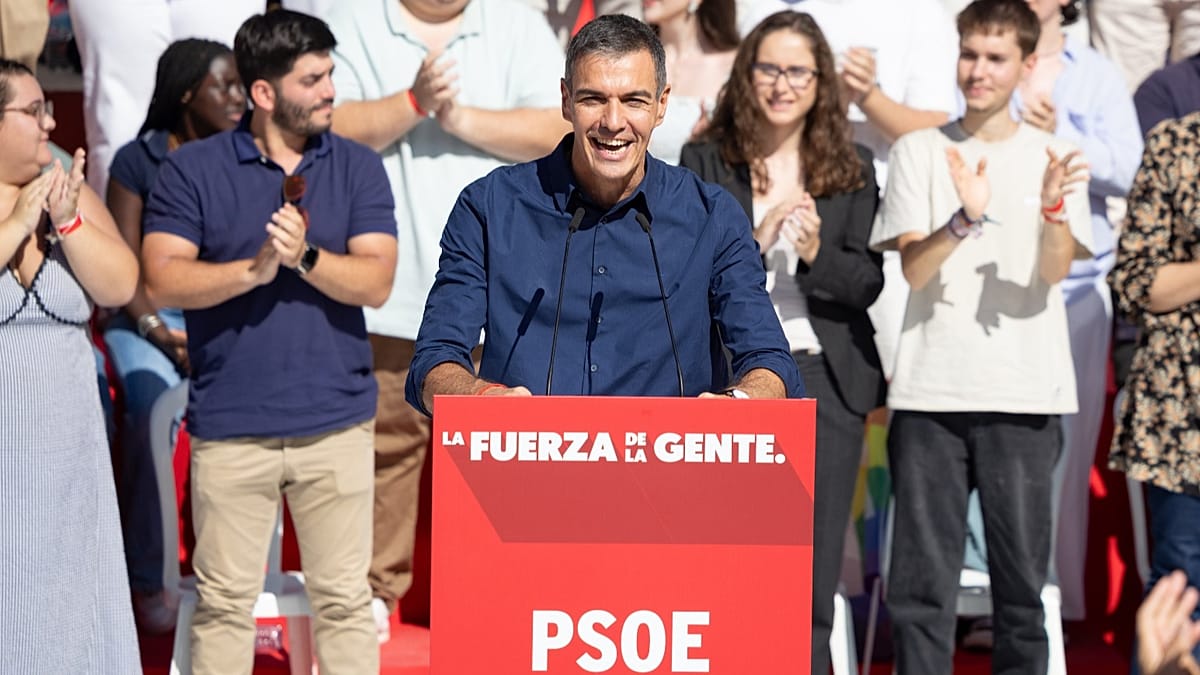
Spanish Prime Minister Pedro Sánchez officially launched his campaign for the 29 November general election in Dos Hermanas, a town in the province of Seville, before a crowd of more than 5,000 supporters. The choice of location was deliberate: Dos Hermanas is the largest municipality in Andalusia still governed by the Socialists after the last regional elections, and it holds symbolic weight for Sánchez's political career.
It was here in 2017 that Sánchez began his bid to reclaim the leadership of the Spanish Socialist Workers' Party (PSOE). His subsequent campaigns in 2019 and 2023 also started in this town, which Alejandro Moyano, the PSOE's deputy secretary for organisation in Andalusia, calls the party's "lucky city."
The Socialists face an uphill battle to regain voter confidence after a string of electoral defeats: the 2022 Andalusian regional election, the 2023 local and general elections, the 2024 European Parliament vote, and the Andalusian elections earlier this year. Sánchez's early call for a snap election is seen as an attempt to reset the political agenda.
Housing as a rallying cry
In his speech, Sánchez placed housing at the centre of his platform, a pressing issue across Spain. He paid tribute to Maricarmen Abascal, an 87-year-old woman who became a symbol of the country's housing protests after being evicted from her Madrid home. Sánchez said, "The social cause bears the name of an 87-year-old woman," and repeated her words: "What I have suffered, I don’t want anyone else to go through." Abascal's story has resonated widely, and her death has been mourned in Madrid as protests over housing costs continue to swell.
The prime minister framed the election as a choice between social progress and regression. He accused his political opponents of spending eight years spreading "messages of fear," and invoked the fable of 'The Boy Who Cried Wolf' to conclude: "They are the wolf." He described the dilemma facing the People's Party (PP) as "susto o muerte" (fright or death): when in opposition they hurl insults, and when in government they make cuts.
Opposition leader and PP president Alberto Núñez Feijóo also launched his pre-campaign in Madrid on Saturday. Feijóo struck a contrasting tone, pledging to give his all for those seeking change. He attacked Sánchez personally, asserting that he does not come "from the saunas or the sewers" but from a background in management: presenting and balancing budgets, maintaining public services, and stepping up in good times and bad.
The election, called for 29 November, will see a record number of Spanish voters abroad. Some 2,769,645 voters holding a Spanish passport and residing outside the country have been called to vote, an increase of more than 19% (444,335 more than in 2023). This surge is attributed to the so-called "Grandchildren's Law," which has expanded eligibility for citizenship to descendants of Spaniards.
As the campaign unfolds, housing affordability remains a top concern for many Spaniards, particularly in urban centres like Madrid and Barcelona. The government has introduced measures to cap rents and boost social housing, but critics argue they are insufficient. The coming weeks will test whether Sánchez can turn this issue into electoral momentum.



