The Greek government has enacted a new set of Civil Protection measures on the island of Santorini, following recommendations from scientific committees monitoring seismic and volcanic activity. The restrictions, which include the closure of a popular hiking trail and tighter controls at the island's main port, are intended to reduce risks from potential geological events and will remain in effect until at least 31 March 2027.
What the new measures entail
The most significant changes involve traffic management at Athinios Port, where authorities have implemented controls to prevent overcrowding during ferry arrivals and departures. A restricted zone has been established at the Old Port of Fira and surrounding upper areas, barring visitors from entry. The cable car and the Fira–Old Port path remain unaffected.
In the village of Ammoudi, a vehicle circulation ban has been introduced on the municipal road leading to the port from the Oia ring road junction, with exceptions only for a limited number of passenger vehicles managed by the Municipality of Thira. The hiking route from Ammoudi to Agios Nikolaos is now closed to the public.
Authorities have also published a map indicating areas where staying is prohibited due to heightened risk during earthquake tremors linked to the volcano. The measures may be adjusted or lifted immediately if strong natural phenomena—such as earthquakes or extreme weather—occur, subject to reassessment by the competent committees.
Impact on tourism and the local economy
Santorini attracts more than 3 million visitors annually, accounting for roughly 10% of Greece's total tourist arrivals. The new restrictions come as a fresh blow to an island still recovering from last year's seismic swarm, which saw a dramatic drop in tourist numbers. According to Yannis Paraschis, president of the Association of Greek Tourism Enterprises (SETE), airline seat bookings fell by 26% between January and June 2025 compared to the previous year.
Antonis Pagoni, president of the Santorini hoteliers association, told Euronews at the time that overall arrivals were down 20–25%, with some periods seeing a 25–30% decline. “It's a huge reduction in a destination like Santorini that attracts more than 3 million visitors. You know, it's 10% of Greek tourism. We are not sure if Greece can afford to lose that revenue,” he said.
Vassilis Kikilias, Greece's Minister of Maritime Affairs and Insular Policy, stated that “protecting both permanent residents and seasonal tourists is the government's primary focus as the summer season gets underway.”
Geological context and history
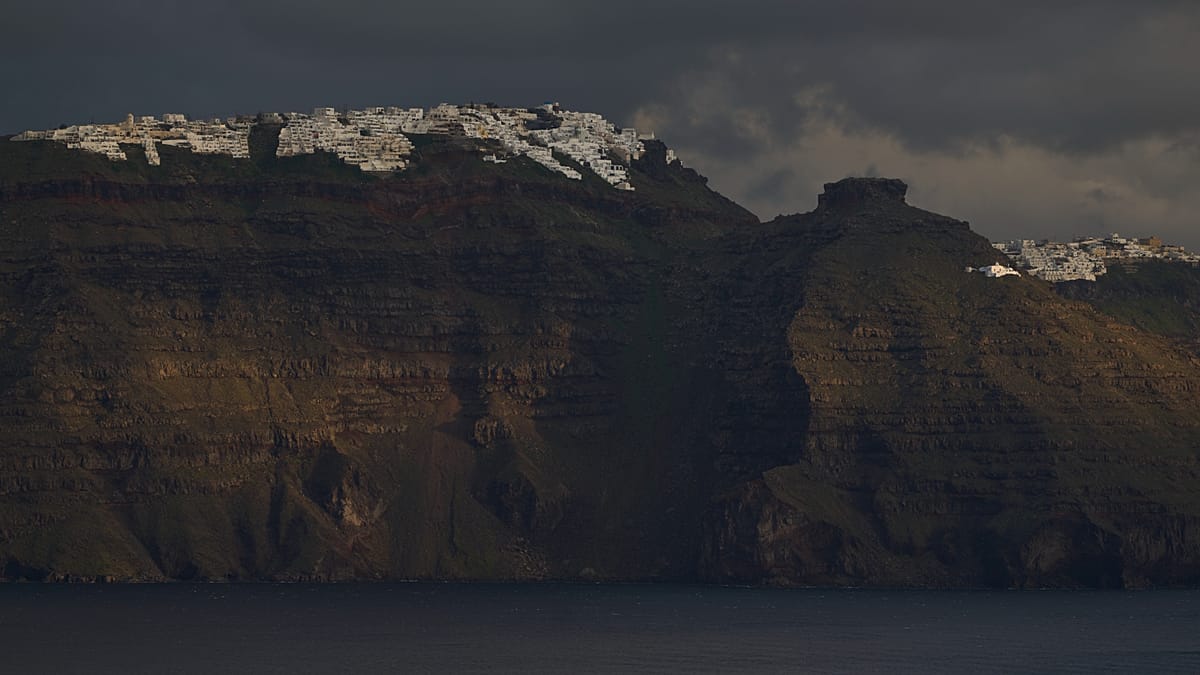
Santorini is an archipelago comprising the islands of Thira, Thirassia, Aspronissi, Palea Kameni, and Nea Kameni, located 128 nautical miles southeast of mainland Greece. Historically known as Strongili (“the round one”), the island was once a single ring-shaped landmass encircling a caldera. The Minoan volcanic eruption around 1600 BCE—one of the most powerful in recorded history—fragmented the island, and subsequent smaller eruptions created the current archipelago, including the volcanic islets of Nea Kameni and Palea Kameni.
The caldera is encircled by the cliffside villages of Oia, Fira, Firostefani, Imerovigli, and Akrotiri, all offering views over the Aegean Sea and the volcano. Visitors often take hiking tours to Nea Kameni to observe volcanic activity, but the new restrictions now limit access to certain trails and ports.
For travelers planning a trip to the region, it is worth noting that other European destinations are also adapting to changing circumstances. For instance, Travel + Leisure's 2026 'It List' highlights global luxury hotels, including European entries, offering alternative options for discerning tourists.
The situation on Santorini underscores the delicate balance between tourism and natural hazard management in the Mediterranean. As scientists continue to monitor the volcano, the island's authorities are preparing for a summer season that may see fewer visitors but a stronger emphasis on safety.