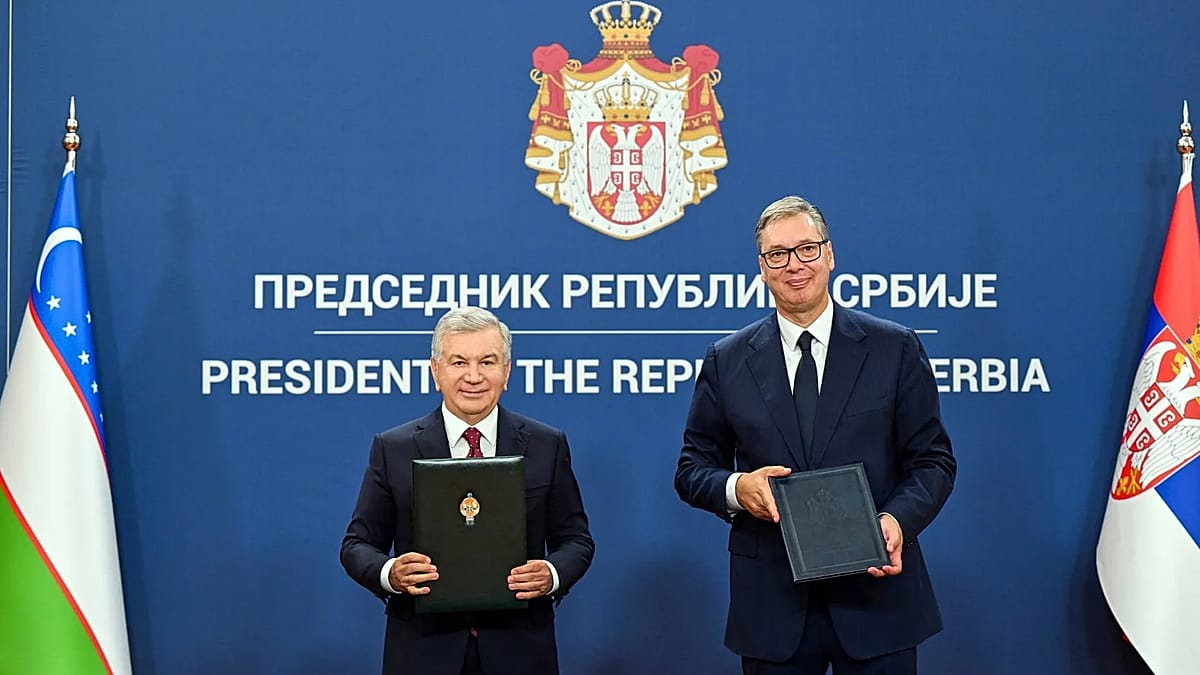
Belgrade and Tashkent are moving to put their economic relationship on a firmer footing. During Uzbek President Shavkat Mirziyoyev's first official visit to the Serbian capital, the two governments signed 20 agreements spanning transport, energy, digitalisation, and labour mobility. The talks also produced a commitment to begin preparations for a free trade agreement, a step that could significantly lower barriers for businesses in both countries.
A strategic partnership takes shape
The visit, which took place in Belgrade, was framed by both sides as a milestone in bilateral relations. Serbia's President Aleksandar Vučić and President Mirziyoyev discussed ways to expand trade, which remains modest compared with the potential both governments see. The signed accords are intended to create a legal framework for deeper cooperation in sectors where each country has strengths—Serbia in agriculture, machinery, and pharmaceuticals; Uzbekistan in energy, textiles, and increasingly in digital services.
One of the most significant outcomes was the agreement to start work on a free trade agreement. Such a deal would be the first of its kind between Serbia and Uzbekistan, and it could serve as a template for Belgrade's broader engagement with Central Asia. For Tashkent, it offers a gateway to the Western Balkans and, by extension, to the European Union market, given Serbia's stabilisation and association agreement with the bloc.
The two presidents also expressed support for the so-called Middle Corridor, the trade route that connects Central Asia to Europe via the Caspian Sea, the South Caucasus, and Turkey. Serbia's endorsement of the corridor is notable, as it signals a willingness to participate in infrastructure projects that could diversify supply chains between Asia and Europe. The corridor has gained renewed attention as companies seek alternatives to traditional routes through Russia.
Labour mobility was another key item on the agenda. With Serbia facing labour shortages in construction, IT, and healthcare, and Uzbekistan having a young, increasingly skilled workforce, the two governments agreed to facilitate the movement of workers. This could lead to more Uzbek nationals taking up employment in Serbia, a development that would require careful management of legal and social protections.
The agreements also cover digitalisation, an area where Uzbekistan has made notable strides in recent years. The country has invested heavily in e-government and IT infrastructure, and Serbian companies could find opportunities in providing software and technical expertise. Conversely, Uzbek tech firms might look to Serbia as a base for entering the European market, a prospect that aligns with the broader trend of Uzbekistan's local brands setting their sights on global markets.
The visit comes at a delicate time for Serbia's foreign policy. Belgrade has faced criticism from the EU over its handling of the funeral of Ratko Mladić, the convicted war criminal, which drew thousands of mourners despite international rebukes. The EU's condemnation of the event has strained relations, and Serbia's outreach to Uzbekistan can be seen as part of a broader effort to diversify its international partnerships. However, analysts caution that Belgrade must balance its ties with Moscow, Beijing, and Brussels, and that closer cooperation with Tashkent is unlikely to alter that fundamental calculus.
For Uzbekistan, the visit is part of a wider push to strengthen its presence in Europe. President Mirziyoyev has pursued an active foreign policy since coming to power in 2016, seeking to attract investment and expand trade beyond its traditional partners. Serbia, with its relatively low labour costs and its status as a candidate for EU membership, offers an attractive entry point. The two countries have also discussed cooperation in agriculture, with Serbia's experience in food processing and Uzbekistan's vast arable land presenting potential synergies.
The agreements signed in Belgrade are not just about trade in goods. They also include provisions for cooperation in education and culture, with plans for student exchanges and joint research projects. Such initiatives could help build long-term ties between the two societies, which have limited direct contact despite their shared history as parts of larger empires.
Observers note that the success of the free trade agreement will depend on the details, which are yet to be negotiated. Tariff reductions alone are unlikely to transform the relationship; non-tariff barriers, customs procedures, and transport logistics will also need to be addressed. The Middle Corridor, if developed effectively, could play a crucial role in reducing transit times and costs, making trade between Serbia and Uzbekistan more competitive.
The visit also had a symbolic dimension. Mirziyoyev's presence in Belgrade was a signal that Uzbekistan sees Serbia as a reliable partner in Europe, and that Belgrade is willing to look beyond the EU's immediate neighbourhood. Whether this translates into a substantial increase in trade remains to be seen, but the groundwork has been laid. As both countries move forward with the free trade negotiations, businesses on both sides will be watching closely.