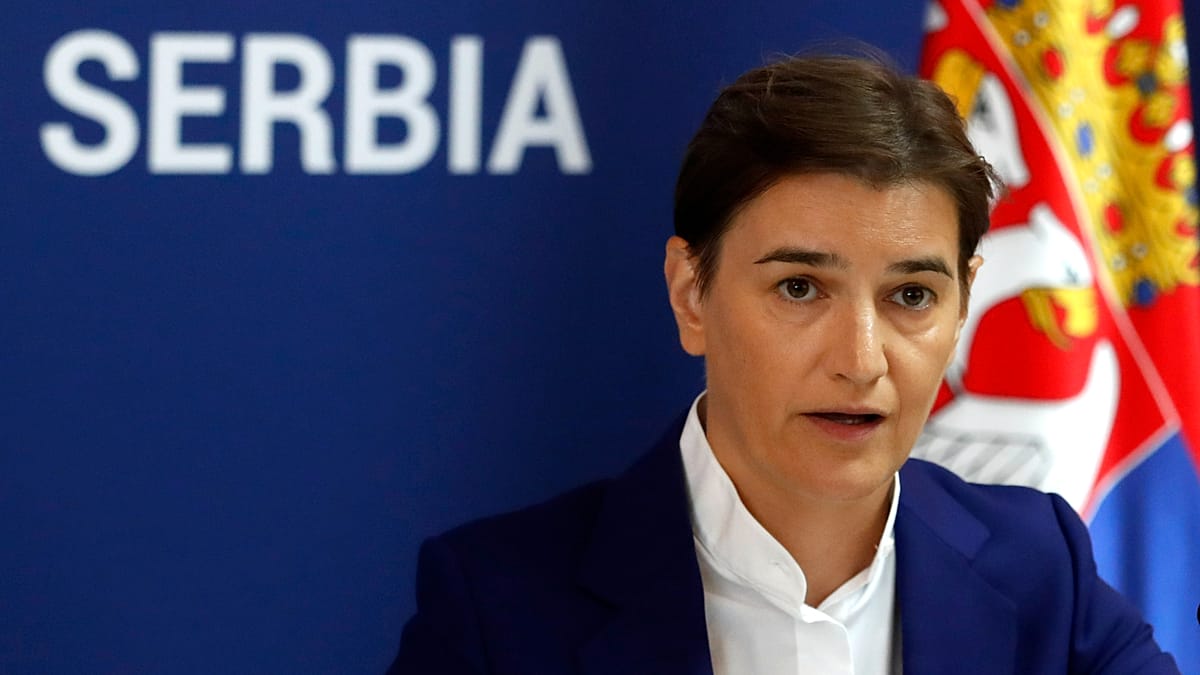
Speaking at a conference in Brussels focused on Serbia's preparations for EXPO 2027 and its EU accession talks, former Serbian Prime Minister Ana Brnabić pushed back against the persistent narrative that Belgrade is Moscow's proxy in the Balkans. In an interview with Euronews, Brnabić, now speaker of the National Assembly, insisted that Serbia is an autonomous, sovereign state with nearly a millennium of history—not a "little Russia."
Brnabić detailed the extent of Serbian support for Ukraine since the full-scale Russian invasion began in February 2022. She noted that Belgrade has allocated over €60 million in direct financial and humanitarian aid, though it has not provided military assistance. "We were the only country in the Western Balkans which, at the most difficult moments in the winter months, delivered electrical equipment to Ukraine—because we have similar power systems—as well as generators and spare parts," she said. "Even when these could not be bought on the market, we were sending them to Ukraine from our own reserves."
She emphasized that communication between Serbian President Aleksandar Vučić and Ukrainian President Volodymyr Zelenskyy is "exceptionally regular," and that she maintains close contact with Ruslan Stefanchuk, the speaker of Ukraine's Verkhovna Rada. This cooperation, Brnabić argued, is often overlooked by EU observers who cling to the stereotype of Serbia as Russia's Trojan horse.
Rejecting the 'Little Russians' Label
Brnabić acknowledged that Serbia has traditionally good relations with Russia—Moscow was one of the few countries to condemn NATO's 1999 air strikes on Belgrade—but stressed that the relationship is not frictionless. "The Russian Federation has often criticised Serbia for, for example, voting at the United Nations to condemn Russian aggression against Ukraine, and they have frequently criticised us for the aid and support we provide to Ukraine," she said. "Truth matters, and perhaps we should also be communicating it more effectively. Unfortunately, stereotypes are so strong and entrenched that even when we talk about what we are doing, people often ignore it or simply do not believe it."
She urged critics to ask Ukraine directly about the scale of Serbian support, echoing a suggestion made by Foreign Minister Marko Djurić. The remarks come amid heightened scrutiny of Serbia's foreign policy, especially as the EU continues to push for alignment with its sanctions against Russia. Serbia has not imposed sanctions on Moscow, a point of contention in Brussels.
EU Accession Double Standards
Brnabić also used the Brussels platform to voice frustration over what she described as unequal treatment in the EU accession process. She pointed to the requirement that Serbia implement all recommendations from the Office for Democratic Institutions and Human Rights (ODIHR) on electoral conditions before it can open Cluster 3 in accession talks—a cluster for which Belgrade has been technically ready since 2021. "If you look at other candidate countries which also have ODIHR recommendations on improving electoral conditions, they are not required to implement even one of them, and they have already opened all their clusters," she said. "This is a double standard that is hard for us to explain to our citizens and it undermines the credibility of the European Union."
Despite these grievances, Brnabić reaffirmed that Belgrade believes its place is in the EU. "That is why we are not giving up; we will keep fighting, we will work even harder, but it is important that we present not only plans but also results," she said. The conference also touched on Serbia's preparations for EXPO 2027, with 140 countries already signed up to participate. Deputy Prime Minister and Finance Minister Siniša Mali and Foreign Minister Marko Djurić were also in attendance.
The broader context of Serbia's EU path remains complex. The bloc has linked progress to normalisation of relations with Kosovo, a condition that has stalled talks for years. Meanwhile, Serbia's balancing act between Brussels, Moscow, and Beijing continues to draw scrutiny. As Brnabić's comments suggest, Belgrade is keen to assert its independence and push back against reductive narratives—even as it navigates the competing pressures of European integration and historical ties to Russia.