Madrid's annual National Day parade unfolded this year against an unusually charged political backdrop. With parliament dissolved and an early general election called for 29 November, the display of military hardware and ceremonial pageantry carried an extra layer of significance.
Prime Minister Pedro Sánchez announced the snap vote last week, setting the stage for a campaign that will dominate the coming weeks. The parade, held on 12 October, thus served as a reminder of the armed forces' role in Spanish public life just as the country enters a period of political uncertainty.
King Felipe VI and Queen Letizia presided over the ceremony, accompanied by their daughters, Princess Leonor and Infanta Sofía. The route began near the Royal Botanical Garden, wound along the Paseo del Prado and Paseo de Recoletos, and concluded at Plaza de Colón.
New hardware takes centre stage
This year's parade featured the debut of three Dragón 8x8 armoured vehicles from the Army – two infantry variants and one combat engineer version – assigned to the King Alfonso XIII 2nd Brigade of the Legion. The Dragón, a modular wheeled platform designed for modern battlefield roles, marks a significant upgrade in Spain's land capabilities.
Also making their first appearance were two Marine Corps vehicles equipped with the Aracne anti-drone system, alongside two Asturcón drones from the Military Emergency Unit (UME), which are used for surveillance and forest fire detection. The inclusion of these systems underscores the growing importance of counter-drone technology, a lesson reinforced by the war in Ukraine.
Notably absent were units from Ceuta, the Spanish enclave on Morocco's coast. The Defence Ministry kept those troops deployed locally following the illegal entry of thousands of migrants in July, a decision that highlights the ongoing migration pressures facing Spain's southern border.
Aerial spectacle and ceremonial favourites
The aerial display remains the most anticipated segment. It brought together 82 aircraft in 18 formations, led by two F/A-18s from Wing 15. A highlight was the flypast of an Airbus A330 MRTT refuelling aircraft escorted by fighter jets, symbolising Spain's commitment to NATO and its role in international security missions.
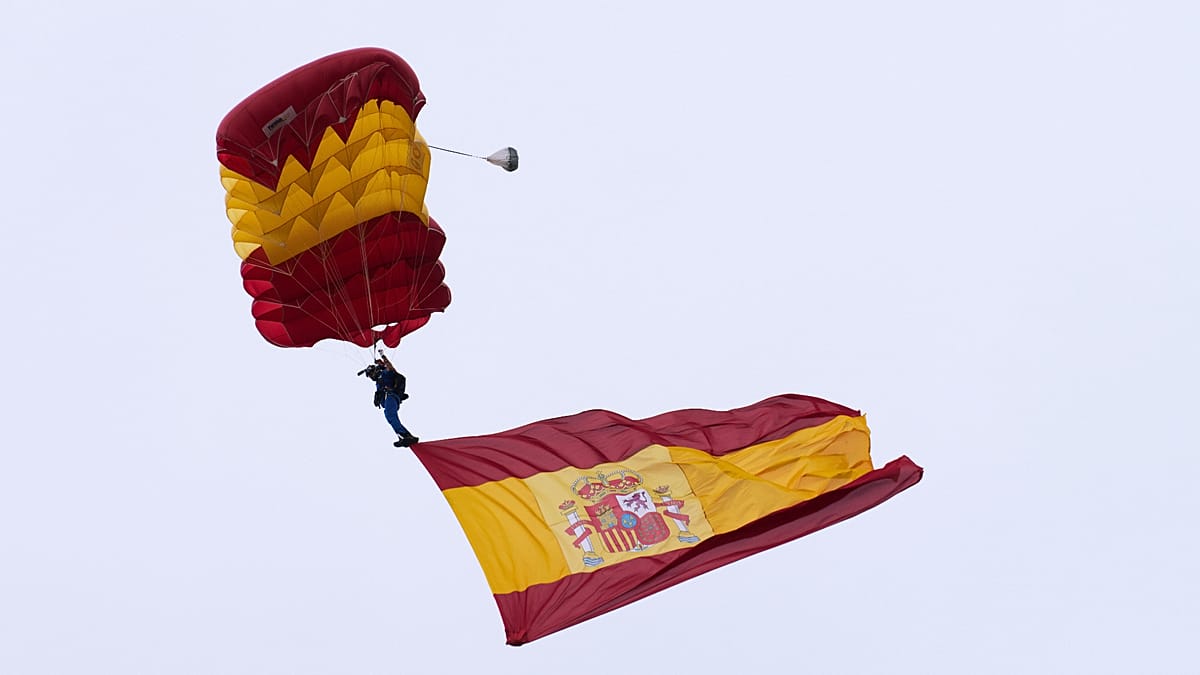
Before the aircraft roared overhead, paratroopers descended along the route. Staff Sergeant Pablo García Matanza served as the lead jumper, while Corporal First Class José Antonio Lago carried the national flag, a 24-square-metre emblem that drew applause from the crowds.
The Spanish Legion, known for its distinctive rapid march – around 160 steps per minute compared with the 90 of the Regulares – once again proved a crowd favourite. Their disciplined, fast-paced advance is a staple of the parade and a reminder of Spain's military traditions.
Beyond the spectacle, the parade took place against a backdrop of pressing domestic issues. Spain's housing crisis and migration pressures have fuelled public debate, and the upcoming election will likely focus on these challenges. The government's decision to hold the vote in late November, rather than waiting until the spring, adds a sense of urgency to the political calendar.
As Spain looks ahead to the election, the National Day parade offered a moment of national unity, even as the country prepares for a contentious campaign. The debut of the Dragón and other new systems signals a modernising military, while the absence of Ceuta units serves as a reminder of the security concerns that remain.



