What if the next luxury handbag came not from a cow or a synthetic polymer, but from a creature that walked the earth 68 million years ago? That is the question behind T-Rex Leather, a biomaterial project developed by Lab-Grown Leather Ltd in collaboration with the global marketing agency VML. The initiative recently won four Cannes Lions awards—Gold, Silver, and Bronze across PR, innovation, and B2B categories—at the International Festival of Creativity in Cannes.
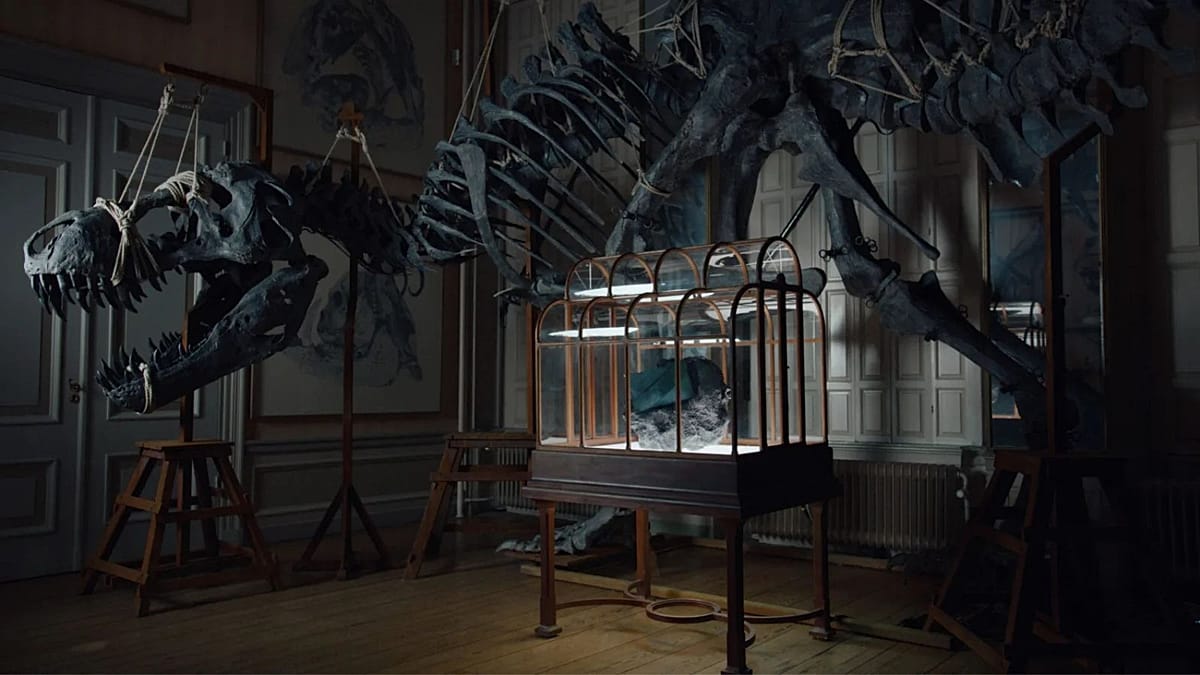
Dimitri Guerassimov, VML's Global Chief Creative Officer, explained to European Pulse how the project began. Scientists started with fragments of fossilised T-Rex collagen recovered from the first T-Rex discovered in Montana. Using artificial intelligence and computational biology, they reconstructed the missing genetic code. The result is a lab-grown leather that, for now, has been shaped into a single, one-of-a-kind luxury handbag unveiled in Amsterdam in April.
From Sub-Product to Precious Material
Guerassimov said the inspiration came from a persistent problem in the lab-grown leather industry: it is often compared to cow leather and perceived as a lesser alternative. “We decided to create a leather that is completely outside comparison, completely a thing of its own, enriched on one side with science and on the other with storytelling,” he said. “We actually created a precious leather versus a sub-product.”
The strategy appears to be working. Lab-Grown Leather Ltd has now pivoted entirely to T-Rex Leather, abandoning its other ventures. According to Guerassimov, the pipeline of potential clients and collaborations is so large that the company is scaling up production. “It's going to be a really, really big thing,” he added.
The project also highlights the role of AI in material science. Guerassimov described the process as “data-driven innovation.” AI was essential for guessing and reconstituting the missing parts of the collagen, a task that would have been impossible just a few years ago. “This idea predates this year by quite a lot. The AI was not yet there for us to do it properly,” he noted.
For the luxury sector, which is increasingly under pressure to address sustainability and ethical sourcing, T-Rex Leather offers a narrative that is both scientifically advanced and culturally resonant. It sidesteps the environmental costs of traditional animal farming while tapping into a fascination with prehistory. The handbag itself is a proof of concept, but Guerassimov envisions broader applications in fashion, accessories, and even interior design.
The project also raises questions about the future of AI in creative industries. Guerassimov, whose agency operates across Europe and beyond, sees AI as a tool rather than a threat. “Most of the tools we use, that are called AI, are really predictive algorithms that are very good with what's already existing,” he said. “It's actually a great tool, a great simplifier. A lot of things can be imagined and used in ways that amplify what we're doing.”
Yet he acknowledged the limits of current AI. “It absolutely doesn't replace what we as content creators are doing,” he said. “For now, humans are humans, and it's great to have humans imagining content for humans.”
The T-Rex Leather project arrives at a time when European regulators are grappling with the implications of AI and synthetic biology. The EU's AI Act, which draws mixed reactions from industry and lawmakers, sets a framework for such innovations. Meanwhile, the luxury market in Europe continues to expand, with brands like Dior Spa opening new outposts in Italy and other destinations. T-Rex Leather could become a case study in how biotechnology and storytelling can converge to create value—and perhaps reshape an industry.