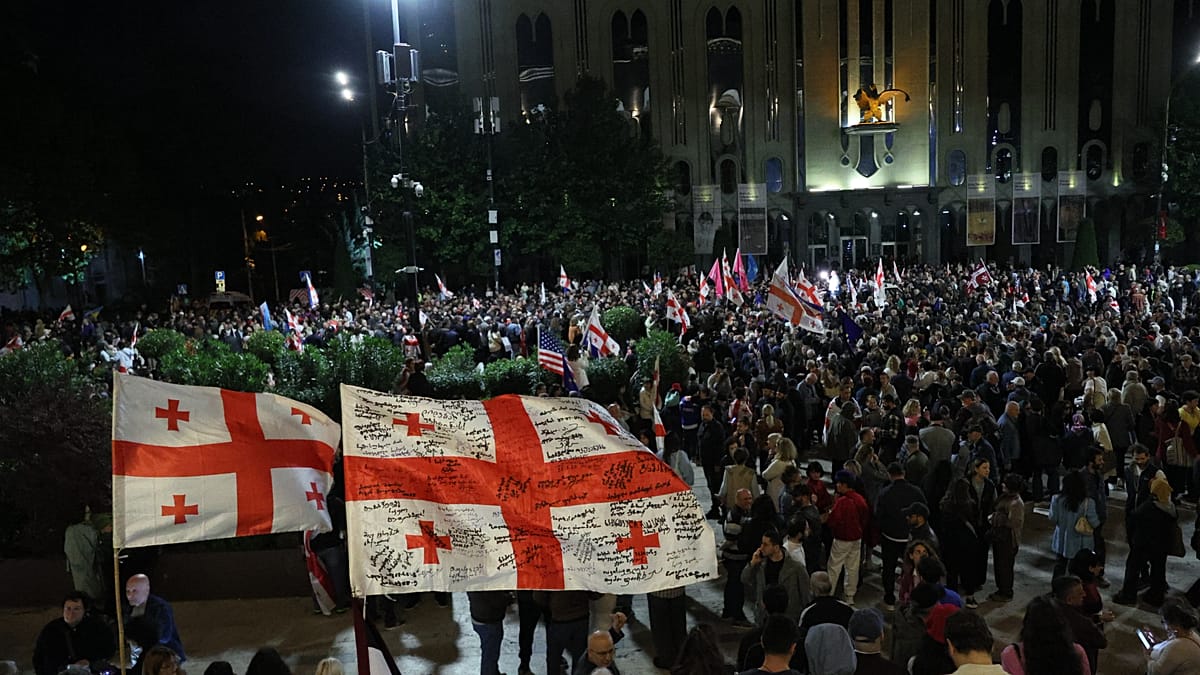
On Tuesday, Georgia marked the 35th anniversary of its independence from the Soviet Union with a military parade and oath-taking ceremony for new recruits. But as the official events concluded, thousands of citizens took to the streets of Tbilisi in a pro-European demonstration that underscored the country's deepening political fault lines.
Waving both Georgian and European Union flags, protesters marched through the capital's central avenues before gathering outside the parliament building, where a heavy police presence monitored the crowd. Many carried placards reading "We are Europe" and portraits of Mikheil Saakashvili, the imprisoned former president who championed Western integration during his tenure.
A Divided Society, a Contested Future
The rally, organized by a coalition of opposition parties that have recently sought to overcome internal divisions, comes at a moment of intense polarization in Georgia. Critics accuse the ruling Georgian Dream party of democratic backsliding and steering the country closer to Moscow—allegations the government denies.
"We've been out in the streets for more than 500 days, and we'll keep coming out for as long as it takes to defend Georgia's European future," one protester told reporters. Another demonstrator, 59-year-old chemist Irakli Nanadze, added: "People will win in the end. No authoritarian government can stand up to a united people—and we are united."
The protest echoes similar demonstrations across the continent, from Belgrade to Madrid, where citizens have taken to the streets to demand political accountability and alignment with European norms.
Government Defends Sovereignty, EU Path Stalled
Prime Minister Irakli Kobakhidze, in his Independence Day address, struck a defiant tone. He urged every patriotic Georgian to take pride in the fact that the country is "independent and sovereign as never before." He argued that this strength has allowed Georgia to "firmly defend its faith, preserve peace and remain on the continuous path of progress and development—a path that will inevitably lead us to the Promised Land, the achievement of all our national goals, to a united and flourishing Georgia."
Kobakhidze has previously insisted that Tbilisi's trajectory toward EU membership is "steady and irreversible," despite Brussels effectively freezing Georgia's accession process. The European Union has expressed concern over the government's recent legislative moves, including a controversial "foreign influence" law that critics say mirrors Russian legislation used to suppress dissent.
Joining the EU is enshrined in Georgia's constitution and enjoys the support of more than 80 percent of the population, according to opinion polls. Yet the gap between public aspiration and political reality has widened, fueling frustration among pro-European Georgians.
The situation in Georgia resonates with broader debates across the continent about the terms of EU enlargement. In Ukraine, for instance, officials have rejected proposals for associate membership, insisting on full accession rights—a position that has also drawn attention in Brussels and Berlin.
What Lies Ahead
As Georgia navigates its 35th year of independence, the tension between its European aspirations and the government's increasingly authoritarian tendencies remains unresolved. The opposition, for its part, is working to present a united front, but the path forward is uncertain. For the thousands who marched on Tuesday, the message was clear: Georgia's future lies in Europe, and they are prepared to keep fighting for it.