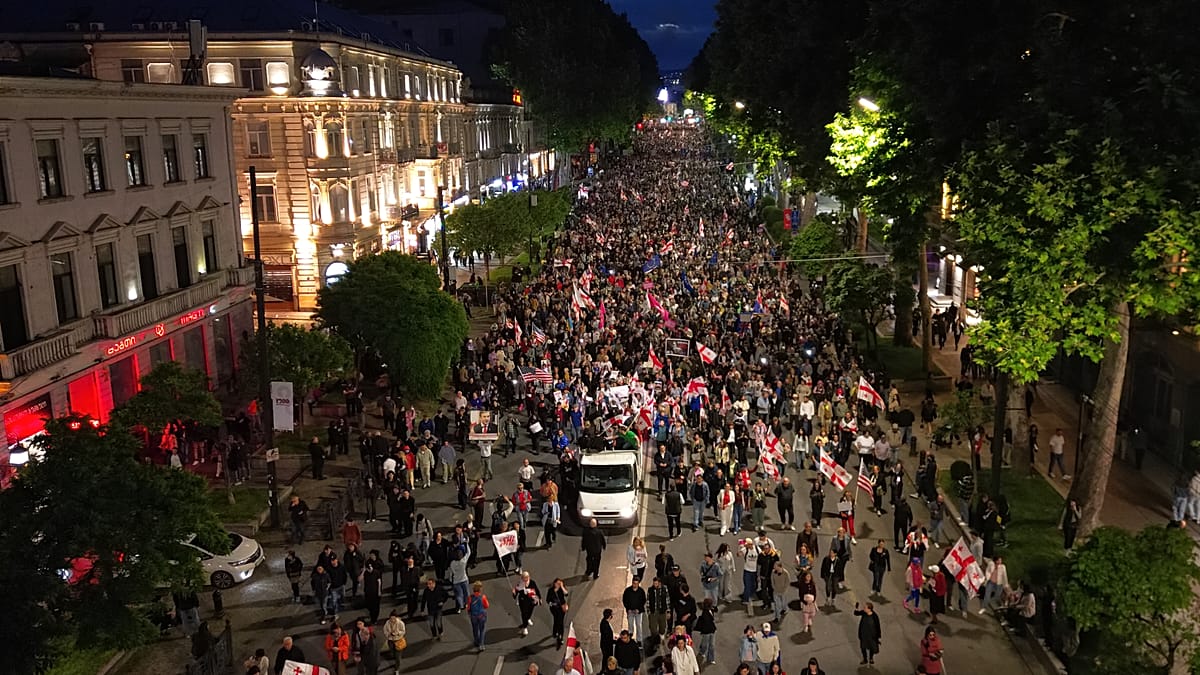
On Georgia's Independence Day, thousands of protesters filled the streets of Tbilisi, turning the national holiday into a powerful demonstration against the ruling Georgian Dream party. The demonstrators accuse the government of deliberately stalling the country's European Union accession process, eroding civil liberties, and steering Georgia back into Russia's orbit.
Pro-EU Sentiment Boils Over
The protests, which took place on 26 May, mark a significant escalation in public discontent. Georgia, a country in the South Caucasus, has long aspired to join the EU, but progress has been slow. The European Commission granted Georgia candidate status in December 2023, but the process has since stalled, with Brussels citing concerns over democratic backsliding and the rule of law.
Protesters waved Georgian and EU flags, chanting slogans demanding the government resign and calling for a clear commitment to European integration. Many held signs reading “Georgia chooses Europe” and “No to Russian influence.” The rally was largely peaceful, though tensions were high as police maintained a visible presence.
“We are here to remind the government that our future is in Europe, not in the past,” said Nino, a 34-year-old teacher from Tbilisi who attended the rally. “They are trying to silence us, but we will not be silenced.”
The protests come amid a broader pattern of similar demonstrations across Europe, where citizens are increasingly vocal about their governments' foreign policy directions. In recent weeks, Belgrade saw violent protests demanding early elections, while Madrid witnessed mass rallies calling for the prime minister's resignation.
Georgian Dream Under Fire
The Georgian Dream party, founded by billionaire Bidzina Ivanishvili, has been in power since 2012. Critics accuse it of increasingly authoritarian tendencies, including crackdowns on media freedom, civil society, and political opposition. The government has also been accused of maintaining close ties with Moscow, despite the 2008 Russo-Georgian War that left 20% of Georgian territory under Russian occupation.
In recent months, the EU has repeatedly warned Georgia about the need to implement reforms, particularly in the areas of judicial independence and anti-corruption. The European Parliament passed a resolution in April 2024 urging the Georgian government to halt what it called “democratic backsliding.”
“The government is playing a dangerous game,” said Tamar, a 28-year-old IT specialist who joined the protest. “They talk about Europe but act like Russia. We want real change, not empty promises.”
The protests also reflect a broader geopolitical struggle in the region. Georgia, along with Ukraine and Moldova, has sought closer ties with the EU and NATO, but faces pressure from Russia, which views the South Caucasus as part of its sphere of influence. The EU has sought to counter this by offering financial aid and political support, but progress has been uneven.
In a related development, viral misquotes recently distorted EU diplomat Kaja Kallas's remarks on China and Russia, highlighting the information warfare that often accompanies such geopolitical tensions.
What Next for Georgia?
The protests are unlikely to subside soon. Organizers have vowed to continue demonstrations until the government commits to a clear EU roadmap. The Georgian Dream party, meanwhile, has dismissed the protests as the work of a “radical minority” and accused opposition parties of exploiting the situation for political gain.
Analysts say the situation is precarious. If the government fails to address public demands, it could face a prolonged crisis that further destabilizes the country. On the other hand, a genuine commitment to EU reforms could unlock much-needed investment and strengthen Georgia's position vis-à-vis Russia.
“Georgia is at a crossroads,” said Dr. Lasha Tchantouridzé, a political analyst at the University of Tbilisi. “The government must choose between a European future and a return to the past. The people have made their choice clear.”
The EU has also signaled its willingness to engage. In a statement, the European Commission reiterated its support for Georgia's European aspirations but stressed that progress depends on tangible reforms. “The EU stands with the Georgian people,” the statement read. “We urge the government to listen to their voices.”
As night fell over Tbilisi, the protesters remained, their chants echoing through the city streets. For many, the fight for Europe is far from over.