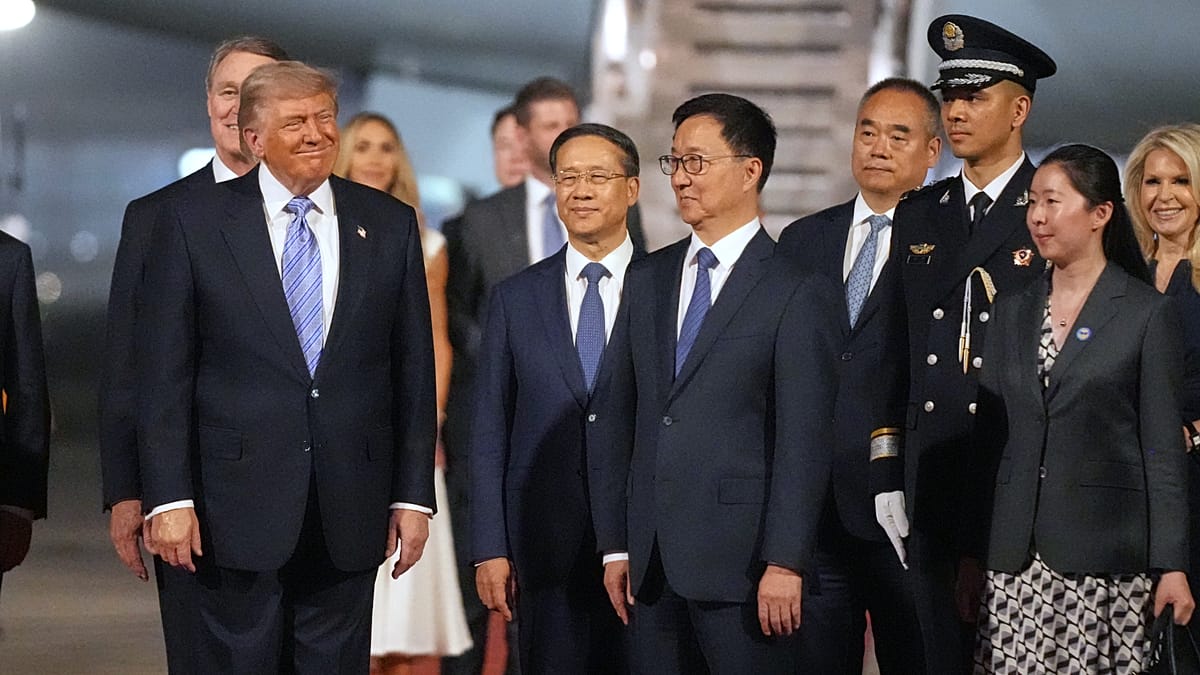
US President Donald Trump touched down in Beijing on Wednesday evening, beginning a three-day state visit aimed at resetting the fraught economic relationship between the world's two largest economies. He was received by Chinese Vice President Han Zheng in a formal welcome ceremony at the airport.
Trump has made clear that trade will be the central focus of his discussions with Chinese President Xi Jinping. “I’ll be talking to him about trade more than anything else,” the US president said ahead of the summit, which runs from 13 to 15 May. He is expected to push for agreements that would see China purchase more American agricultural products and aircraft, part of a broader effort to narrow the US trade deficit with Beijing.
A Trade War That Reshaped Global Supply Chains
The meeting comes after more than a year of escalating tariffs and retaliatory measures that have sent bilateral trade into a steep decline. The trade war has forced companies on both sides of the Pacific to rethink their supply chains, with many European firms caught in the crossfire. German automakers, French luxury goods exporters, and Dutch semiconductor equipment manufacturers have all faced disruptions as the US-China conflict disrupted established trade flows.
European capitals have watched the summit closely, aware that any deal between Washington and Beijing could either ease pressure on European exporters or create new competitive disadvantages. The European Commission has already prepared contingency plans for a potential surge in Chinese exports diverted from the US market, which could undercut European industries.
Trump’s delegation includes several US tech executives, notably Nvidia CEO Jensen Huang, added at the last minute. The presence of the chipmaker’s chief signals that artificial intelligence and semiconductor export controls will also be on the table, despite earlier expectations that a chip deal had faded. European policymakers are particularly attentive to this dimension, given the EU’s own efforts to build semiconductor sovereignty under the European Chips Act.
The summit’s agenda extends beyond commerce. Trump is also expected to raise issues such as Iran’s nuclear programme, Taiwan’s status, and cybersecurity — topics that have direct implications for European security and foreign policy. The EU has its own strategic interests in the South China Sea and in maintaining a unified stance on Taiwan, making the outcome of these talks relevant far beyond the Pacific.
As the two leaders sit down in the Great Hall of the People, European diplomats in Brussels and national capitals will be parsing every statement for signs of a broader realignment. The summit may produce short-term trade deals, but the longer-term question — whether the US and China can stabilise their rivalry — will shape Europe’s economic and strategic landscape for years to come.