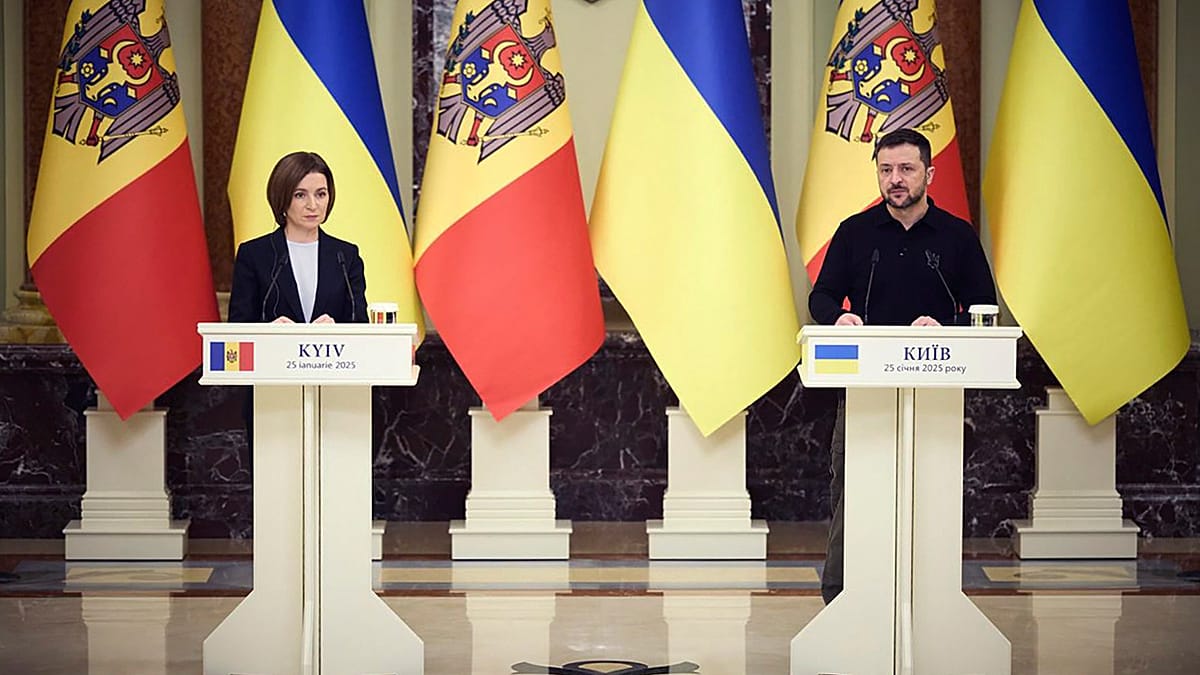
Ukraine and Moldova formally launched the first phase of European Union accession negotiations in Luxembourg on Monday, breaking a two-year political stalemate that had stalled their bids since they were granted candidate status in 2023. The talks, described by EU enlargement commissioner Marta Kos as a historic step, come after Hungary’s new government lifted its veto on opening negotiations with Kyiv.
“It is a historic milestone for my country,” said Cristina Gherasimov, Moldova’s deputy prime minister, speaking to reporters in Luxembourg. “This is also a strong signal for us that the EU is also getting ready to receive new member states.”
Both countries submitted their membership applications shortly after Russia’s full-scale invasion of Ukraine in February 2022. EU leaders unanimously agreed in June 2024 to open accession talks with Kyiv and Chișinău, but progress was blocked by Hungary’s former prime minister Viktor Orbán, who cited concerns over the rights of the Hungarian minority in Ukraine’s Transcarpathia region. Because the two countries’ bids were coupled, Hungary’s veto also indirectly held back Moldova’s progress.
The new Hungarian government under Prime Minister Péter Magyar struck a deal with Kyiv in recent weeks guaranteeing the freedoms of the Hungarian minority, paving the way for Monday’s talks. However, Hungarian Foreign Minister Anita Orbán cautioned that “the fulfilment and implementation of the agreement is a fundamental condition in the European integration process of Ukraine,” a reminder that the road ahead remains fraught with obstacles.
Accelerating the Accession Process
Commissioner Kos told reporters she was “positive” that both countries could sustain momentum and open the remaining five thematic clusters of negotiations next month. The push to advance before summer is politically delicate, as it would involve integrating Ukraine and Moldova into the EU’s Common Agricultural Policy (CAP), a prospect that countries such as Poland and France may resist. The Cypriot Presidency of the Council of the EU, which steered preparations for the talks, framed enlargement as a “security guarantee and an expansion of European space of security, stability and prosperity,” calling it a “geopolitical necessity” in times of upheaval.
During the two-year limbo, the European Commission and Kyiv pressed ahead with technical reforms in a process called “front-loading,” despite Hungary’s veto. President Volodymyr Zelenskyy has framed Ukraine’s accession as an essential security guarantee for the post-war country. Kos described enlargement as “the most important foreign policy of the European Union,” noting that more progress has been made in reviving the policy in the past 16 months than in the previous 15 years.
Kos has also floated ideas for gradual integration, such as a form of membership-lite that would allow Ukraine to join without full voting rights. German Chancellor Friedrich Merz proposed “associate membership,” but both European diplomats and Zelenskyy quickly dismissed the idea. “There can be no half membership or quarter membership,” Kos told reporters on Monday, “but there are many options with what we can do in the field of gradual integration,” including phased access to voting rights and funding programmes.
The talks in Luxembourg mark a significant step forward for the EU’s enlargement policy, which has been revitalised after years of stagnation. As the bloc faces geopolitical pressures from Russia’s war and shifting global alliances, the accession of Ukraine and Moldova is seen as both a strategic necessity and a test of the EU’s ability to absorb new members. The coming months will reveal whether the political will to integrate both countries can overcome the technical and political hurdles ahead.