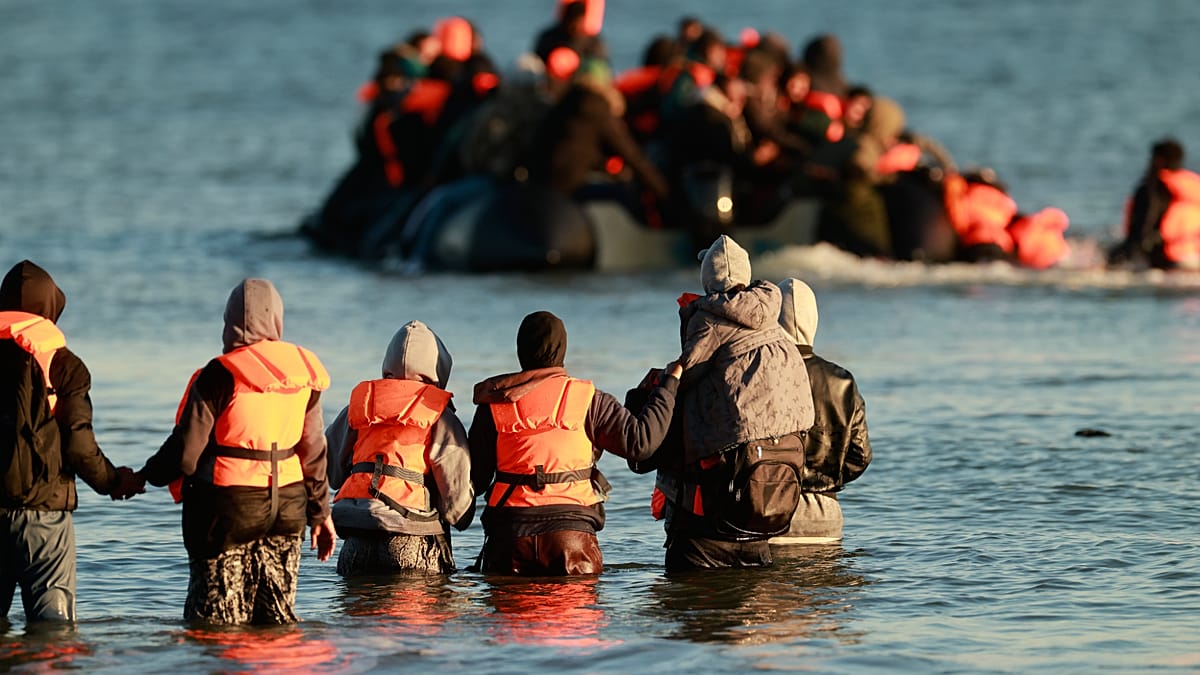
On Tuesday morning, a large group of migrants, including families with young children, boarded a dangerously overcrowded boat on the beach at Gravelines, a commune in the Hauts-de-France region near Dunkirk. The vessel, a small inflatable dinghy, was visibly packed far beyond any safe capacity as it set off across the English Channel toward the United Kingdom.
Video footage from the scene shows dozens of people wading into the cold water and clambering aboard the already overloaded boat. Several children could be seen among the passengers, some held by adults as the dinghy wobbled under the weight. French authorities did not immediately intervene, though maritime patrols in the area have been stepped up in recent months.
The crossing attempt comes amid a persistent surge in irregular migration across the Channel. According to data from the UK Home Office, more than 29,000 people have made the journey so far in 2025, a figure that continues to strain bilateral relations between Paris and London. The route remains one of the world's busiest shipping lanes, and the risks are well documented: dozens of migrants have died or gone missing in the Channel in recent years.
Local tensions and European dimensions
Gravelines, a small port town of about 11,000 residents, has become a frequent departure point for Channel crossings. Local officials have repeatedly called for more resources from the French national government and from the European Union to manage the situation. The town's mayor, Bertrand Ringot, told local media that the community is "overwhelmed" and that the current approach is failing both migrants and residents.
The broader European context is hard to ignore. While the UK is no longer a member of the EU, the Channel crisis has become a recurring point of friction between Brussels and London. The EU has offered technical and financial support to France for border management, but the fundamental challenge remains: how to balance humanitarian obligations with border security. Similar pressures are visible elsewhere on the continent, such as at Ceuta, where hundreds of migrants swam from Morocco in a dramatic incident earlier this year.
France's interior ministry has pledged to increase patrols and to dismantle smuggling networks, but the numbers of arrivals show little sign of abating. The UK government, for its part, has pushed for a returns agreement and for joint maritime patrols, though negotiations have stalled over disagreements on legal frameworks and burden-sharing.
For the migrants themselves, the decision to board such a precarious vessel is often a last resort. Many have traveled from conflict zones in the Middle East and Africa, passing through multiple European countries before reaching the northern French coast. The journey is not only dangerous but also expensive: smugglers charge thousands of euros per person for a place on a boat that may not even be seaworthy.
As the weather in the Channel remains unpredictable, with strong currents and cold water temperatures, the risks of such crossings are only magnified. Local aid groups, such as the NGO Utopia 56, have warned that the situation is a humanitarian crisis in plain sight. "Every day, people are putting their lives in the hands of criminals," said a spokesperson for the group. "The response from both the French and British governments has been inadequate."
The incident in Gravelines is a stark reminder that the Channel crisis is far from resolved. It also underscores the broader challenges facing Europe as a whole: how to manage migration in a way that respects human dignity while maintaining public order and security. Until a coordinated European approach emerges, scenes like this one are likely to repeat themselves along the continent's northern shores.