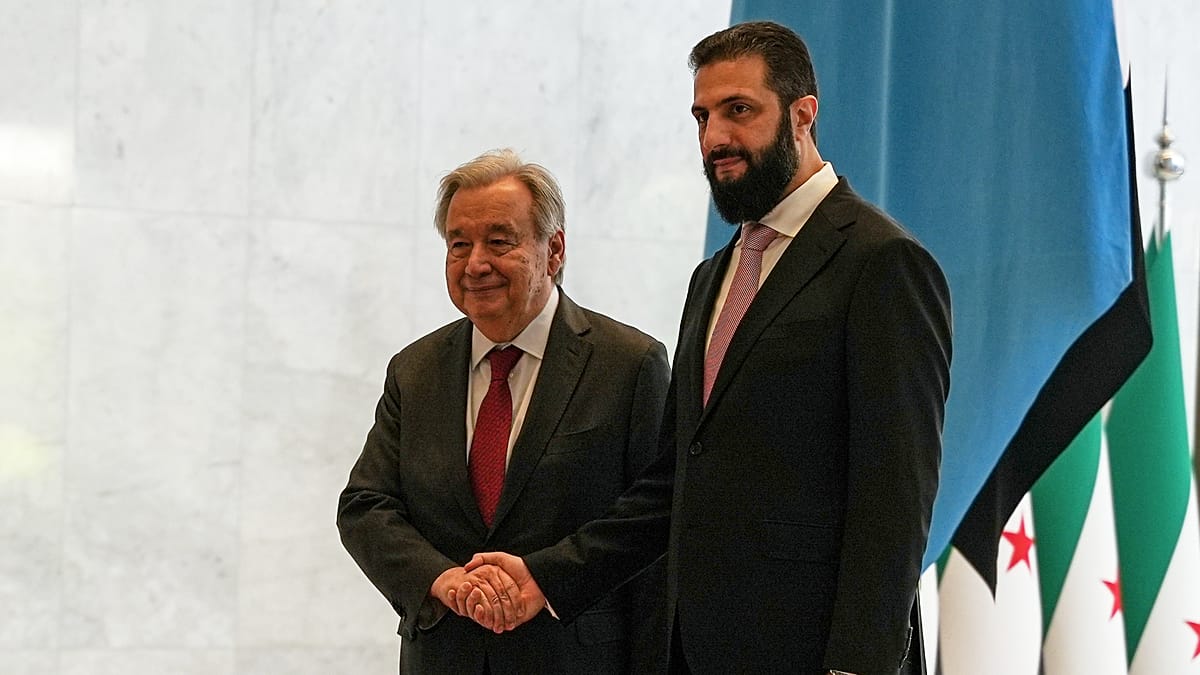
United Nations Secretary-General António Guterres arrived in Damascus on Saturday for the first visit by a UN chief to Syria since 2009, two years before the country's devastating civil war began. In a post on X, Guterres described the trip as a 'visit of solidarity' and urged the international community to 'spare no effort to support the people of Syria' as the nation navigates a fragile transition following the ousting of longtime leader Bashar al-Assad.
Shortly after landing, Guterres met with Syria's interim president, Ahmad al-Sharaa, at the presidential palace. The two leaders discussed the country's recovery from a conflict that erupted in March 2011 and has claimed more than half a million lives. Guterres also toured the old quarter of Damascus and the Umayyad Mosque, a historic site that has stood as a symbol of the city's multi-layered heritage.
Sanctions relief and the challenge of rebuilding
Since the fall of the Assad family's five-decade rule in December 2024, when forces led by al-Sharaa's fighters stormed Damascus, Syria has been grappling with the aftermath of war and the lingering effects of Western sanctions. The United States and European nations have lifted many of the punitive measures imposed during the Assad era, but the tangible impact on the ground remains limited. The international community has pressed the new Islamist-led authorities to build robust, inclusive institutions and establish a governance system that reflects Syria's multi-ethnic and multi-confessional society.
According to UN data, approximately 1.9 million internally displaced people and 1.7 million refugees have returned to their homes since al-Assad's ousting. Yet around 5.5 million Syrians remain displaced inside the country, and another six million live abroad as refugees. The scale of the reconstruction task is immense, with infrastructure across cities like Aleppo, Homs, and Damascus still in ruins. A recent trade fair in Aleppo signaled tentative steps toward economic revival, but sustained international investment and political stability remain elusive.
Golan Heights tensions and Israeli incursions
Guterres is also scheduled to meet representatives of Syrian civil society and women's organisations, and to visit the UN peacekeeping force stationed in the Israeli-occupied Golan Heights since 1974. The situation there has grown increasingly volatile since al-Assad's overthrow. Israel sent troops into the UN-patrolled buffer zone that had separated Israeli and Syrian forces, and has carried out airstrikes and repeated incursions deeper into Syrian territory. Israeli officials have stated their intention to maintain a presence in a 'security zone' in southern Syria, where they seek a broader demilitarised area.
'What is happening in the region around the Golan Heights is totally unacceptable,' Guterres told a press conference alongside Syria's Foreign Minister Asaad al-Shaibani. The foreign minister called for an 'immediate and unconditional Israeli withdrawal' from the areas where Israeli forces have advanced. Despite these tensions, Israel and Syria's new authorities have held several rounds of direct talks and agreed to establish an intelligence-sharing mechanism, though the arrangement has not halted Israeli military activity.
The Golan dispute adds another layer of complexity to Syria's recovery, as the country seeks to reassert its sovereignty while managing relations with a powerful neighbour. The UN chief's visit underscores the international community's cautious engagement with the post-Assad order, balancing humanitarian needs with geopolitical realities.