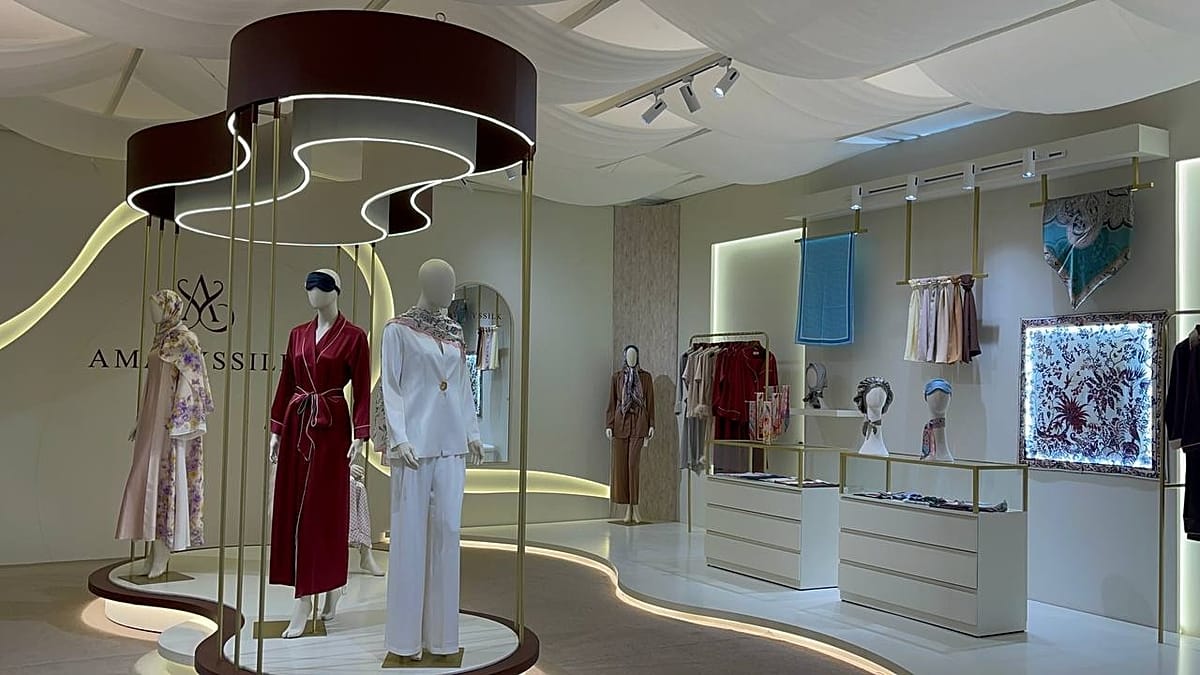
For the first time in years, Aleppo's industrial fairgrounds buzzed with activity last week as more than 300 companies from around 20 countries gathered for the Nas Tex 2026 exhibition. Syrian officials are presenting the four-day event as the first step toward rebuilding a textile industry that once supplied fabrics to Arab and European markets.
Before the civil war that began in 2011, Aleppo and Damascus were synonymous with high-quality textiles. Mills in northern Syria produced garments that reached consumers across the Middle East and Europe, and Damascus fabrics were prestigious enough to be used for royal occasions, including the wedding gown of Britain's Queen Elizabeth II. The industry thrived on a combination of fine cotton, skilled labour, and competitive pricing, making Syria a genuine force in regional manufacturing.
The conflict dismantled that in a matter of years. Factories were damaged or destroyed. Investors and skilled workers fled to Turkey and Egypt, taking their expertise with them. Syrian officials have alleged that equipment from northern Syrian factories was transferred to Turkey during the war, a claim Ankara has consistently denied. Cotton production, which reached roughly 1 million tonnes annually at the start of the 2000s, collapsed.
Labour Cost Advantage and Geographic Proximity
Proponents of a recovery point to what the industry still has. Wissam Muhaysin, of textile and hosiery equipment company Sardaro Muhaysin, argues that labour is the key. "The minimum wage in Turkey is about $1,000 a month, not counting social insurance and holidays, while a worker in China earns around 5,000 renminbi, the equivalent of $800 to $900," he said. "In Syria, by contrast, labour is skilled, costs less and has high productivity, which allows it to compete with Turkey and China."
Muhaysin also noted that Syria's proximity to Gulf and European markets shortens shipping times and costs compared with goods from China. This geographic advantage is a central theme in the pitch to investors. Makram Shattahi, vice-president of the Syrian-Chinese Business Council, told Euronews that a twinning agreement has been signed with Suzhou Land Group to develop Syria's Sheikh Najjar industrial city, along with a furniture-focused industrial zone and a worker training centre. "We want to prepare qualified workers who can move straight into workshops and factories to work in production," he said.
Shattahi described the first signs of recovery as already visible. "Many of those who invested in Egypt and Turkey have now begun to return, and the large number of production lines and machines sold at the fair shows that many factories are preparing to resume operations," he added. "When we export to the Gulf or Europe we are much closer than China. That shortens time and shipping costs and gives Syrian products a better chance to compete."
Challenges Remain: Yarn Quality, Fuel Costs, and Market Size
Despite the optimism, significant hurdles persist. Hussam Othman, whose family has run a fabric, clothing, and printing factory for nearly 70 years, said local yarn quality remains a problem, forcing reliance on imports, mostly from India. Fuel and mazut prices are among the biggest daily constraints, alongside a domestic market too small on its own to sustain an export-oriented recovery. "The Syrian market alone is not enough," Othman told Euronews. "What we really need is more exports."
In one corner of the exhibition, Ahmed Dubeik was trying to revive silkworm breeding and silk dyeing, crafts that once gave Syria a place on medieval trade routes. "We are trying to make Syria a Silk Road again, but we are still working with manual machines," he said. "If we manage to introduce a modern reeling machine, we will be able to improve quality and boost exports."
Government data show that the number of textile establishments reached more than 24,000 in 2024, representing around 19% of all industrial establishments in the country, second only to engineering industries. However, only 56.8% are currently operating, with more than 10,000 facilities still out of service. Syria's Minister of Economy and Industry Nidal al-Shaar said the country's cotton production could reach between 300,000 and 400,000 tonnes a year if investment could be attracted and idle plants brought back online, enough to supply domestic factories and support a textile export push.
The government is focusing development on three industrial cities: Sheikh Najjar in Aleppo, Adra in the Damascus countryside, and Hassia in Homs. The lifting of Western sanctions on Syria earlier this year has changed the calculation for at least some potential investors. "Sanctions used to make investors afraid of pumping money into an industry that requires large amounts of capital, because capital is cowardly," Muhaysin said.
For European readers, the revival of Syria's textile industry holds implications for supply chains and trade patterns. As the EU investigates illegal textile waste shipments from Italy to Turkey, the potential return of Syrian production could reshape regional dynamics. Meanwhile, the OPCW's restoration of Syria's voting rights after the fall of the Assad regime and a cooperation pledge signals a broader international re-engagement. The visit of French President Macron to post-Assad Syria further underscores the shifting geopolitical landscape. Whether Syria can reclaim its place as a textile powerhouse remains uncertain, but the first steps are being taken.