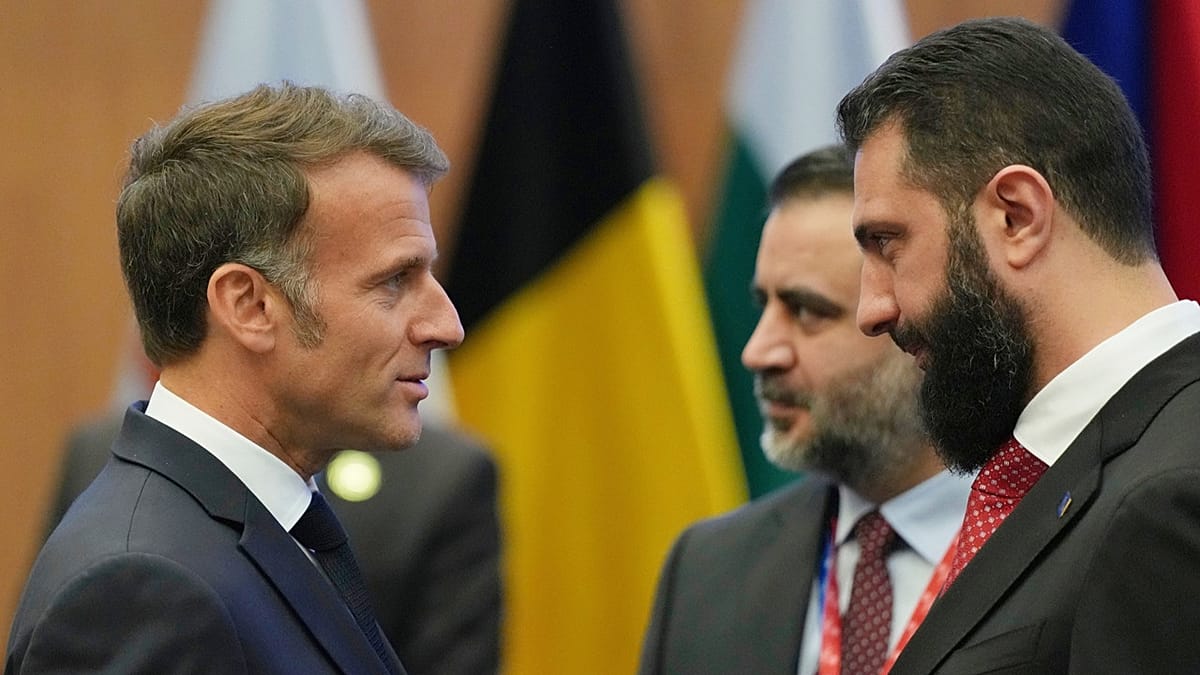
French President Emmanuel Macron arrived in Damascus on Monday, becoming the first Western European leader to visit Syria since the new authorities took power after the ousting of Bashar al-Assad. The trip marks a significant step in the re-engagement of European powers with the post-conflict country.
Macron was greeted at Damascus International Airport by Syrian Foreign Minister Asaad al-Shibani. In a post on X, the French president wrote: “I have come to express France’s commitment to the Syrian people. For a sovereign Syria, united in its diversity and at peace with its neighbors. Together, let us open a new chapter of stability and peace.”
Business and Security on the Agenda
According to Syria’s state-run SANA news agency, Macron is accompanied by a business delegation, underscoring the economic dimension of the visit. Talks are expected to cover regional security, investment opportunities, and the potential for European companies to re-enter the Syrian market.
Macron’s office stated that France supports all those who can “contribute to build a new Syria” in line with the aspirations expressed during the 2011 Arab Spring uprisings. The French president is scheduled to meet with members of Syrian civil society on Tuesday before holding talks with President Ahmad al-Sharaa at the presidential palace. The two leaders will then head to the NATO summit in Ankara, where broader security issues—including the situation in Ukraine and the alliance’s eastern flank—are likely to dominate discussions. This visit comes amid renewed focus on NATO deterrence, as German Chancellor Friedrich Merz and Baltic leaders have pledged stronger NATO deterrence ahead of the Ankara summit.
In an interview broadcast by French channel BFMTV on Monday, al-Sharaa praised France’s “constructive role” in the post-Assad transition. “Macron has sought to engage with us in Syria and followed every step and stage of the transition,” al-Sharaa said, adding that the French president had helped in the lifting of international sanctions on Damascus. The issue of sanctions relief is a key priority for the new Syrian government, which is seeking to rebuild the country’s shattered economy and attract foreign investment.
Macron’s visit also signals a shift in European policy toward Syria. While the European Union has maintained a cautious stance, France appears to be taking the lead in re-establishing diplomatic and economic ties. The French president’s schedule includes the signing of memorandums of understanding and a joint news conference with al-Sharaa.
The trip is not without controversy. Human rights groups have urged Macron to condition any engagement on guarantees of political pluralism and accountability for past atrocities. The Syrian conflict, which began in 2011, has killed hundreds of thousands and displaced millions. The new authorities have promised a transition to inclusive governance, but scepticism remains high both in Europe and among Syrian civil society.
Macron’s visit comes at a time of broader geopolitical realignment in the Middle East. The NATO summit in Ankara will also address the alliance’s role in the region, with leaders expected to reaffirm Article 5 amid pressure from the United States. Meanwhile, the European Union continues to grapple with migration challenges, as highlighted by Pope Leo XIV's recent visit to Lampedusa, calling for Europe to act on migrant deaths.
For now, Macron’s presence in Damascus represents a gamble: that engagement, rather than isolation, can help steer Syria toward stability. Whether that bet pays off will depend on the ability of both sides to translate diplomatic gestures into concrete progress on security, economic recovery, and political reform.