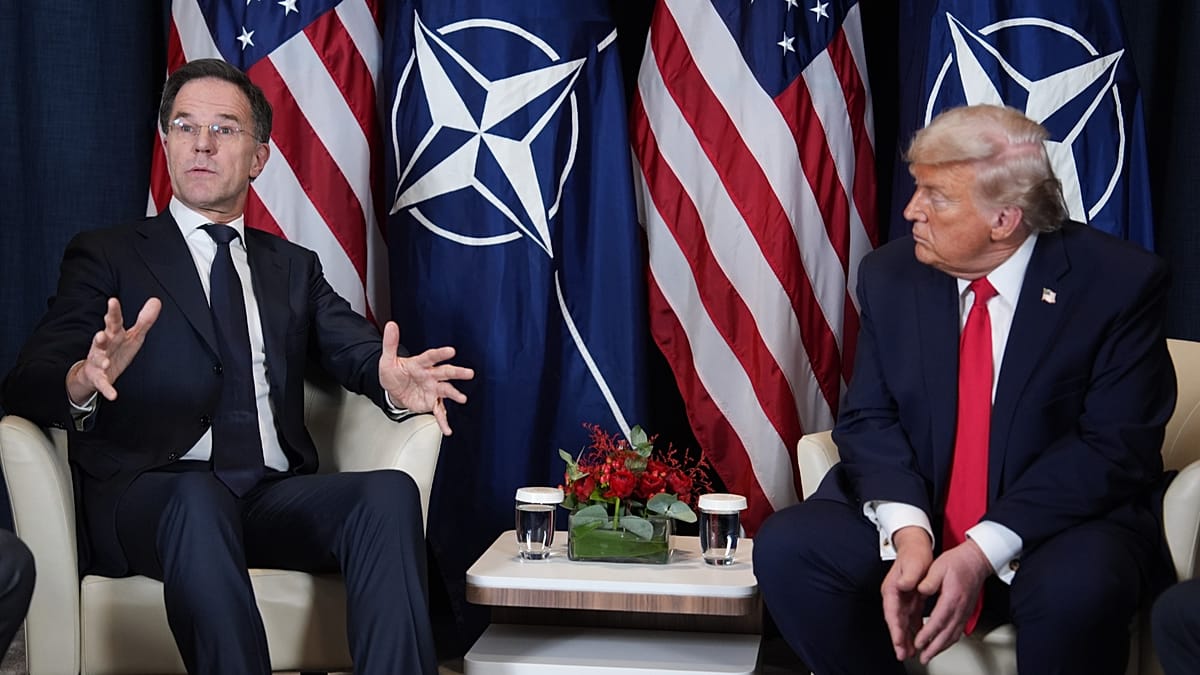
When NATO leaders gather in Ankara next week, they are expected to adopt a final declaration that reaffirms the alliance’s core principle of collective defence under Article 5. A draft of the document, seen by Euronews, states that all 32 member countries — including the United States — remain committed to the idea that an attack on one is an attack on all.
The declaration also describes Russia as a “long-term threat to Euro-Atlantic security and stability” and includes a firm line that “Iran can never have a nuclear weapon.” It commits allies to provide an additional €70 billion in support for Ukraine, with “at least equivalent levels” of aid planned for 2027. The text has been negotiated at ambassador level and will require endorsement by leaders when the summit concludes on 8 July.
For European capitals, the most sensitive element is Washington’s explicit reaffirmation of Article 5. US President Donald Trump has repeatedly cast doubt on whether his administration would defend allies he considers to be underpaying for their own security. In recent weeks, Trump has refused to guarantee US assistance to European countries that fail to meet NATO’s defence spending targets, and he has used his Truth Social platform to accuse allies of abandoning Washington during its operations against Iran. “They were not there for us!!!” he wrote on Thursday night.
Europe’s Push for Self-Reliance
European NATO members are approaching the Ankara summit with a dual strategy: securing Washington’s short-term commitment while accelerating their own defence investments to reduce long-term dependence on the United States. The alliance is moving toward what some officials describe as “NATO 3.0” — a transformed security arrangement with Europe taking a leading role in its own defence.
That shift has been driven by concrete US signals. In May, Washington announced it would reduce the pool of military assets it makes available to NATO even in wartime, including long-range bombers, fighter jets, submarines, and warships. US Ambassador to NATO Mathew Whittaker told journalists in Brussels on Wednesday that “allies were told we would reduce what we are providing for the NATO force model,” adding that Europeans “can’t be freeriding on American taxpayers.”
NATO Secretary General Mark Rutte is expected to counter that narrative by highlighting the surge in European and Canadian defence spending. According to a source familiar with the preparations, Rutte will point out that core defence expenditure from Europe and Canada has risen by 20 percent year-on-year. The combined extra investment for 2025 and 2026 is estimated at $258 billion (€225 billion).
Rutte will also note that allies have spent a total of $1 trillion (€870 billion) on defence since Trump’s first administration — a figure he plans to brand as “Trump’s trillion.” His argument will be that this historic spending must now be translated into combat-ready capabilities through transatlantic cooperation.
The summit comes at a particularly volatile moment for the alliance. In January, Trump declined to rule out using military force to “take” Greenland, a semi-autonomous territory of NATO ally Denmark. That remark, combined with his repeated criticism of allied contributions, has deepened European unease about the reliability of the US security guarantee.
For Ukraine, the Ankara summit represents a critical opportunity to secure immediate air defence deliveries. Kyiv is pressing NATO for concrete commitments to bolster its air defences against ongoing Russian strikes, which have intensified in recent weeks. The alliance’s pledge of €70 billion in additional support is intended to signal long-term solidarity, but Ukrainian officials are seeking faster, more tangible results.
The broader context of the summit is a transatlantic relationship under strain. Trump’s pre-summit rhetoric has been particularly pointed, and European leaders are bracing for further demands. While the Ankara Declaration will paper over some differences, the underlying question of how Europe can future-proof its own defence remains unresolved.
As the summit approaches, the focus will be on whether the final text can hold the alliance together — and whether the commitments made in Ankara will translate into real military capability. For now, the draft declaration offers a unified front, but the cracks are visible beneath the surface.