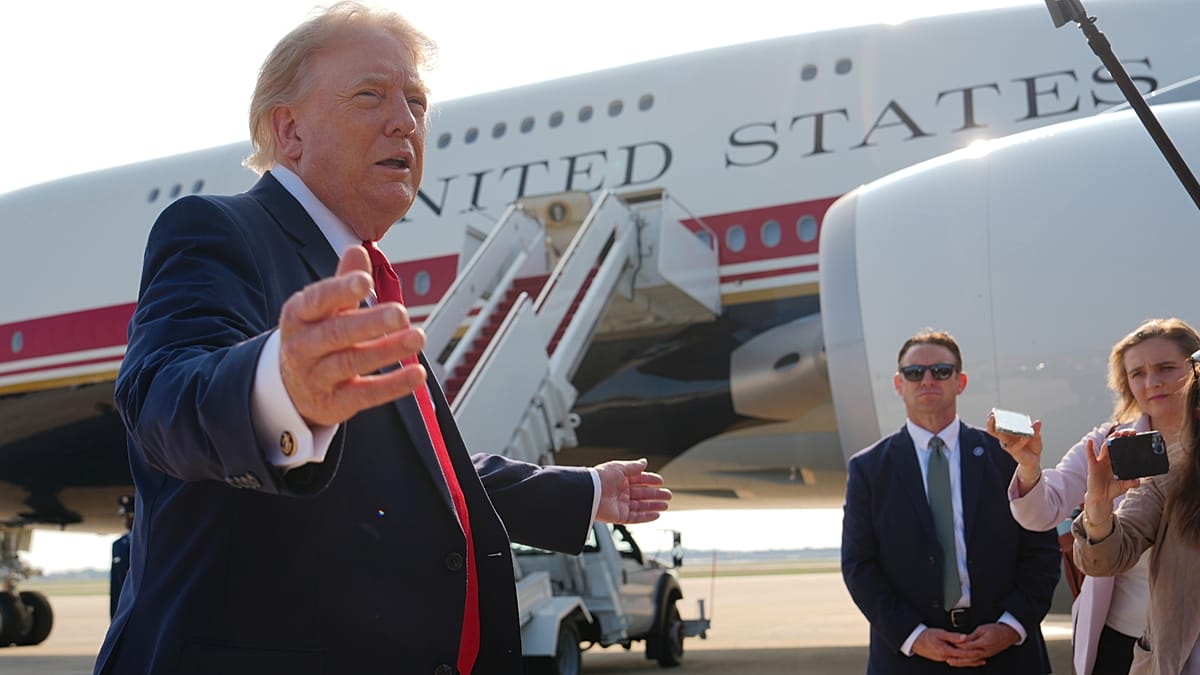
United States President Donald Trump has described Washington's continued support for NATO as 'ridiculous,' reigniting transatlantic tensions just days before the alliance's summit in Ankara. In a post on his Truth Social platform on Thursday, Trump argued that the relationship is 'one-sided' and 'not reciprocal,' adding that European allies 'were not there for us!!!'
The outburst, typical of Trump's long-standing grievances with NATO, comes ahead of a summit scheduled for July 7-8 in the Turkish capital, which will bring together all 32 member states. The meeting was expected to focus on defence spending commitments and collective security, but Trump's comments have shifted attention back to the alliance's internal frictions.
Trump has repeatedly pressed European capitals to shoulder more of the burden for their own defence. His administration has already begun scaling back US commitments, a move that has unsettled many European leaders who view NATO as the cornerstone of continental security. The president's latest salvo included a chart comparing NATO members' defence expenditures, highlighting the United States' outsized contribution.
Under pressure from Trump, NATO leaders agreed at a summit last year to increase defence spending to 5% of GDP by 2035. However, many member states, including Germany, France, and Italy, remain far from that target, with some still below the previous 2% guideline. The disparity has been a recurring source of friction, particularly as the war in Iran has strained alliance resources and tested solidarity.
European confidence in the United States and Trump personally has plummeted in recent months, as reflected in polling across the continent. The perception that Washington is an unreliable partner has prompted some EU capitals to explore alternative security arrangements, though NATO remains the primary framework for collective defence.
The upcoming summit in Ankara will be closely watched for signs of a rift or, conversely, a renewed commitment to burden-sharing. Turkey, a key NATO member with a complex relationship with both Washington and Brussels, will host the gathering amid heightened geopolitical tensions. The alliance, founded in 1949 to counter the Soviet Union, has long been credited with maintaining stability in Europe and solidifying US global leadership.
European Reactions and Implications
European officials have reacted with caution to Trump's latest remarks. Many are wary of provoking a direct confrontation but are also preparing for the possibility of further US disengagement. The European Union has been quietly working on bolstering its own defence capabilities, though progress has been uneven. A recent visit by European Commission President Ursula von der Leyen to Armenia, where she unveiled a major EU support package, underscored the bloc's efforts to project security beyond its borders.
The timing of Trump's comments is particularly awkward given the summit's proximity. Some analysts suggest the president's rhetoric is aimed at extracting concessions from allies, while others see it as a genuine reflection of his transactional approach to foreign policy. Either way, the episode highlights the fragility of the transatlantic bond at a moment of multiple crises, from the war in Iran to tensions in the Balkans.
In a related development, Albanian police recently clashed with protesters over a Trump-linked resort in a protected area, illustrating the president's controversial footprint in European affairs. Meanwhile, reports that Ukraine's former top general, Valeriy Zaluzhnyi, plans a presidential run have added another layer of uncertainty to the region's security landscape.
As the Ankara summit approaches, the question of whether NATO can maintain its coherence under Trump's pressure remains open. For European leaders, the challenge is to balance the need for US military backing with the imperative of building a more autonomous defence posture. The outcome of the meeting will likely shape the alliance's trajectory for years to come.