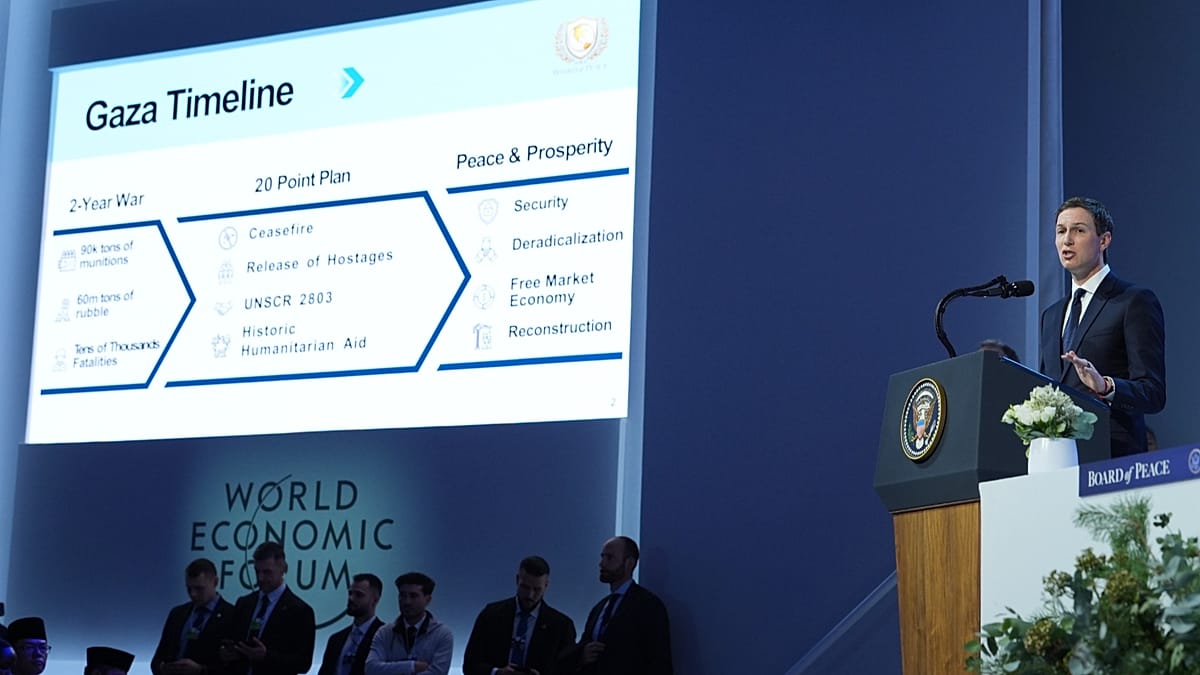
US envoy Jared Kushner is scheduled to meet Israeli Prime Minister Benjamin Netanyahu on Monday, following direct talks with Hamas leaders in Egypt aimed at reviving a US-backed Gaza peace plan that Israel has so far rejected.
The meeting comes two weeks after Hamas endorsed the latest stage of the plan, which Netanyahu has refused to support, insisting that any settlement must ensure the group is “genuinely disarmed.”
Kushner, who is also President Trump’s son-in-law, met Hamas’s new leader Khalil al-Hayya in the Egyptian Mediterranean city of El-Alamein on Sunday, according to sources familiar with the talks. During the meeting, Kushner pressed Hamas to take “concrete, verifiable steps” and relayed a message that “Gaza can never again be a source of terror for Israel,” one source said, speaking on condition of anonymity due to the sensitivity of the discussions.
Hamas reiterated its commitment to the plan, another source said. In a statement, the group called on mediators and Trump’s so-called Board of Peace to “compel” Israel to “approve the roadmap...and begin establishing a timetable for its implementation.”
A photograph released by Egypt, the host of the talks, did not show al-Hayya but depicted Kushner seated alongside members of the Board of Peace, including former British prime minister Tony Blair. Qatar and Turkey, which have served as key mediators alongside Egypt, also participated.
The United States had refused direct contact with Hamas for years, classifying it as a terrorist organisation and holding it responsible for the 7 October 2023 attack on Israel that triggered the latest war in Gaza. However, the Trump administration has increasingly embraced direct engagement in hopes of ending the devastating conflict, having negotiated the October ceasefire agreement that led to the release of remaining Israeli hostages.
Regional pressure on Israel
The three regional mediator countries, together with five fellow Muslim nations—Jordan, Saudi Arabia, the United Arab Emirates, Pakistan, and Indonesia—issued a joint statement on Sunday condemning Israel’s rejection of the plan. They said Israel “bears direct and full responsibility” for obstructing peace and that its refusal “directly threatens to derail extensive efforts” by Trump.
In response, Netanyahu’s Likud Party accused the Arab countries of trying to “bring down the prime minister” ahead of elections. The inclusion of the UAE is particularly significant, as it normalised relations with Israel five years ago, establishing an economic and strategic partnership that Netanyahu regards as a key achievement.
Netanyahu has expressed opposition to the US plan even after receiving assurances from Nickolay Mladenov, the Board of Peace’s high representative for Gaza, that Israel would not be required to withdraw troops from the territory until Hamas had fully disarmed. The board had initially proposed a phased Israeli withdrawal in tandem with Hamas’s disarmament.
Israel has resumed airstrikes in Gaza after a lull that followed Trump’s promotion of the peace plan, though the October ceasefire never fully halted violence in the Strip. On Sunday, several people were injured after Israeli aircraft targeted a house west of Nuseirat, according to Mahmoud Bassal, spokesman for Gaza’s civil defence agency, which operates under Hamas. The Israeli military said it was responding to a threat by Islamic Jihad militants and that it had taken measures to mitigate civilian casualties. “The terrorists advanced terror attacks and were struck in precise aerial strikes to remove the threat,” the military said.
Separately, several people were wounded after Israeli forces opened fire on tents housing displaced people west of Khan Yunis, where the body of a child was recovered after being killed by Israeli fire on Saturday, the civil defence agency said. Israeli operations have killed at least 1,262 Palestinians since the ceasefire took effect on 10 October, according to figures from Gaza’s Hamas-run health ministry, which the United Nations considers reliable.
The diplomatic push comes amid broader regional tensions, including efforts to reopen the Strait of Hormuz and US-Iran talks over compensation demands. Meanwhile, protests have flared in European ports, such as Piraeus, where demonstrators greeted an Israeli cruise ship, reflecting the conflict’s resonance across the continent.