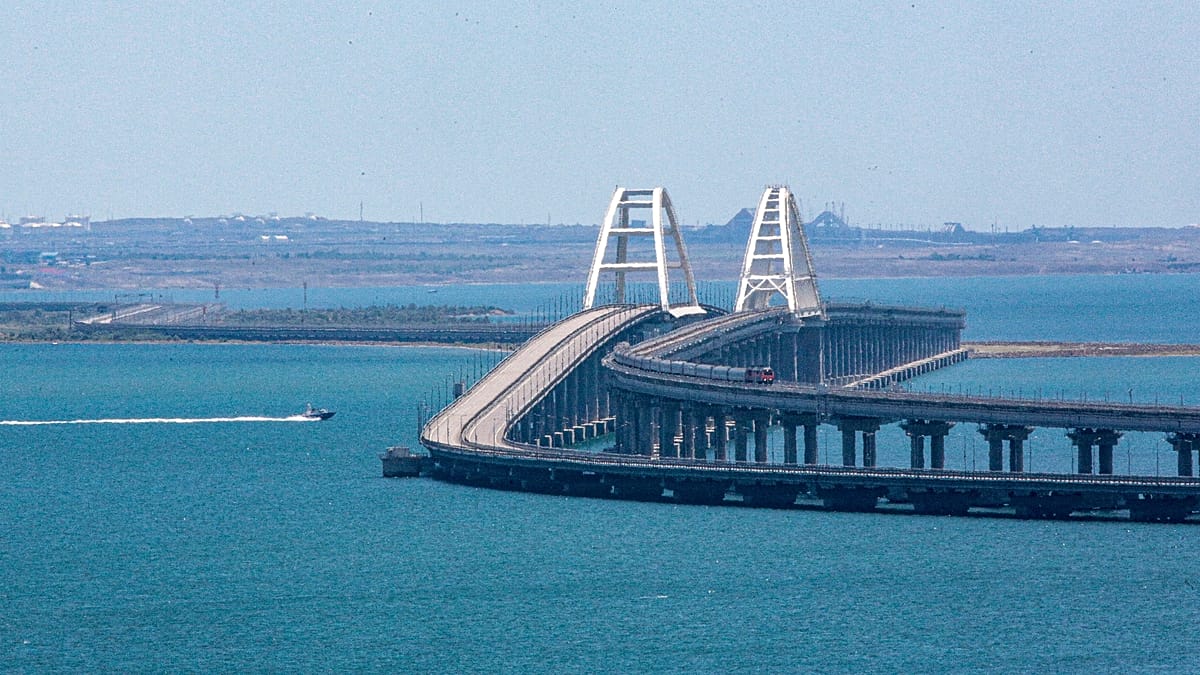
Ukraine has published video footage of its latest strike on the Kerch Bridge, the road and rail link that connects the occupied Crimean Peninsula to mainland Russia. The Security Service of Ukraine (SBU) said the operation was carried out overnight in coordination with the country's defence forces, and that the attack destroyed one of the bridge's arches as well as a section of the roadway.
The Kerch Bridge, which spans the Kerch Strait, has long been a critical artery for Russian military logistics. It allows Moscow to move troops, armour, and ammunition directly into Crimea, which Russia annexed in 2014. The bridge also carries civilian traffic, making it a dual-use target that Ukraine has repeatedly sought to disrupt.
A symbol of occupation
Beyond its military function, the bridge carries deep political symbolism. For the Kremlin, it represents the physical embodiment of its claim over Crimea. For Kyiv, it is a constant reminder of the peninsula's forced integration into Russia, and a legitimate target under international law as part of Ukraine's defence against invasion.
The SBU's statement did not specify the exact time of the strike, but said it was part of a broader effort to degrade Russia's ability to sustain its forces in southern Ukraine. The agency also released aerial footage showing the moment of impact, though the authenticity of the video has not been independently verified.
This is not the first time Ukraine has hit the bridge. In October 2022, a truck bomb caused significant damage, and in July 2023, Ukrainian sea drones struck the structure again. Each attack has forced temporary closures and repairs, but Russia has managed to keep the bridge operational, albeit with reduced capacity.
The latest strike comes as Ukraine continues to develop long-range drone capabilities, which have allowed it to hit targets deep inside Russian-held territory. These drones have also been used against Russian airbases, fuel depots, and naval assets in the Black Sea, as part of a strategy to complicate Moscow's supply lines and force it to divert resources to defend rear areas.
Analysts note that the Kerch Bridge is particularly vulnerable because it is long, exposed, and difficult to defend against swarming drone attacks. However, Russia has installed extensive air defence systems around the bridge, including Pantsir and Tor missile launchers, as well as smoke generators and underwater barriers to protect the pillars.
The attack also has broader implications for the Black Sea region. Recent drone strikes near Romania's coast have raised concerns about the safety of shipping lanes and the potential for escalation involving NATO members. Romania, Bulgaria, and Turkey all have coastlines on the Black Sea, and any disruption to maritime traffic affects regional trade and security.
Ukraine's ability to strike the bridge repeatedly demonstrates its growing capacity to project force across the front line. It also sends a message to Moscow that the occupation of Crimea is not cost-free. As the war enters its third year, both sides are looking for ways to gain an advantage, and the Kerch Bridge remains one of the most high-profile targets in the conflict.
The SBU's release of the footage is also a deliberate communications move, aimed at boosting morale at home and signalling to international partners that Ukraine is actively fighting back. The video has been widely shared on social media, with Ukrainian officials praising the operation as a tactical success.
There has been no immediate comment from Russian authorities, but past attacks on the bridge have prompted retaliatory strikes on Ukrainian infrastructure. Russian missiles have previously targeted bridges in Kyiv, and further escalation is possible.
For now, the Kerch Bridge remains a symbol of the war's enduring stalemate. Ukraine continues to chip away at Russian logistics, while Moscow struggles to protect its most prized infrastructure. The question is how long the bridge can keep functioning under repeated assault, and what that means for the broader campaign in the south.