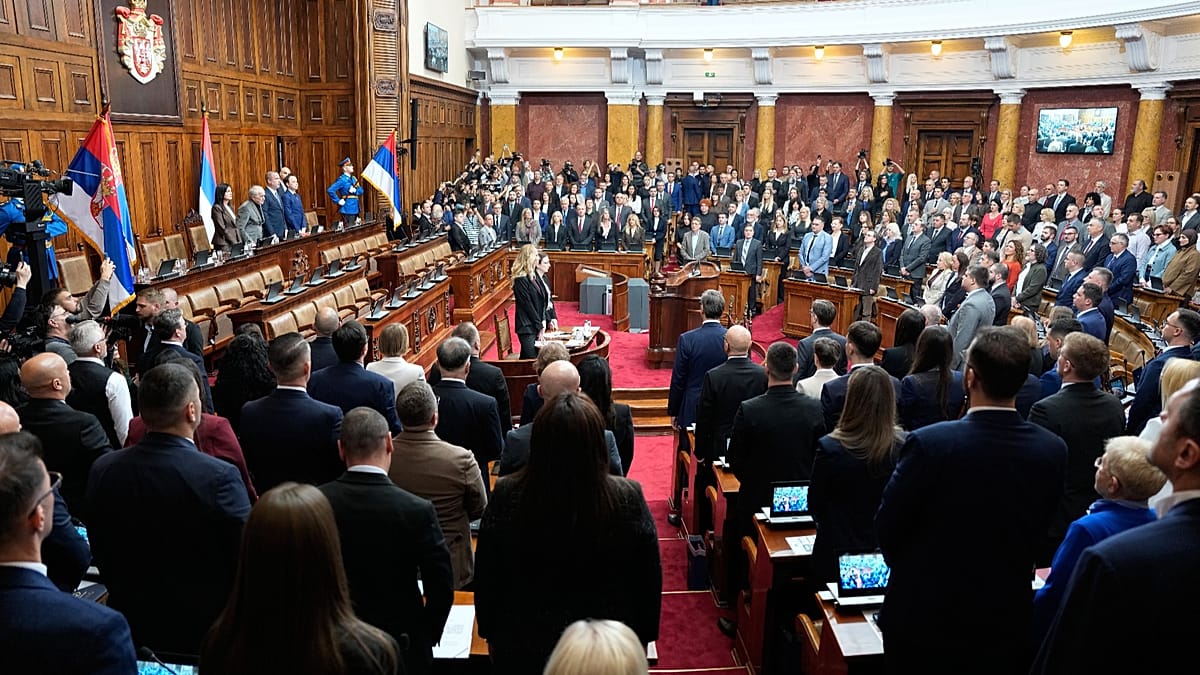
Belgrade's parliament building witnessed a historic shift on Tuesday as lawmakers from Serbia's student-backed movement were sworn in, marking the first sitting since last month's election ended nearly a decade and a half of dominance by Aleksandar Vučić's right-wing party.
The landslide victory, which gave the Students' List 140 of the 250 seats, followed nearly two years of protests ignited by the collapse of a railway station canopy in Novi Sad in 2024, a disaster that killed 16 people and was widely attributed to corruption. The tragedy galvanised the largest demonstrations in Serbia since the fall of Slobodan Milošević in 2000, propelling an anti-graft platform to power.
Outside the assembly, hundreds of supporters gathered to welcome the new lawmakers, chanting slogans from the protest movement and applauding as they arrived. Some held banners wishing the freshly elected MPs luck, while the arrival of Vučić's Serbian Progressive Party (SNS) candidates drew jeers and boos. In one incident, a woman poured yogurt on the head of an SNS member as she climbed the steps.
The Students' List, composed largely of political newcomers from academic and artistic backgrounds, now holds a comfortable majority, enough to govern alone. Vučić's coalition secured 103 seats, with minority parties taking the remaining seven.
"We are preparing very seriously for everything ahead, studying the laws, parliamentary procedures and MPs' duties," Mirjana Nikolić, a prominent candidate from the Students' List, told the AFP news agency earlier this month. The movement has pledged sweeping reforms, including improvements to healthcare, increased investment in education, and a doubling of the defence budget.
Challenges ahead
The new majority has 90 days to nominate a prime minister, present a programme, and form a government. Beyond domestic reforms, the government will face delicate foreign policy balancing acts: maintaining Serbia's historically close ties with Russia while pursuing its long-stated goal of EU membership, and managing relations with Kosovo, whose 2008 declaration of independence Belgrade does not recognise.
The election of a parliamentary speaker will also bring a new acting president, a role the speaker has held since Vučić cut short his second presidential term in September to run for prime minister. A snap presidential election must be called by 27 November and held by 27 December. Both the student movement and the SNS are expected to field candidates, though Vučić is barred from running again due to the constitution's two-term limit.
The student victory sparked days of celebration across Serbian cities, and the broadcast of Tuesday's session drew a wide national audience. The movement's commitment to EU rule-of-law reforms will be closely watched in Brussels, as Serbia seeks to accelerate its accession process.
Analysts note that the new parliament's composition reflects a generational shift in Serbian politics, with many MPs having no prior political experience. The challenge will be translating protest energy into effective governance, particularly in a region where populist and nationalist forces remain influential.
As the session concluded, the focus turned to the formation of a government and the upcoming presidential vote. The student movement's ability to navigate these early tests will determine whether this political earthquake can deliver lasting change.